Video2Force
Feasibility check — predicting contact force from video
① Idea & goal of the feasibility check
② Literature review — self-supervised learning
③ Datasets & metrics
④ Results — supervised feasibility
⑤ Self-supervised force learning
Ivan Domrachev · sinew · 2026 · → chapters · ↓ detail
The missing modality
- Data factories collect enormous visuomotor datasets.
- Almost all of it is vision-only — no haptic / force signal.
- Idea: generate the missing force modality from video — augment existing vision data for free.
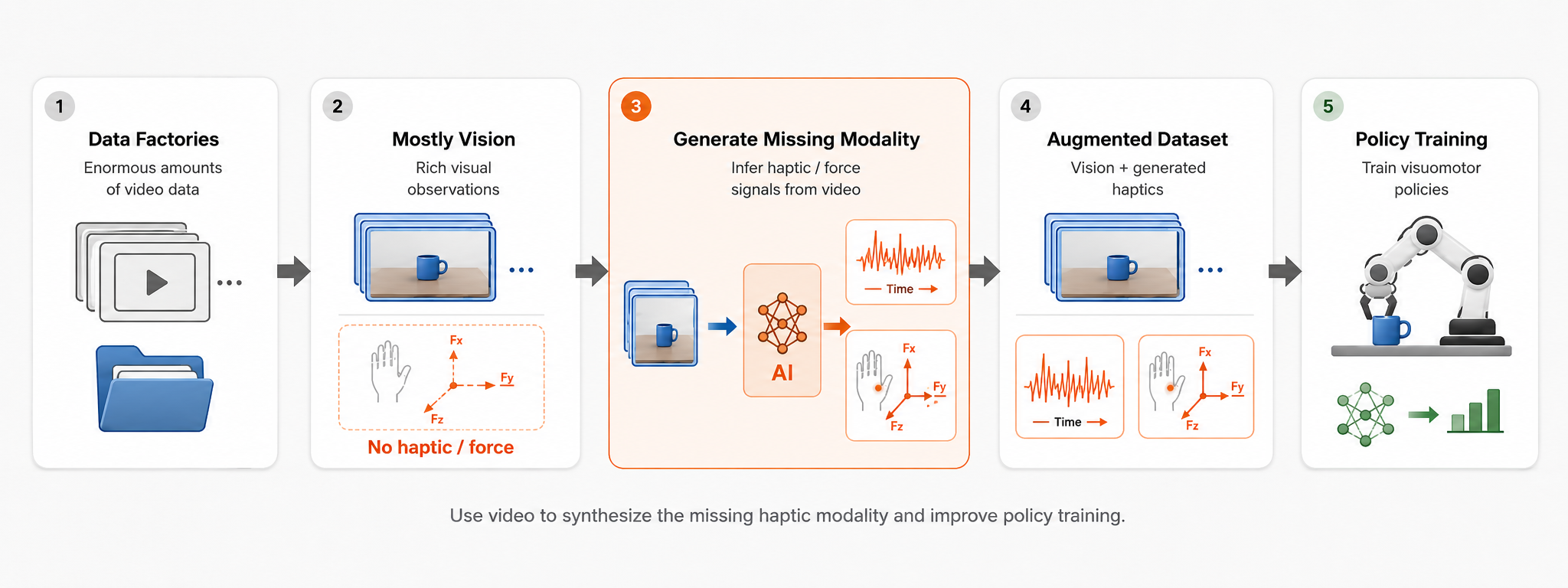
vision → generate missing modality → augmented data → policy training
The idea — climb a hierarchy
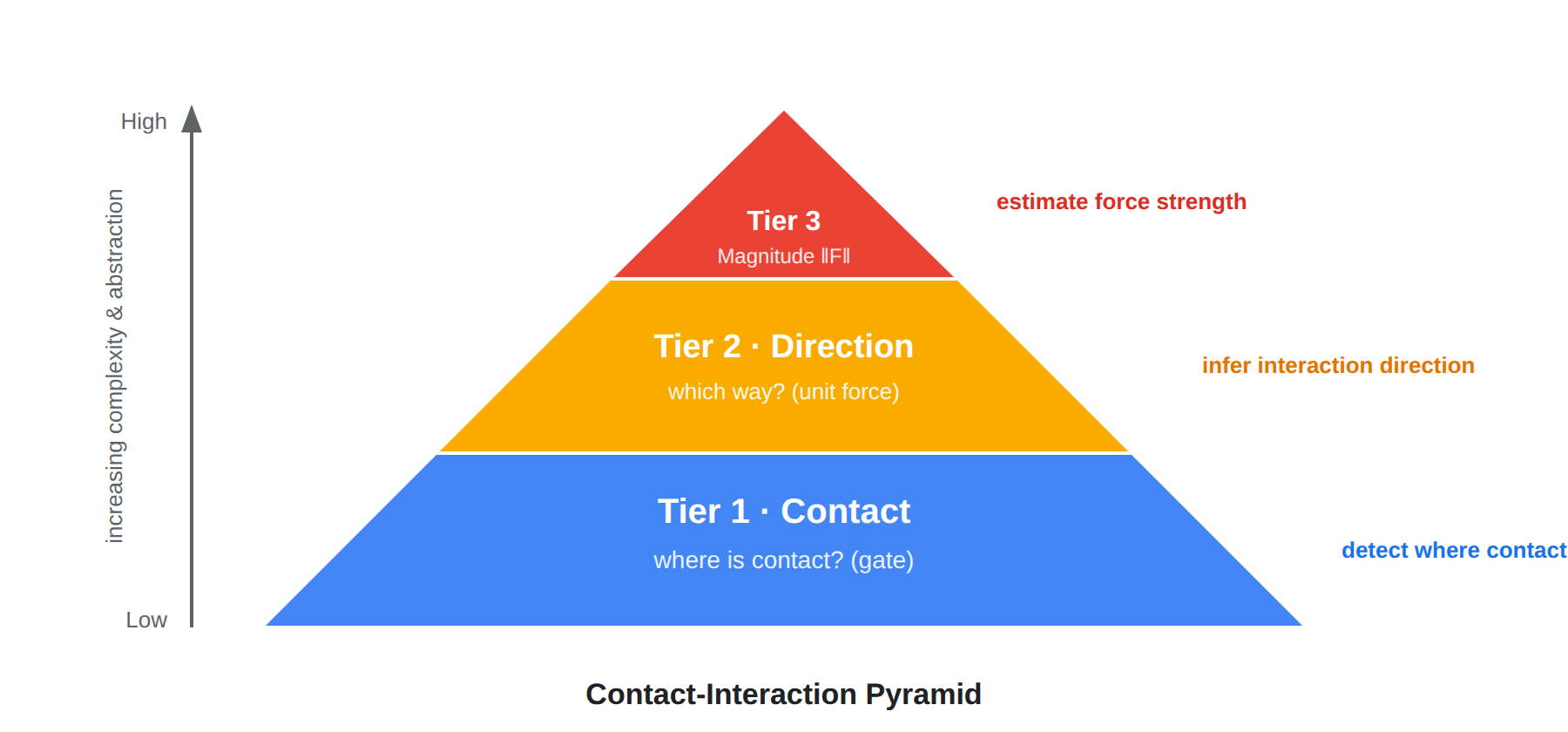
- Contact — where is the contact? (gate)
- Direction — which way is the interaction?
- Force — how strong is it? (magnitude)
Across embodiments: manipulator → dexterous hand → gloves.
Goal of the feasibility check
Using existing datasets, try to predict contact · direction · magnitude — and ask:
- Are videos enough to extract interaction force?
- Which contact info is feasible to extract?
- Is there any room for generalization?
Hypotheses:
- H1 — video detects contact / no-contact.
- H2 — video gives an approximate direction.
- H3 — large-scale data → generalization to unseen robots / scenes.
Self-supervised learning — three families
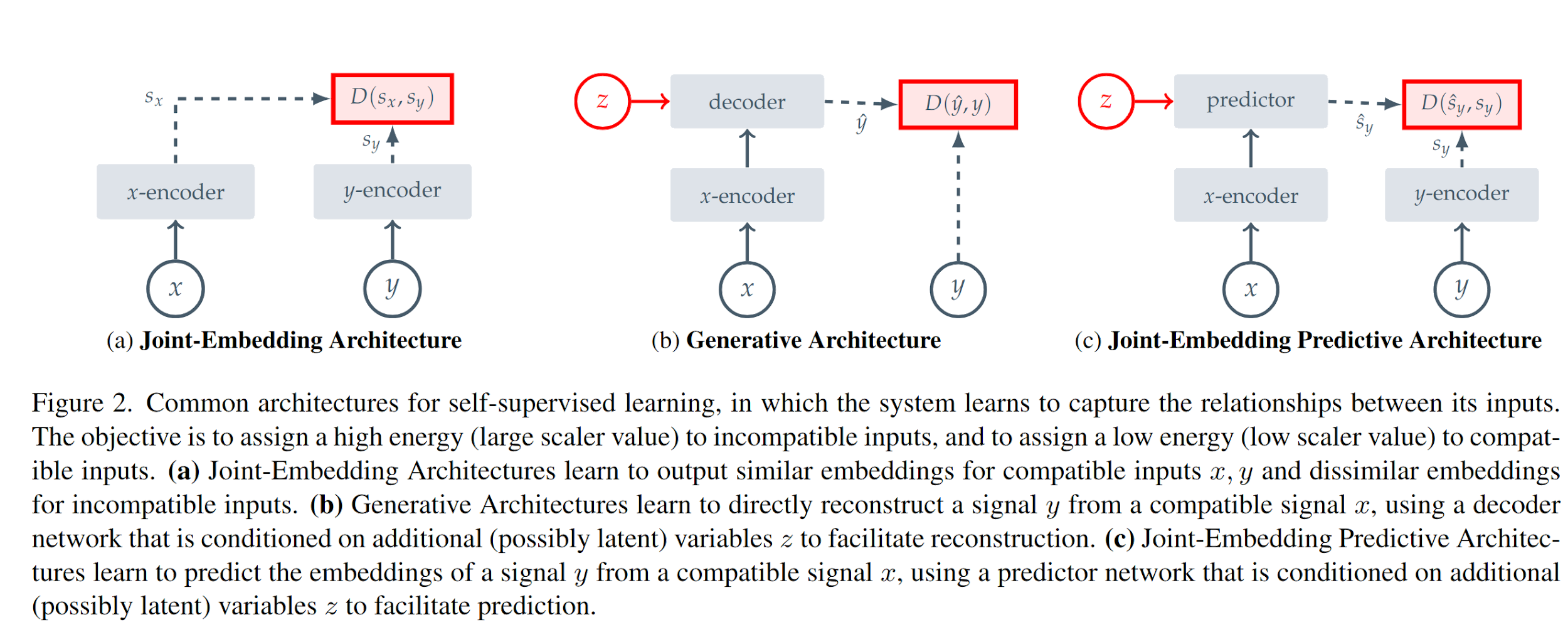
Joint-Embedding (JEA)
score two views in latent space
score two views in latent space
Generative
reconstruct pixels
reconstruct pixels
Predictive (JEPA)
predict target latent
predict target latent
JEA — CLIP & DINO
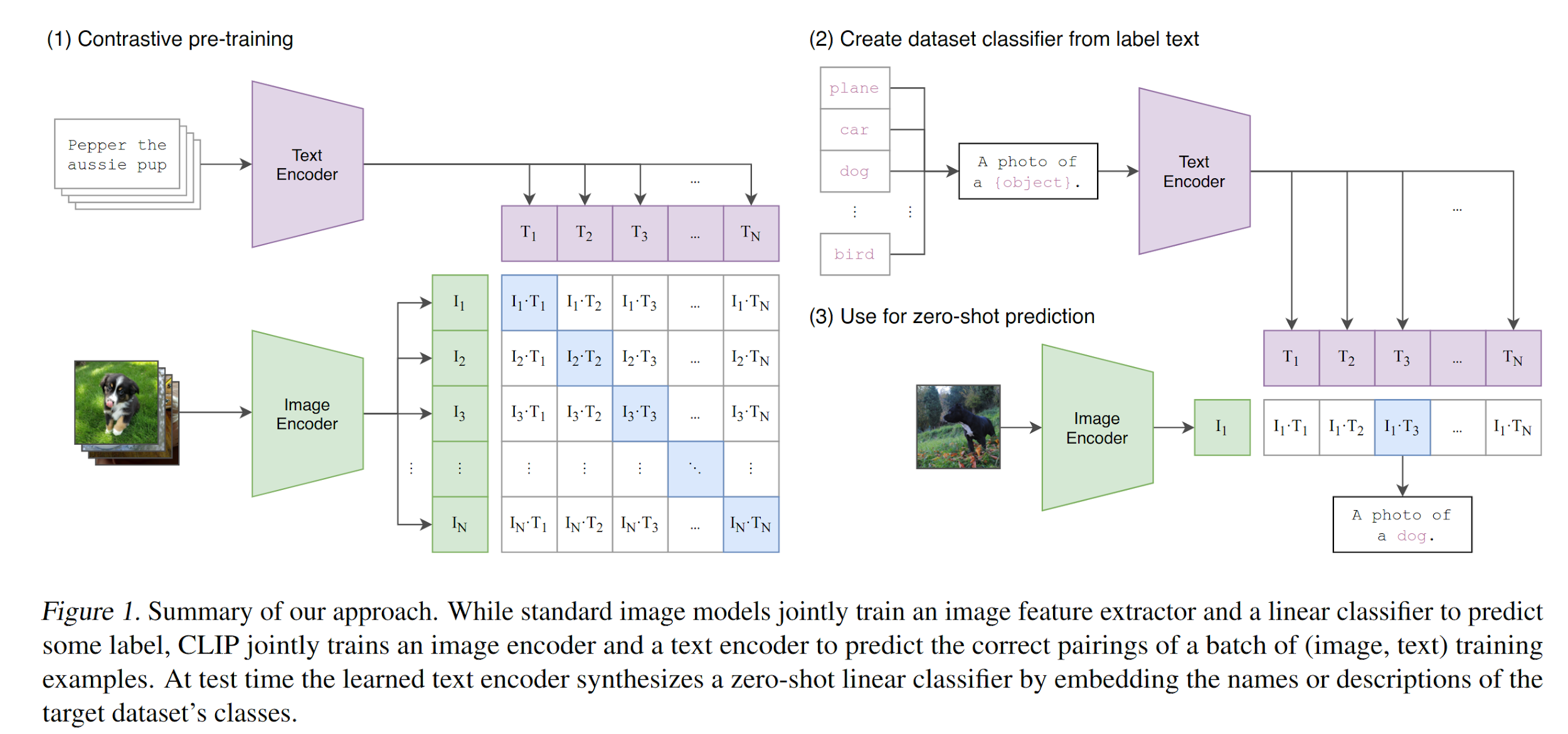
CLIP — image–text contrastive alignment
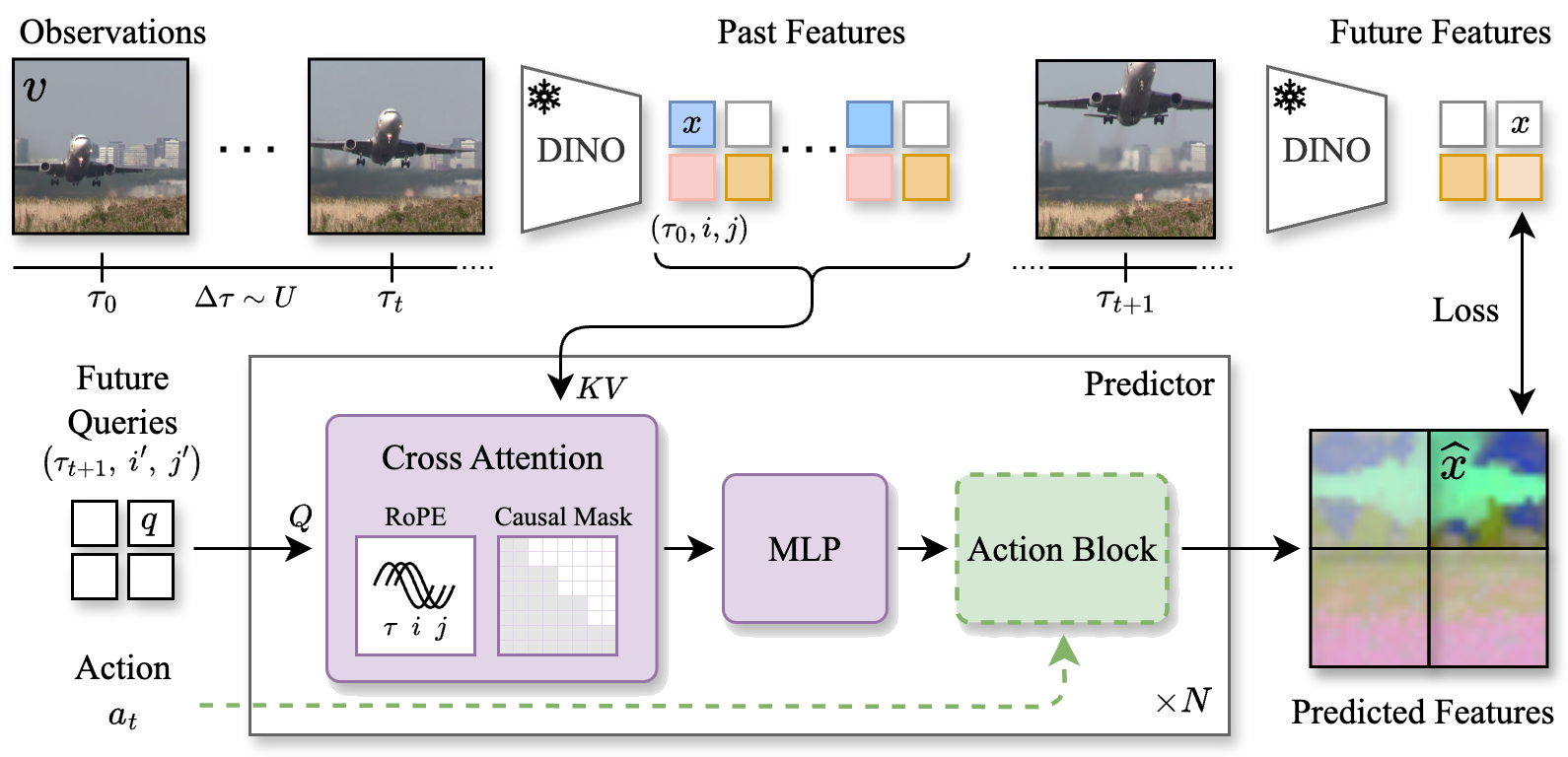
DINO — teacher–student self-distillation
- Strong, transferable backbones.
- Limitations: representation collapse; limited prediction.
Generative & JEPA
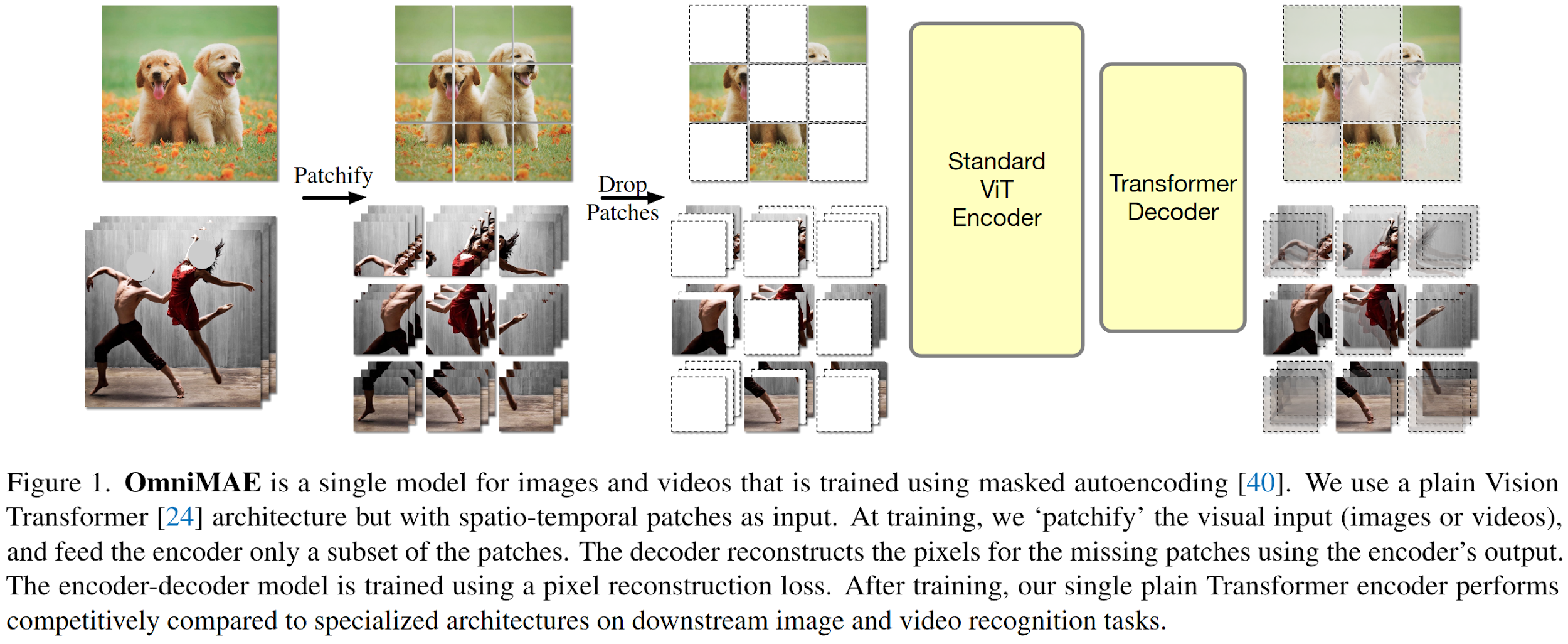
MAE — reconstruct masked patches in pixel space
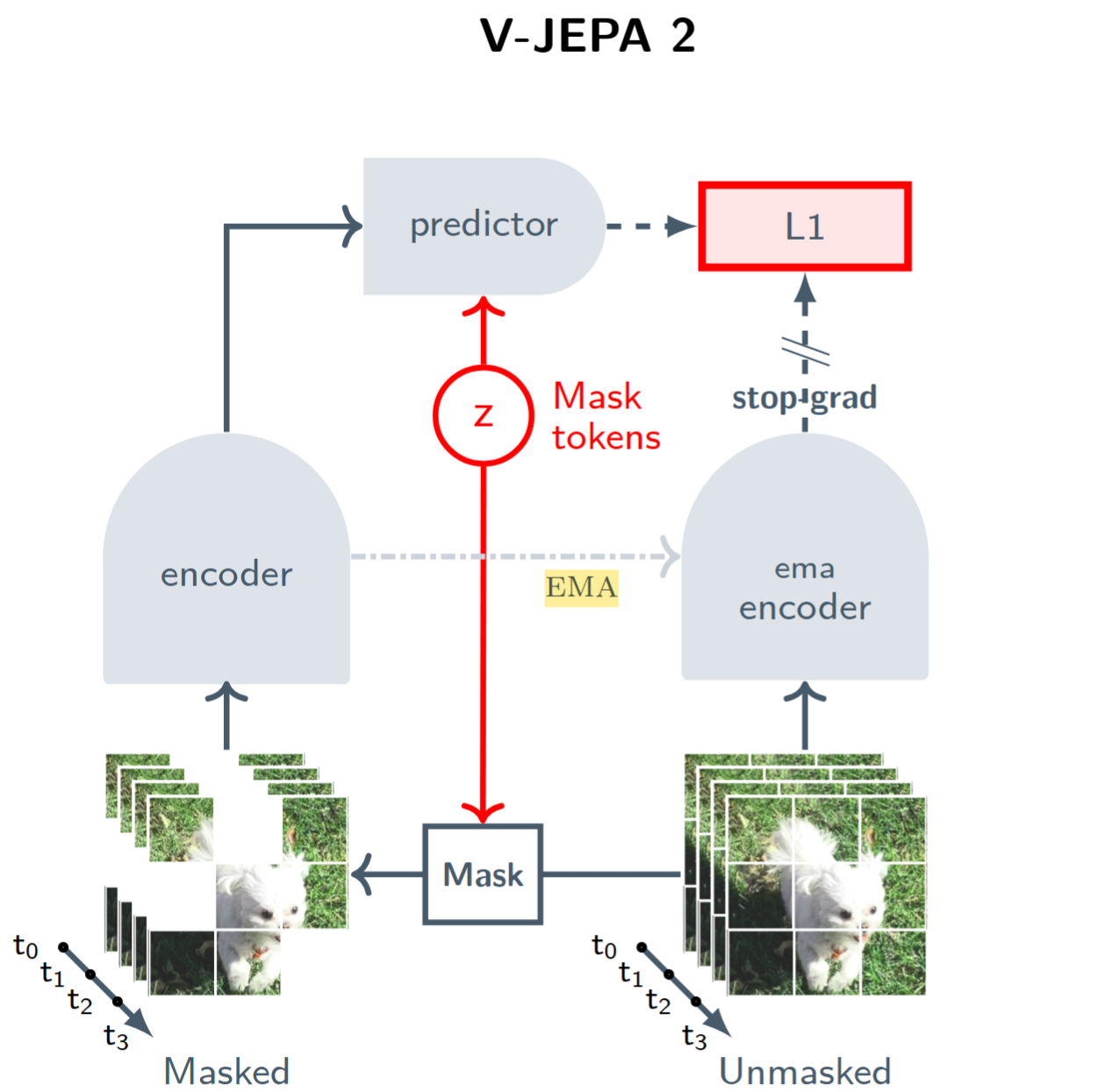
V-JEPA 2 — predict masked latent (EMA target)
- JEPA = best of both — latent prediction, versatile features. We build on V-JEPA.
Sparsh — SSL for touch
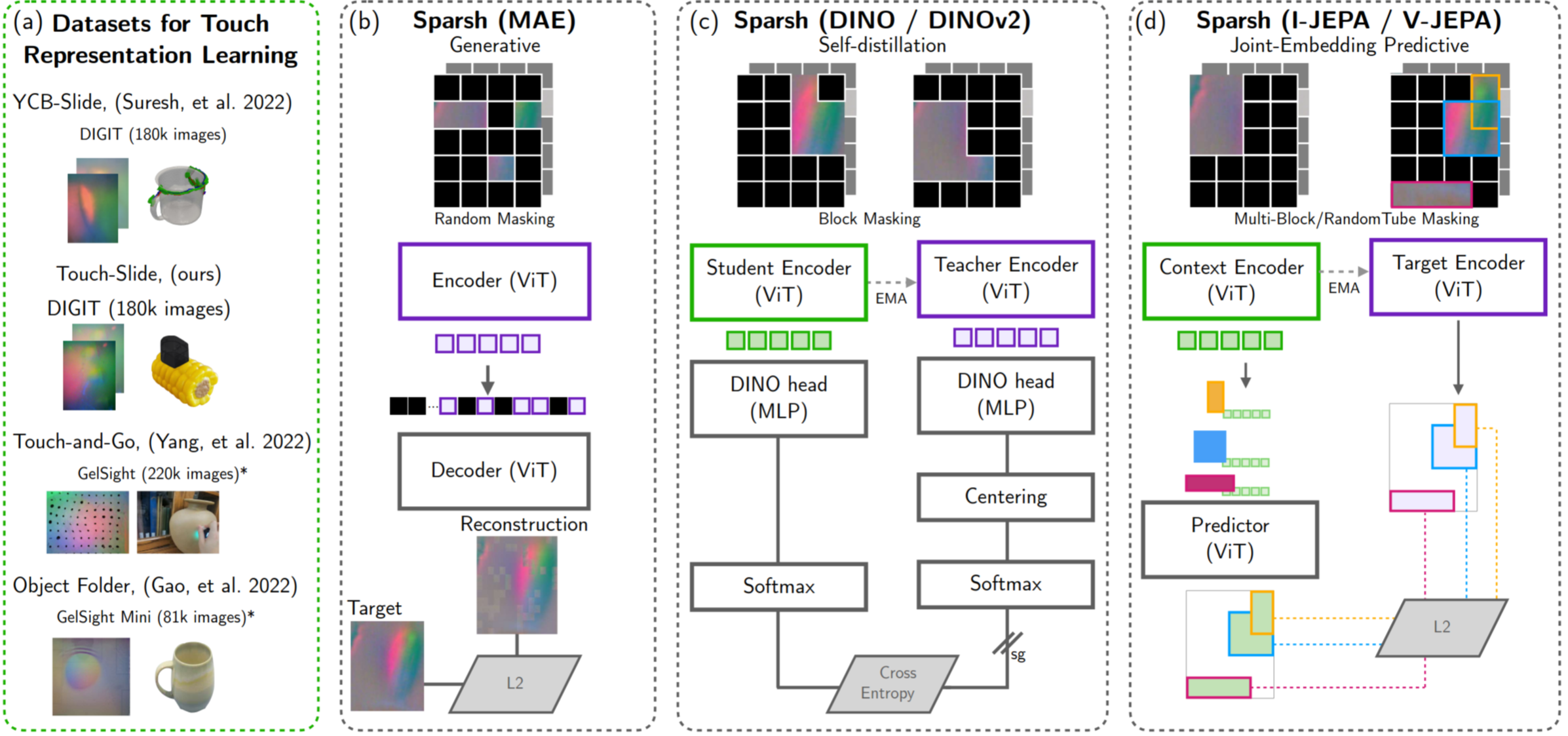
Sparsh: MAE / DINO / JEPA on 462k tactile images
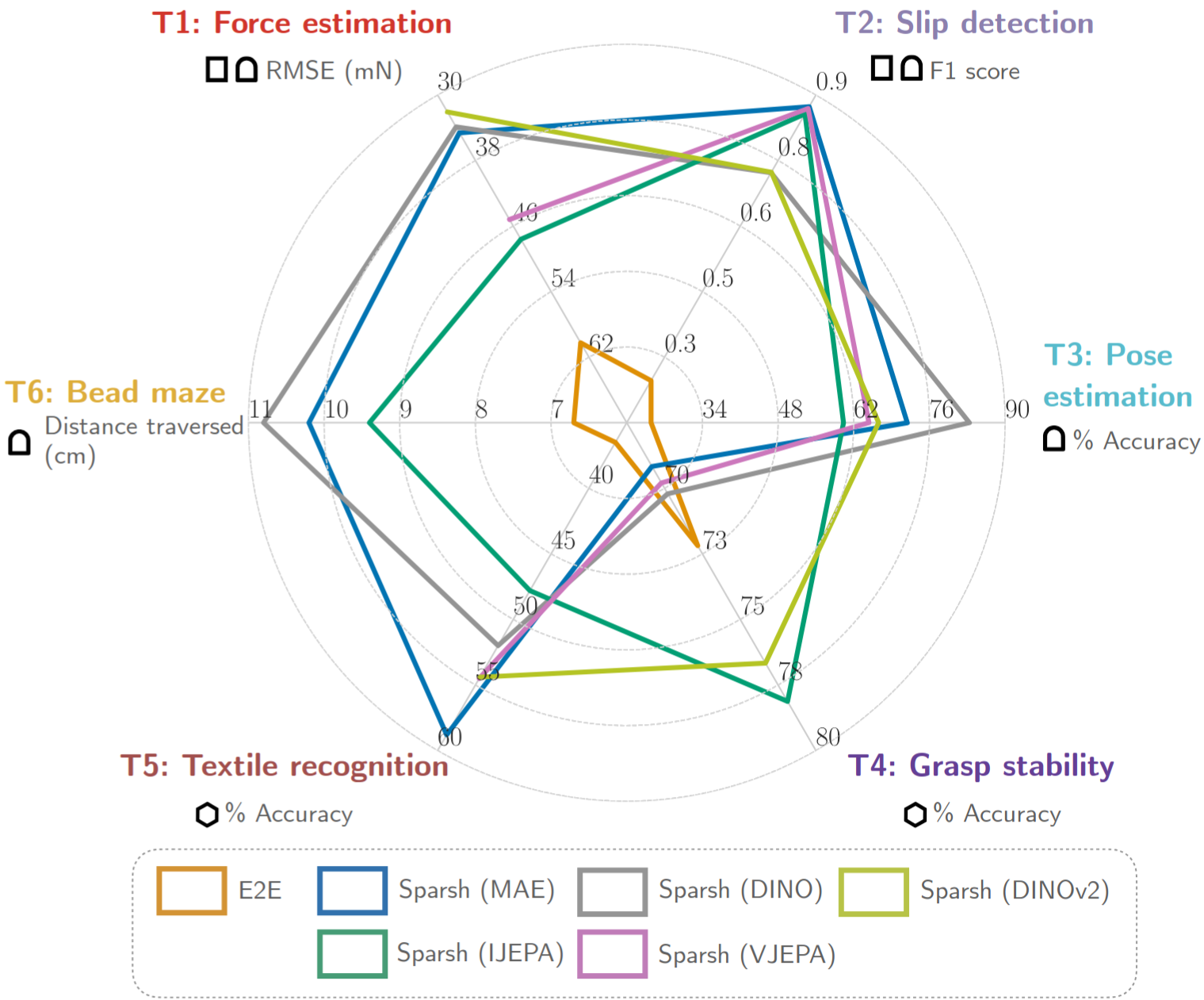
DINO best for force & pose; JEPA for touch semantics
- Gap: ignores F/T data; tactile understanding, not generation.
Goal, refined
Step 1. Pre-trained visual encoders + paired video–force data → supervised force prediction.
Step 2. Devise an SSL approach to learn a force representation given vision as context.
Step 2. Devise an SSL approach to learn a force representation given vision as context.
Three datasets with force
FMB
peg insertion · 4 cams · Panda F/T 10 Hz. Biased force, low variety.
peg insertion · 4 cams · Panda F/T 10 Hz. Biased force, low variety.
REASSEMBLE
NIST board · F/T 100 Hz <1 N error · clean.
NIST board · F/T 100 Hz <1 N error · clean.
RH20T
147 tasks · 4 robots · huge but messy.
147 tasks · 4 robots · huge but messy.
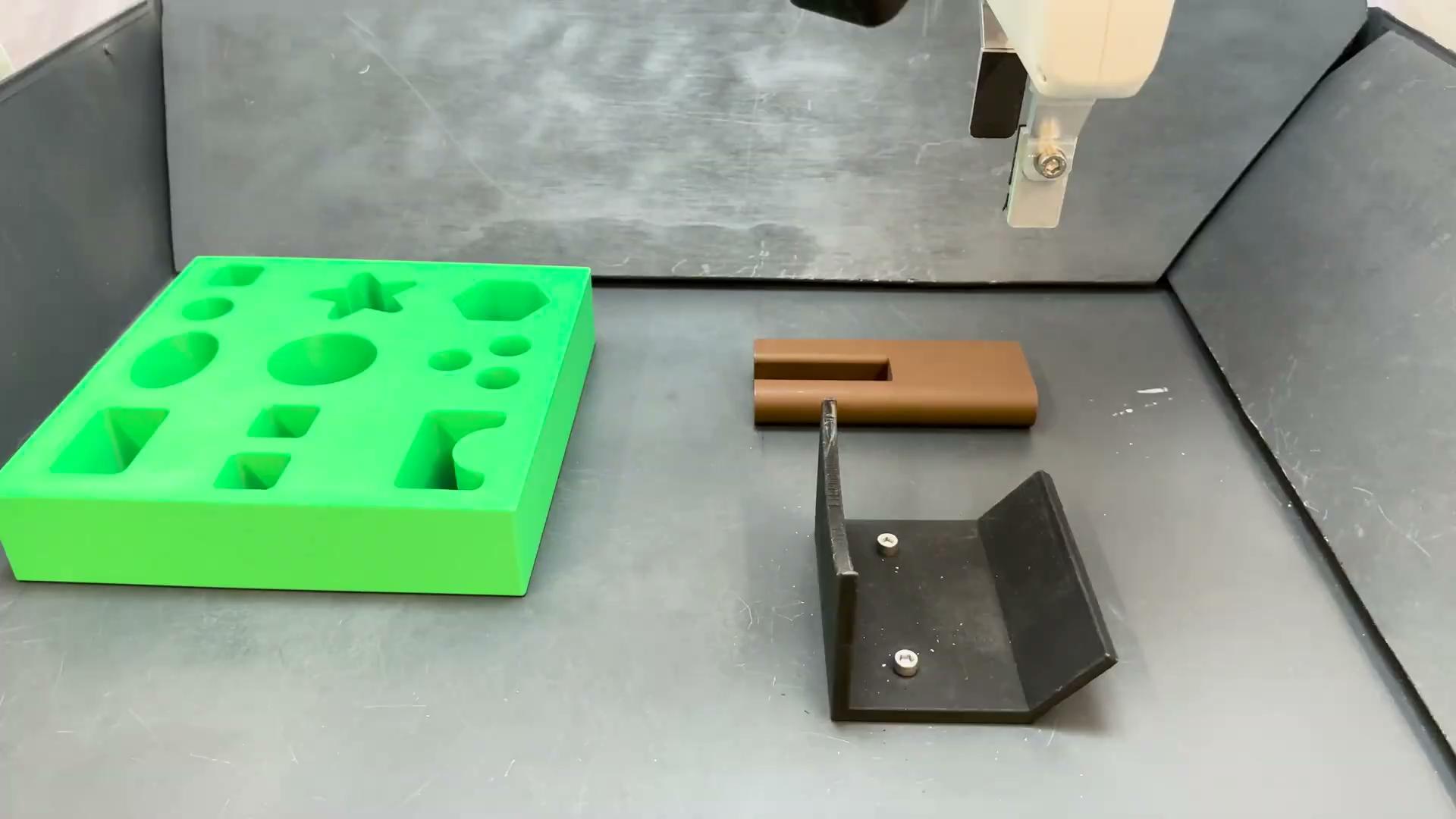
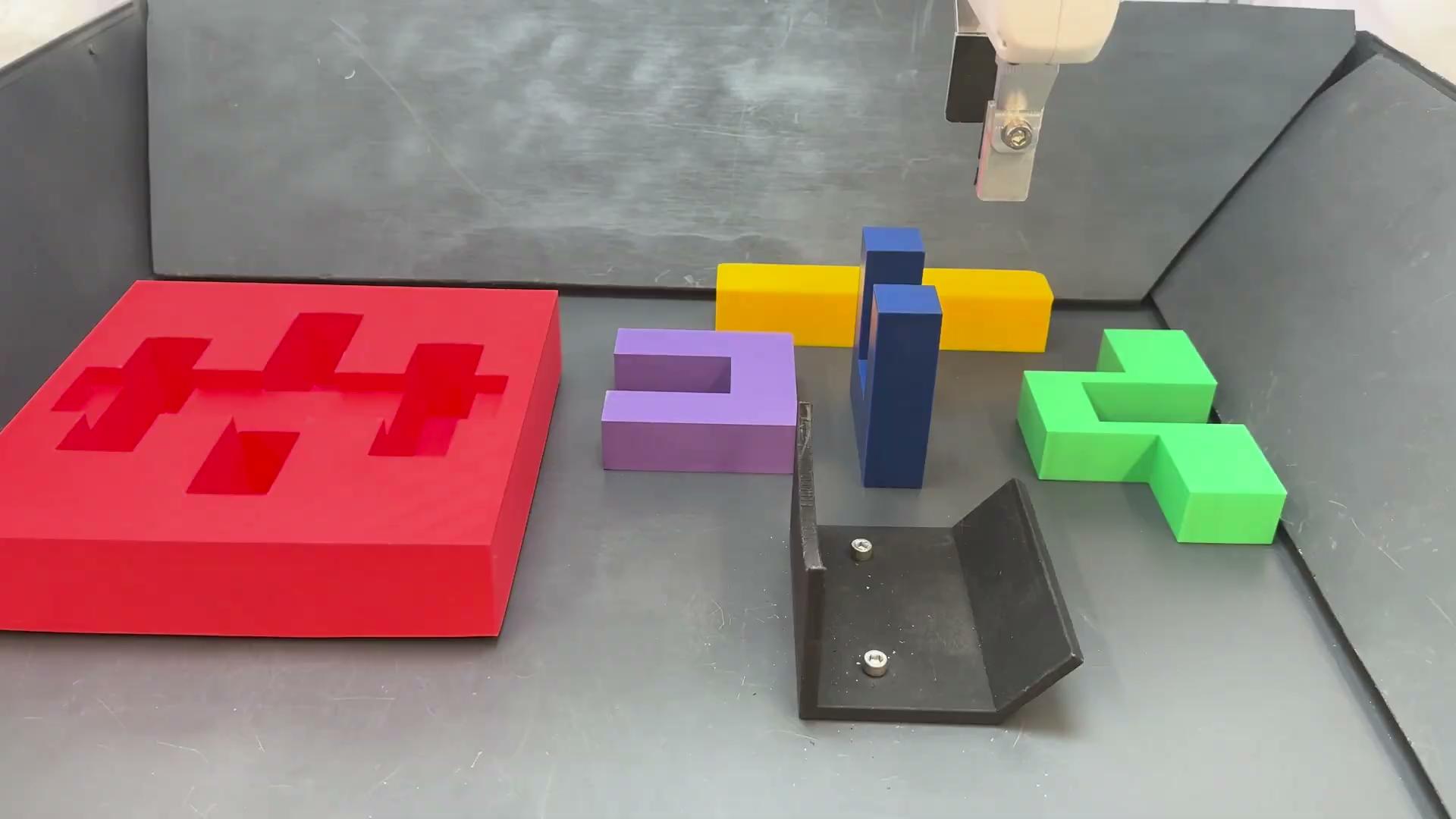
FMB boards & pegs
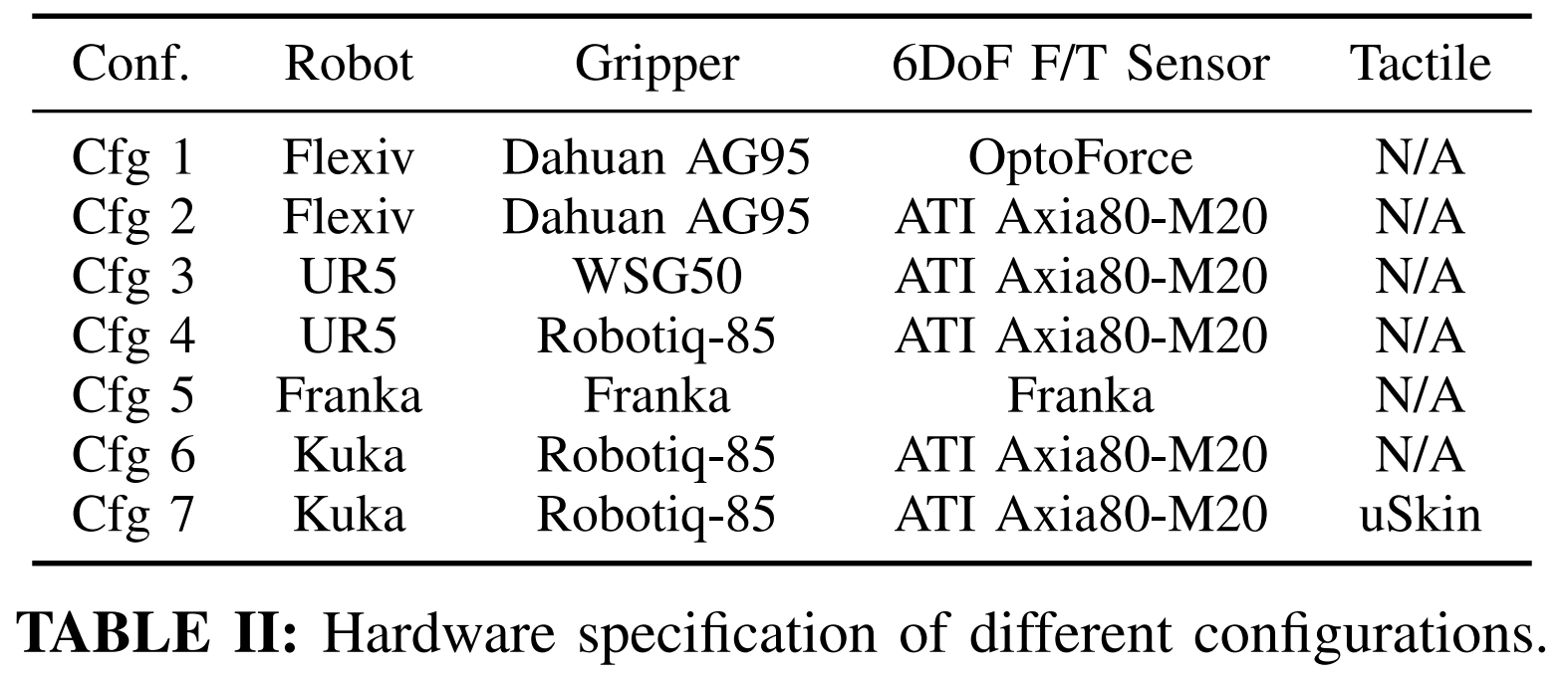
RH20T — 7 configs, 4 robots
Comparison
| Dataset | Task | Samples | F/T quality | Variety |
|---|---|---|---|---|
| FMB | Peg insertion | 1 844 | Poor | Poor |
| REASSEMBLE | Object insert / remove | 2 262 | Perfect | Mediocre |
| RH20T | Diverse manipulation | 12 666 | Mediocre | Huge |
- 16 772 rollouts · 178 hours.
- Train each separately, then combine.
What we predict & how we measure
Predict (3 heads):
- Contact event
- Force unit direction (3-D)
- Force magnitude
Metrics:
- Contact — F1
- Direction — cosine + cos-lift
- Magnitude — MAE (N)
Supervised feasibility
method → results → ablations → conclusions
Frozen V-JEPA → TCN
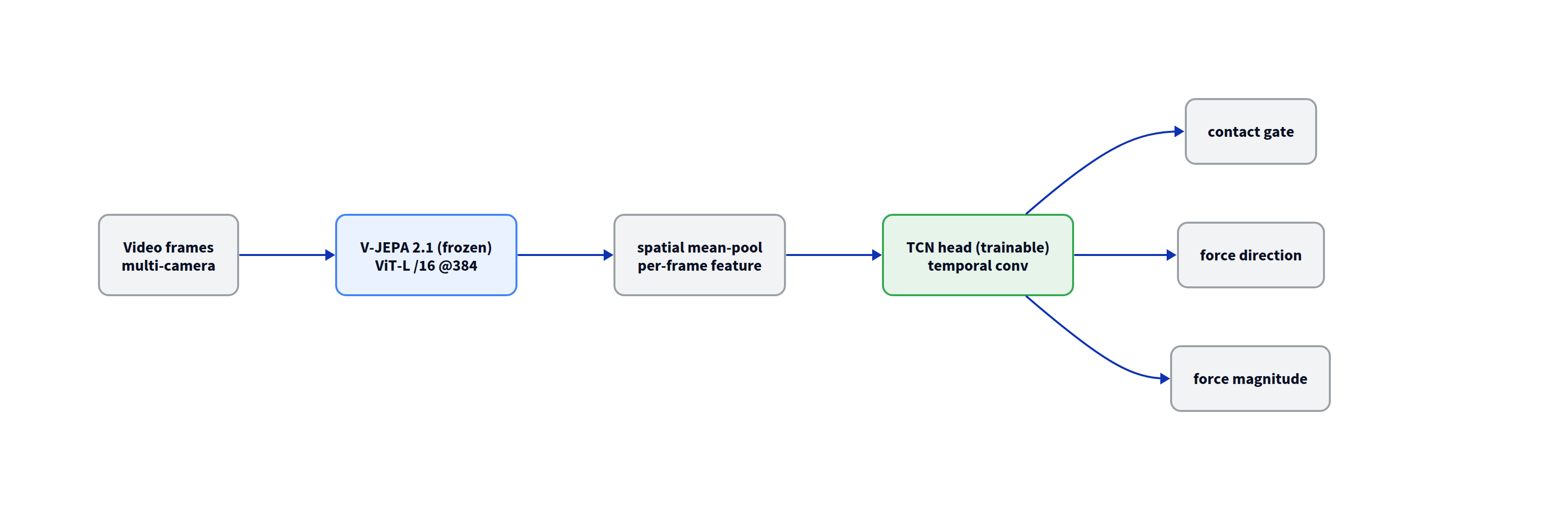
- Encoder frozen; cache features once → small TCN head.
FMB — contact & magnitude work
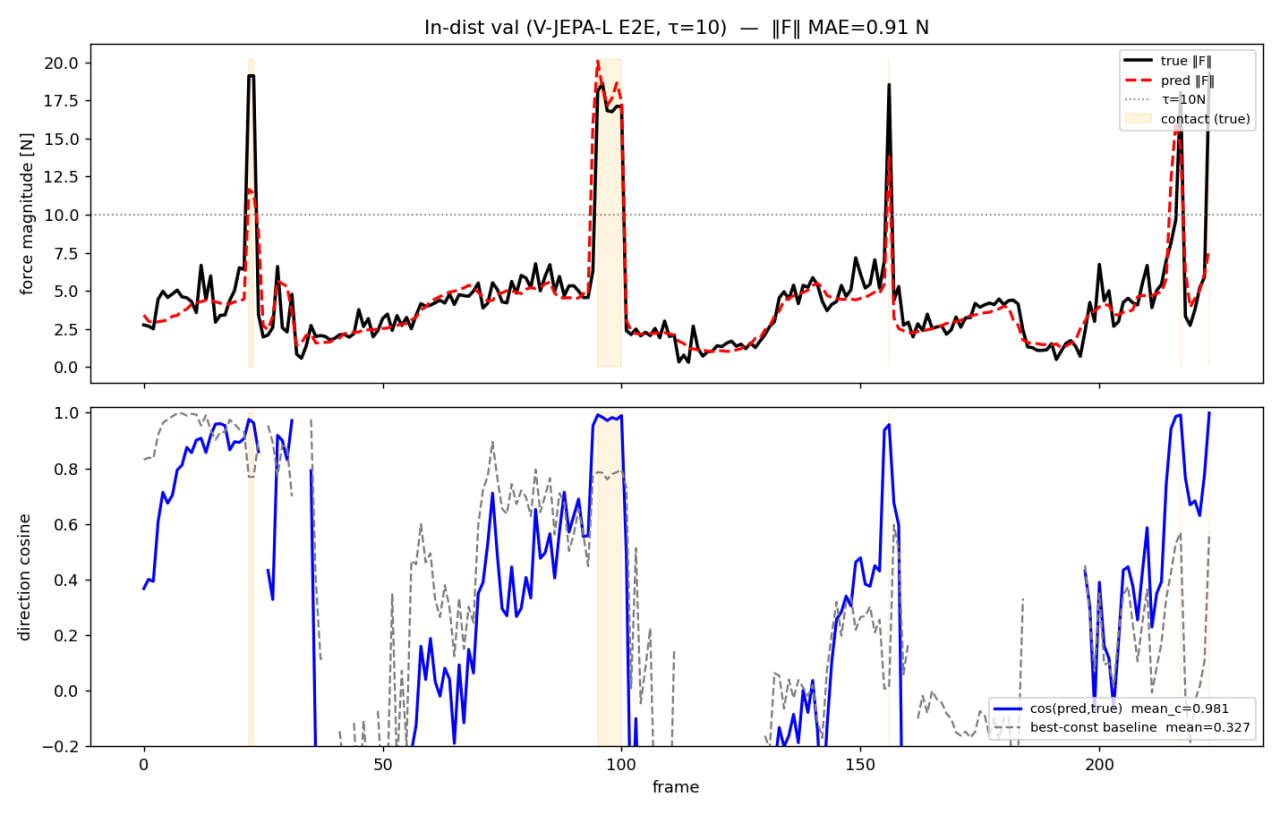
| FMB | F1 | dir | lift | MAE |
|---|---|---|---|---|
| in-dist | 0.779 | 0.965 | +0.015 | 1.06 |
| OOD | 0.767 | 0.953 | +0.042 | 1.06 |
- Contact feasible; magnitude surprisingly accurate.
REASSEMBLE — clean force, real direction
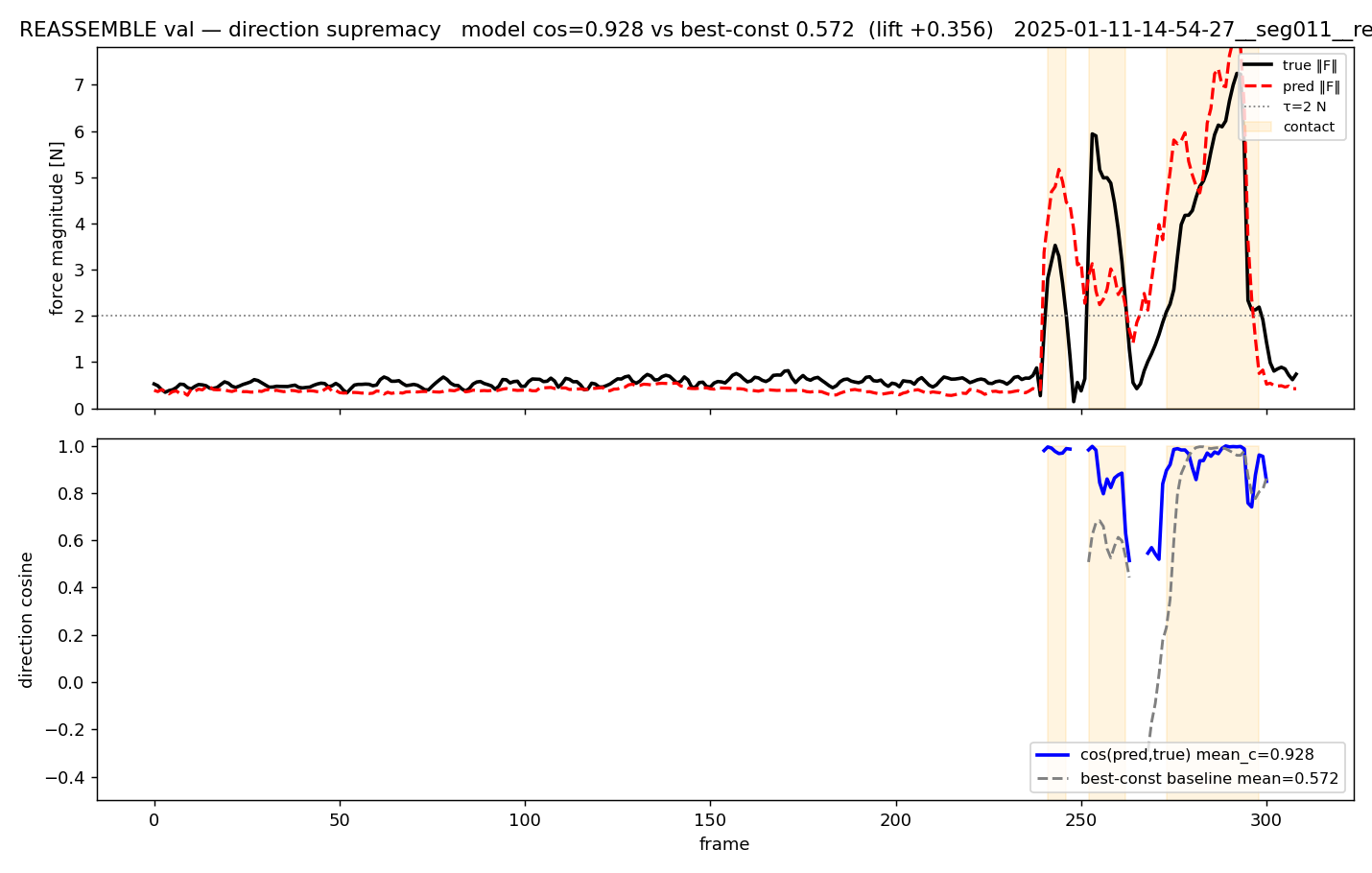
| F1 | MAE | dir | lift | |
|---|---|---|---|---|
| REASSEMBLE | 0.874 | 0.74 | 0.906 | +0.34 |
| FMB | 0.779 | 1.06 | 0.965 | +0.015 |
- Better F/T data → better contact (+9.5% F1).
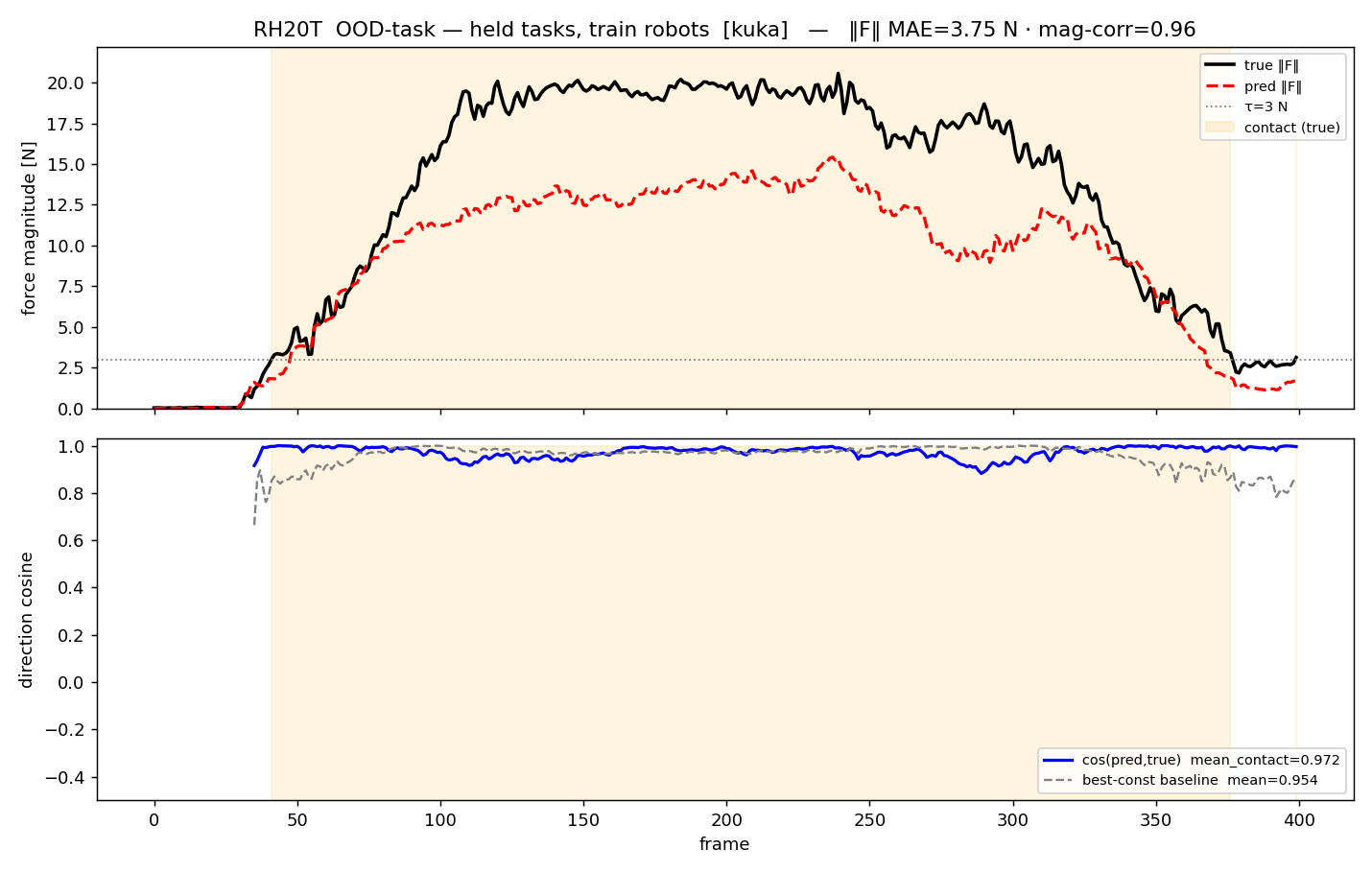
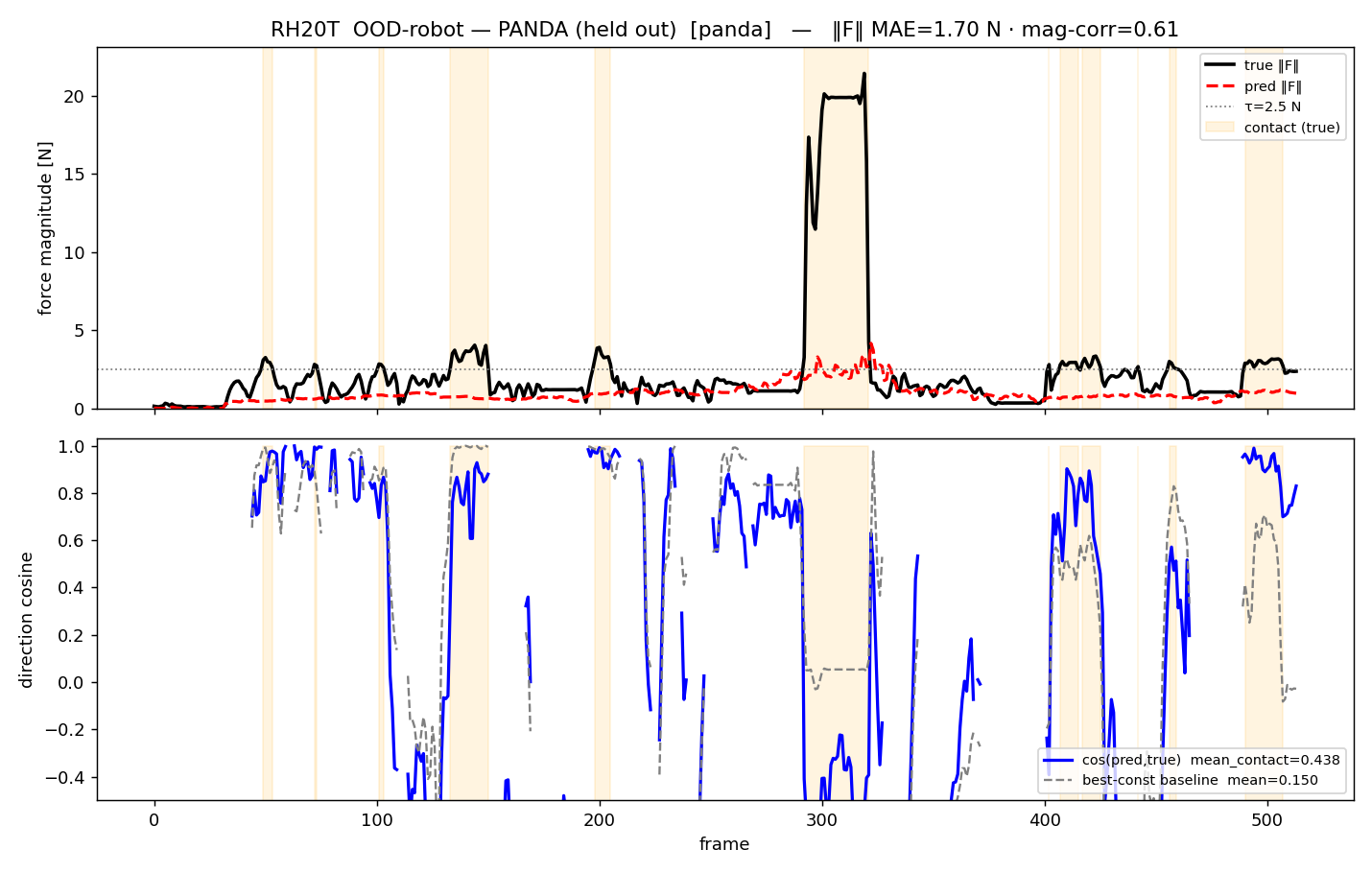
RH20T — generalization is hard
| split | F1 | dir | lift |
|---|---|---|---|
| in-dist | 0.71 | 0.39 | 0.27 |
| OOD task | 0.68 | 0.60 | 0.33 |
| OOD robot | 0.60 | 0.26 | 0.17 |
| OOD both | 0.57 | 0.25 | 0.08 |
- OOD task ok; OOD robot poor.
What encoder & head?
Encoder
video ≫ image; temporal matters
| model | F1 |
|---|---|
| DINOv2-B (img) | 0.52 |
| V-JEPA ViT-B | 0.64 |
| V-JEPA ViT-L | 0.76 |
| ViT-L E2E | 0.779 |
Head
TCN best; predict Mag+Dir+Contact; mean pooling
| head | F1 |
|---|---|
| TCN | 0.768 |
| BiGRU | 0.723 |
| Transformer | 0.689 |
Hypotheses, answered
- H1 — contact: feasible ✓.
- Magnitude: surprisingly good.
- H2 — direction: partial.
- H3 — generalization: partial → motivates SSL.
Self-supervised force learning
idea → method → results → conclusion
SSL of a force representation
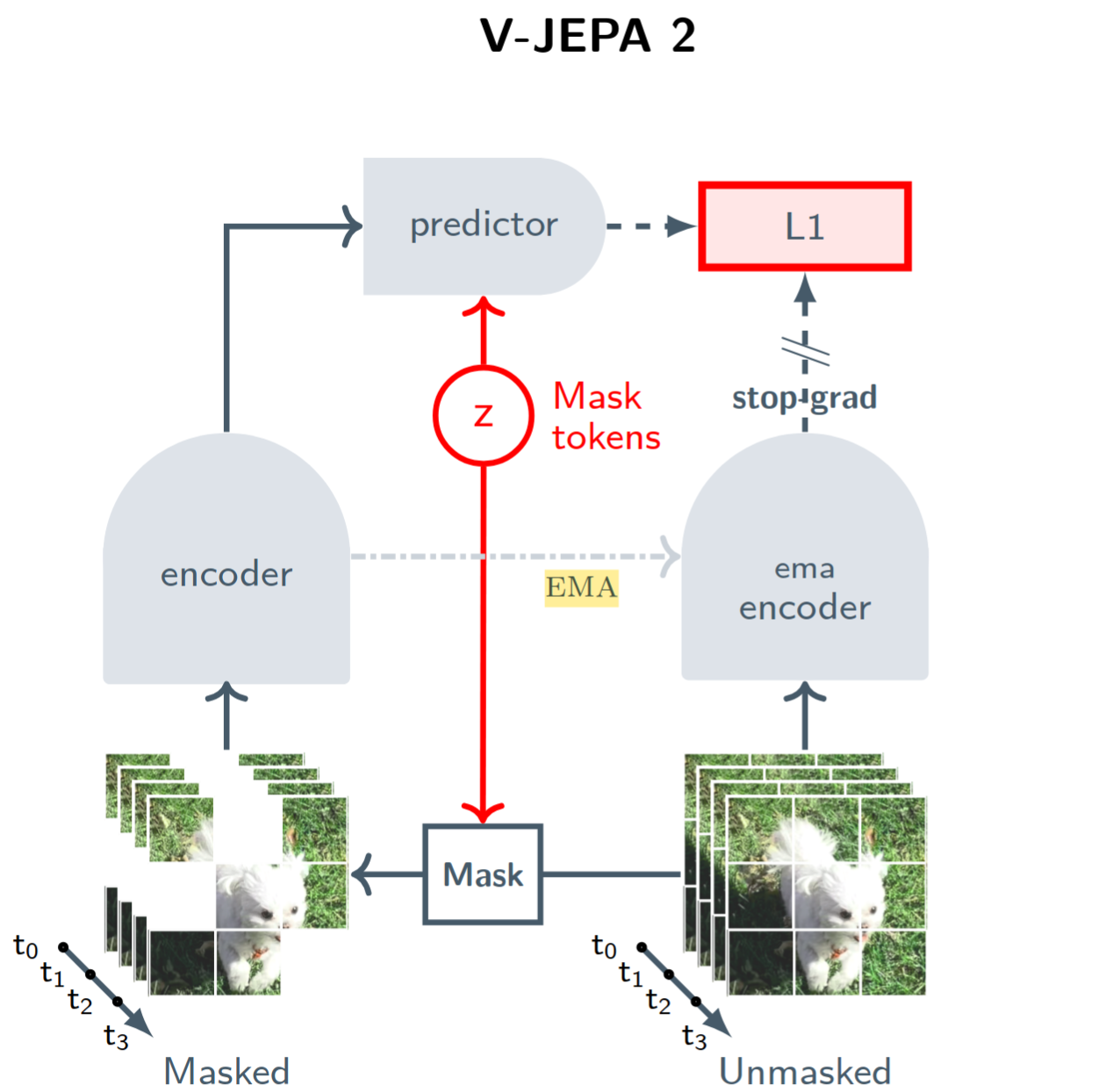
- X masked force · Y true force · Z encoded video.
- Force as the self-supervisory anchor — physical, camera-independent.
Cross-modal force-augment
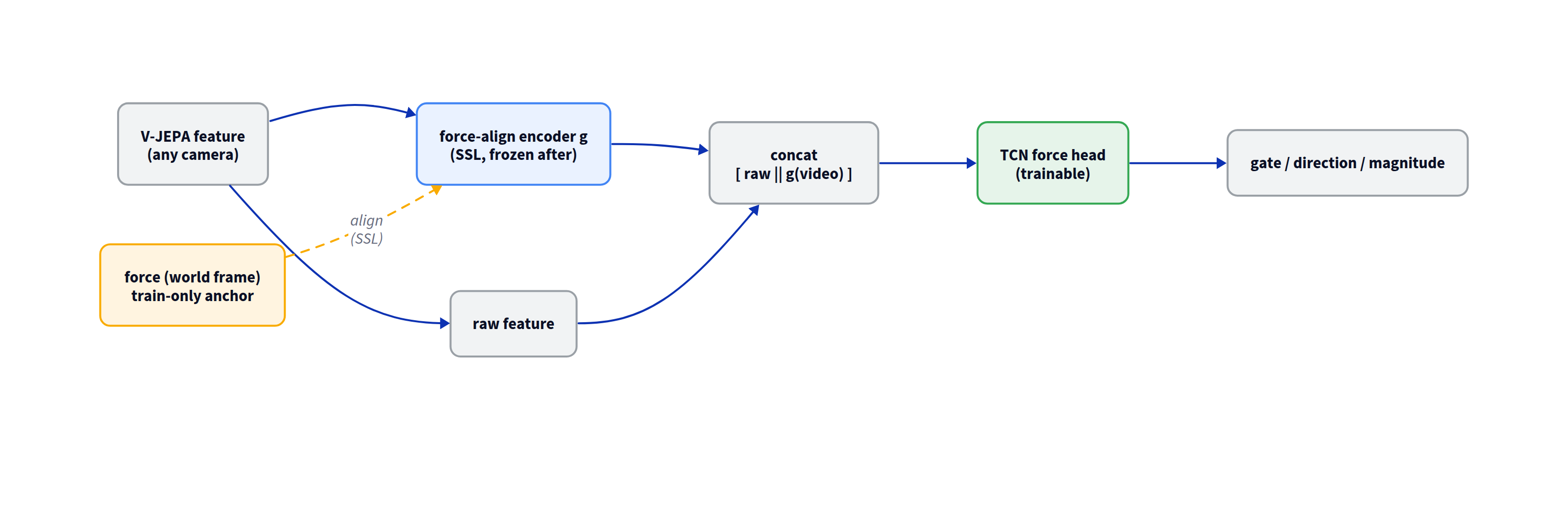
- Augment, don't replace: concat force-aligned embedding onto raw features.
Unseen camera: 0.28 → 0.70
| held-out camera | F1 | direction |
|---|---|---|
| trivial | 0.46 | 0.47 |
| V-JEPA + TCN | 0.28 | 0.41 |
| + force-augment | 0.70 | 0.78 |
- Baseline below trivial; SSL clears it, in-dist preserved.
Cross-dataset direction
| dir cosine | REASS→FMB | FMB→REASS |
|---|---|---|
| trivial | 0.69 | 0.47 |
| V-JEPA + TCN | 0.41 | 0.40 |
| + force-augment (UDA) | 0.87 | 0.83 |
- Needs world-frame force + unlabeled target video.
Why? The latent forgets the camera
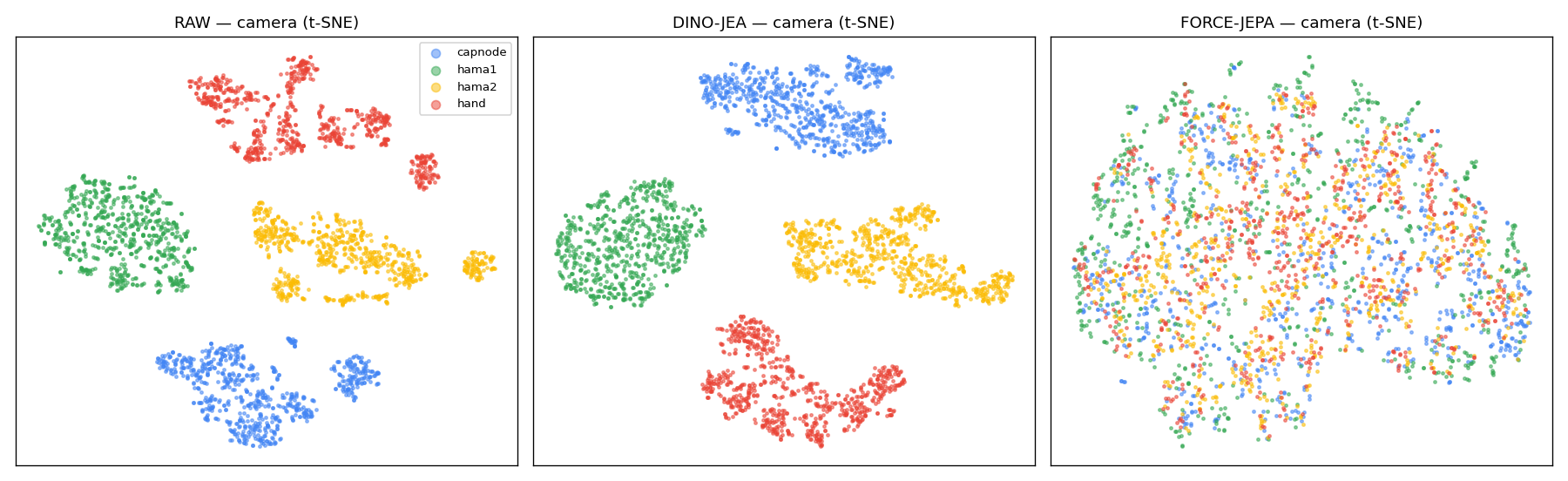
| cam NMI | eff-rank | |
|---|---|---|
| Raw | 1.00 | 396 |
| DINO | 0.79 | 33 |
| Force-JEPA | 0.009 | 61 |
Force-JEPA kills camera identity without collapse.
What SSL bought us
- View-invariant, task-structured, uncollapsed force embedding.
- Wins severe gaps at zero in-dist cost.
Where each tool wins
| regime | winner | signal |
|---|---|---|
| contact (H1) | feasible ✓ | F1 0.87 |
| unseen camera | force-augment SSL | 0.28→0.70 |
| cross-dataset direction | force-augment (UDA) | 0.40→0.85 |
| cross-robot (H3) | open | major room |
Next
- Push cross-robot / cross-scene generalization.
- Joint training + force-frame harmonization.
- Scale the SSL force encoder.
Video is enough for contact & magnitude — and SSL unlocks the transfer.