Video2Force
SSL vs Supervised — a Stage 1–5 synthesis
Ivan Domrachev · sinew · 2026 · not self-contained · → chapters · ↓ detail
The task — climb a contact hierarchy from video
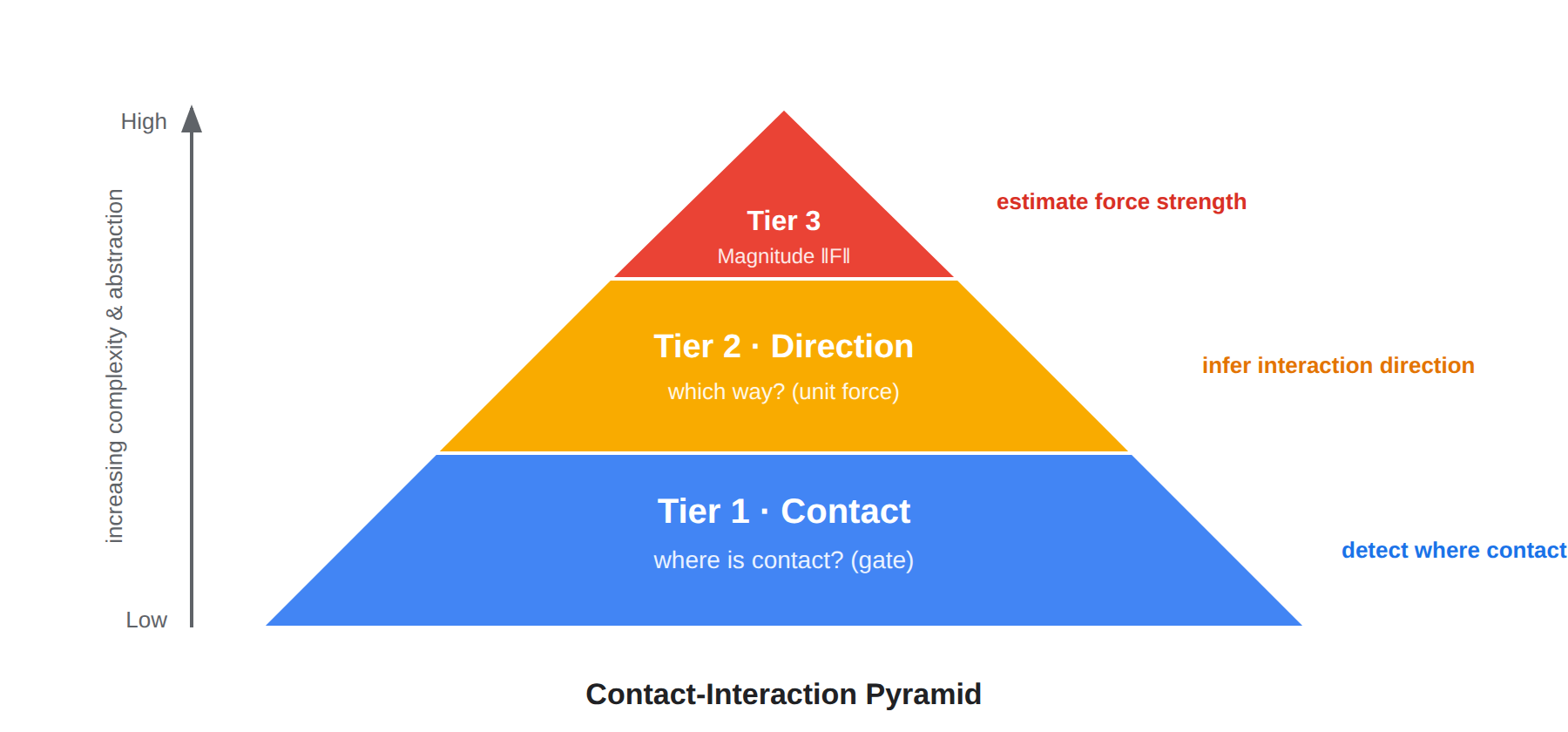
- Contact (gate) → Direction → Magnitude
- Encoder frozen through Stages 1–5; only the trunk / SSL heads train.
- Inference is video-only.
Self-supervised learning — three families
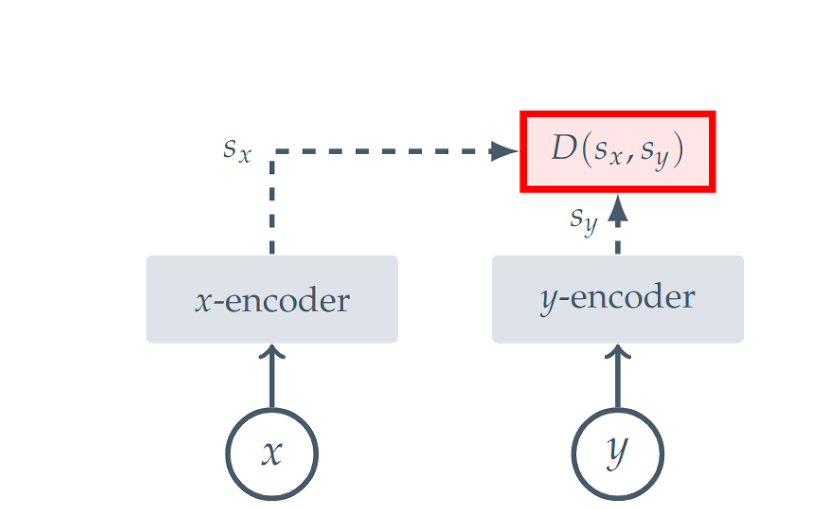
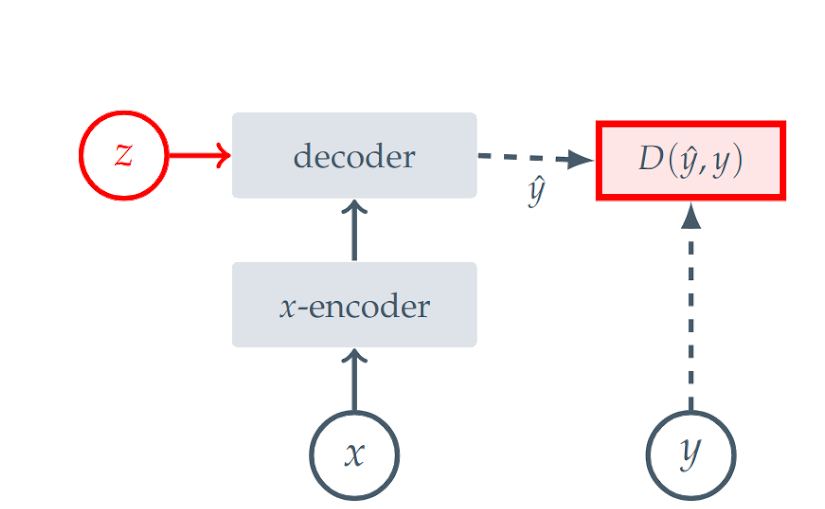
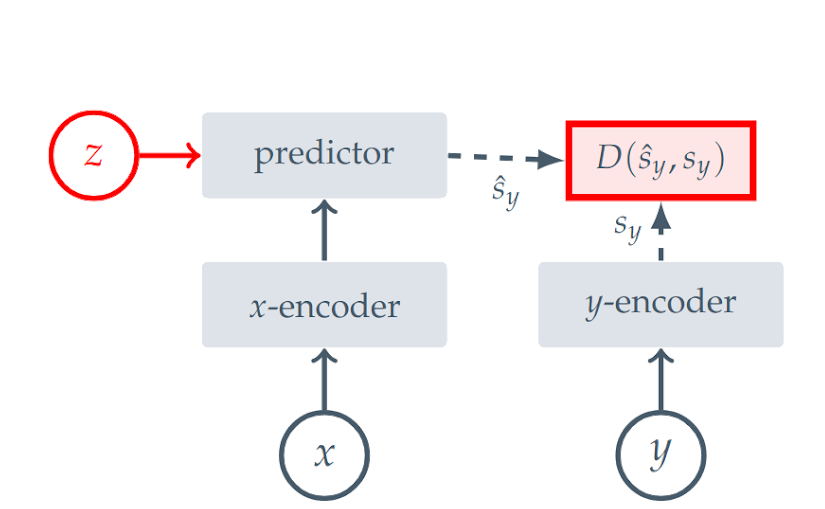
X = video (context), Y = force (target), Z = latent, D(·,·) = energy. We keep the frozen V-JEPA video encoder and learn a force/alignment head on top.
What we actually tried — five stages
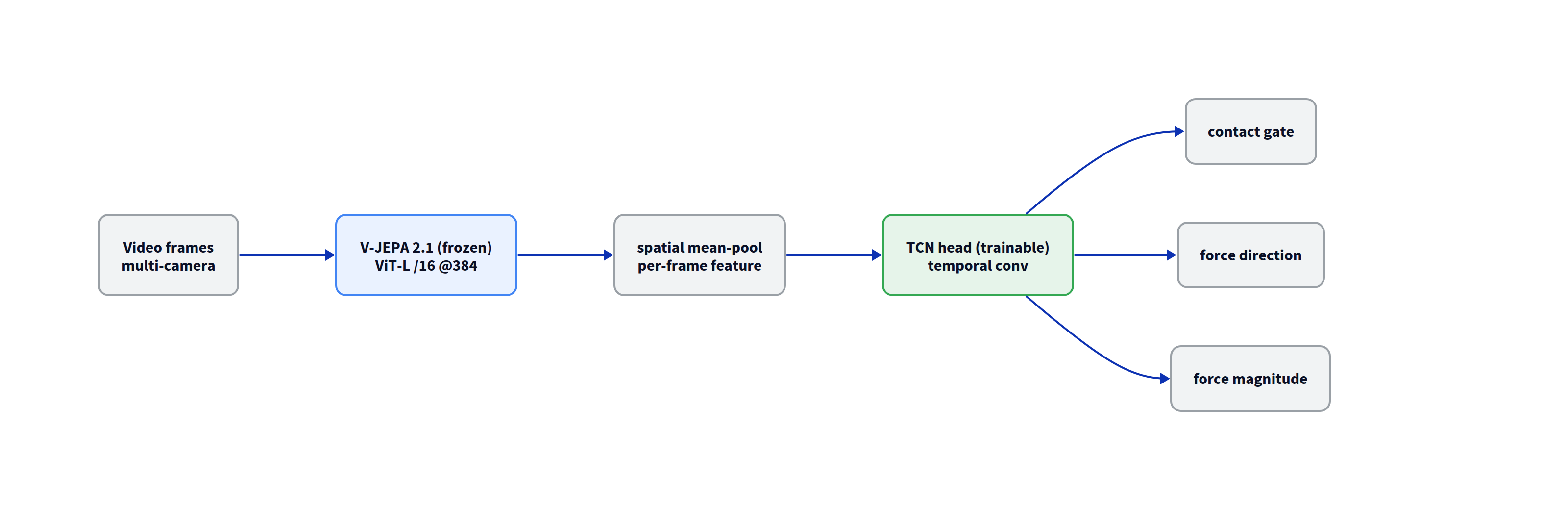
One spine throughout: a frozen video encoder + a trainable head whose target is force (or force-aligned). Diagrams ↓.
Stage 2 — cross-modal DINO alignment
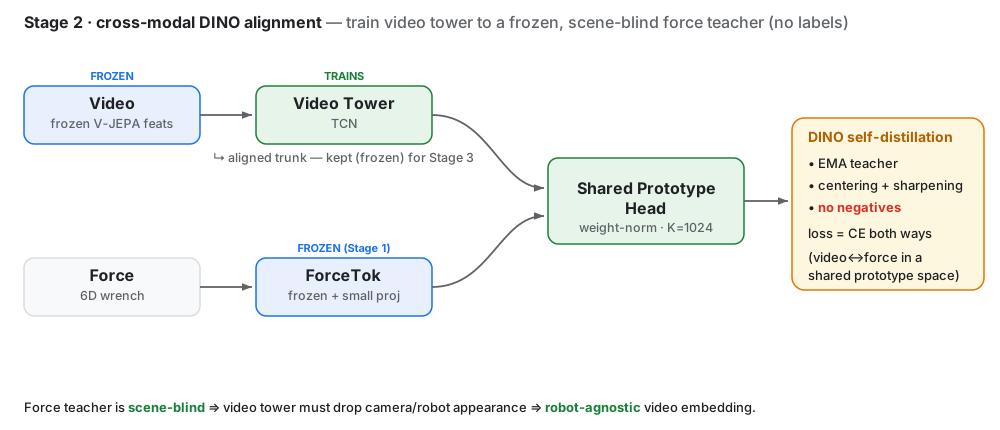
Idea
- Force teacher is scene-blind → pulls a robot-/camera-agnostic video embedding.
- Shared weight-norm prototypes (K=1024), EMA teacher, centering+sharpening.
- VICReg covariance term added in Stage 2 to stop collapse.
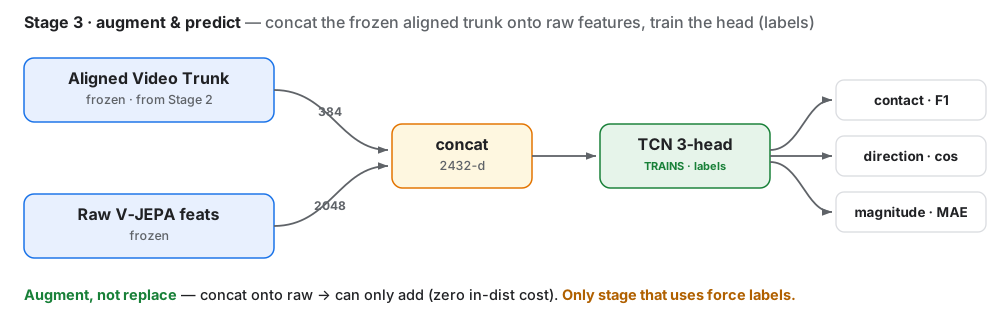
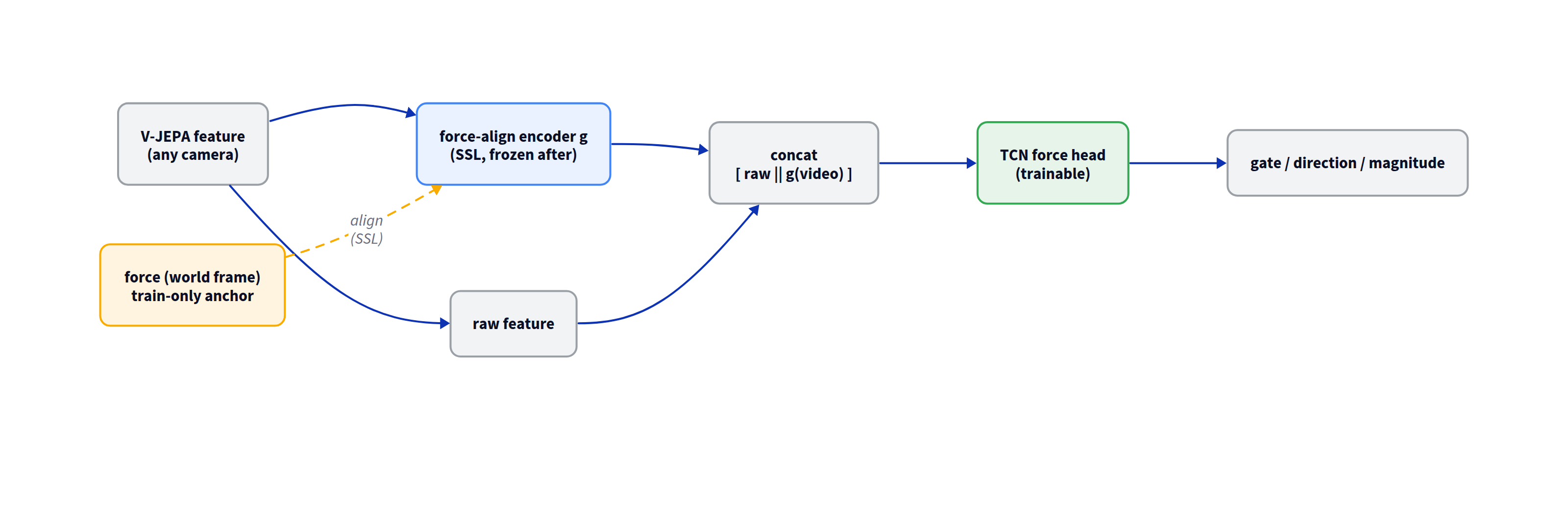
Stage 3 — augment & predict (the only labelled SSL use)
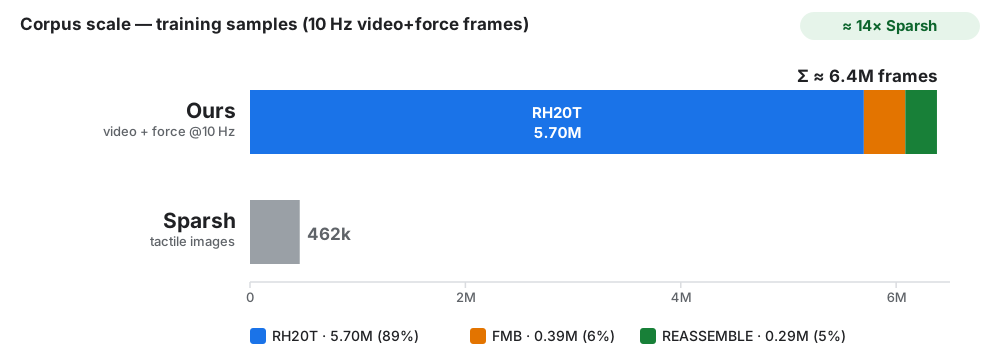
Train / test corpus — three datasets, ~6.4M frames
| dataset | task | cams | force | role |
|---|---|---|---|---|
| FMB | peg/board insertion | 2–4 ext | wrist F/T, biased | train+test |
| REASSEMBLE | NIST board insert/remove | 4 | clean <1 N, 100 Hz | train+test |
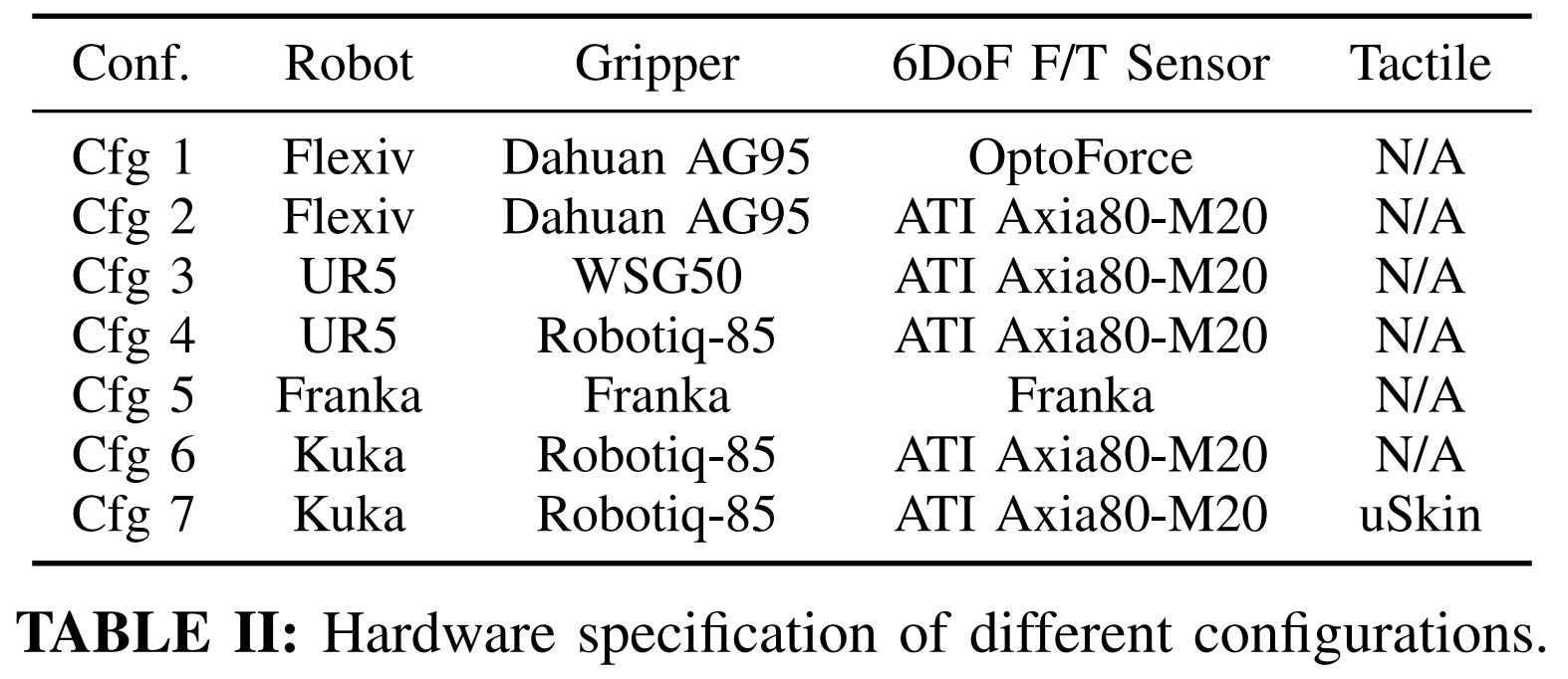
| RH20T | 147 tasks · 4 robots | 8–11 | base-frame, mixed | train+test |
≈16.8k rollouts · ~178 h. Force harmonized to a common world/EE frame; per-source normalization. No wrist-force frame in RH20T; in-hand cam tcp dead-zeroed.
FMB — Functional Manipulation Benchmark
- 3 boards · 54 pegs · single- & multi-object insertion.
- Multi-camera (4 external); 2 cached on server.
- Wrist F/T — force is biased (no gravity-comp) → magnitude noisy, contact clean.
- Contact τ ≈ 8–10 N (valley of the force histogram).
REASSEMBLE — NIST task board
- Insert / remove on a NIST board; 4 cameras.
- Cleanest force — sub-Newton, 100 Hz (down-sampled to 10).
- Real direction signal → the dataset where dir-cosine shines.
- Cross-dataset label overlap: insert / release.
RH20T — diverse, multi-robot (the scale + the mess)
89% of the corpus · sole multi-task source (7-way) · no wrist-force frame · per-robot τ. The generalization stress-test.
Validation = crisp_ws — a held-out OOD workspace
peg-insert · ethernet-insert
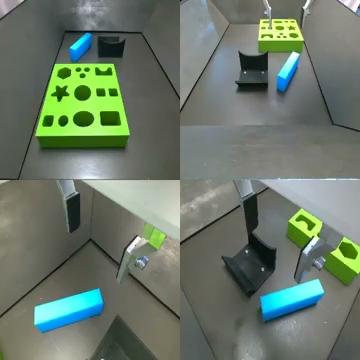
- axial +Z push, low-entropy direction
- contact onset is sharp & repeatable
box-flip
- lateral, rotating contact → direction stress
- off-axis vs the insertion prior
Why this set
- Different lab, robot, cameras → a true OOD check.
- Clean EE-frame force (lab-invariant direction).
- Real + Isaac-sim twin (same 4 views).
- In-domain ceiling (train-on-crisp): gate-F1 ≈ 0.90 every cell → gap is domain shift, not a feature ceiling.
Supervised feasibility
architecture → in-distribution → out-of-distribution
Frozen V-JEPA → dilated TCN → 3 heads
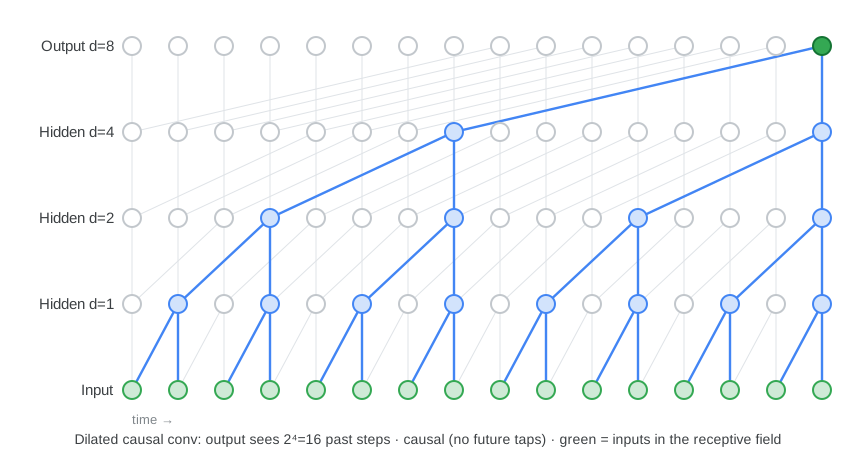
Recipe (frozen ablation winner)
- Encoder: V-JEPA 2.1 ViT-L/16@384, frozen, spatial mean-pool → 1024-d / cam.
- Trunk: dilated TCN, 7 blocks (dil 1→64), hid 384.
- Heads: gate (BCE) · direction (cos) · magnitude (smooth-L1).
- Stage 3 adds a multi-cam view-attention fuser.
In-distribution — contact & direction work
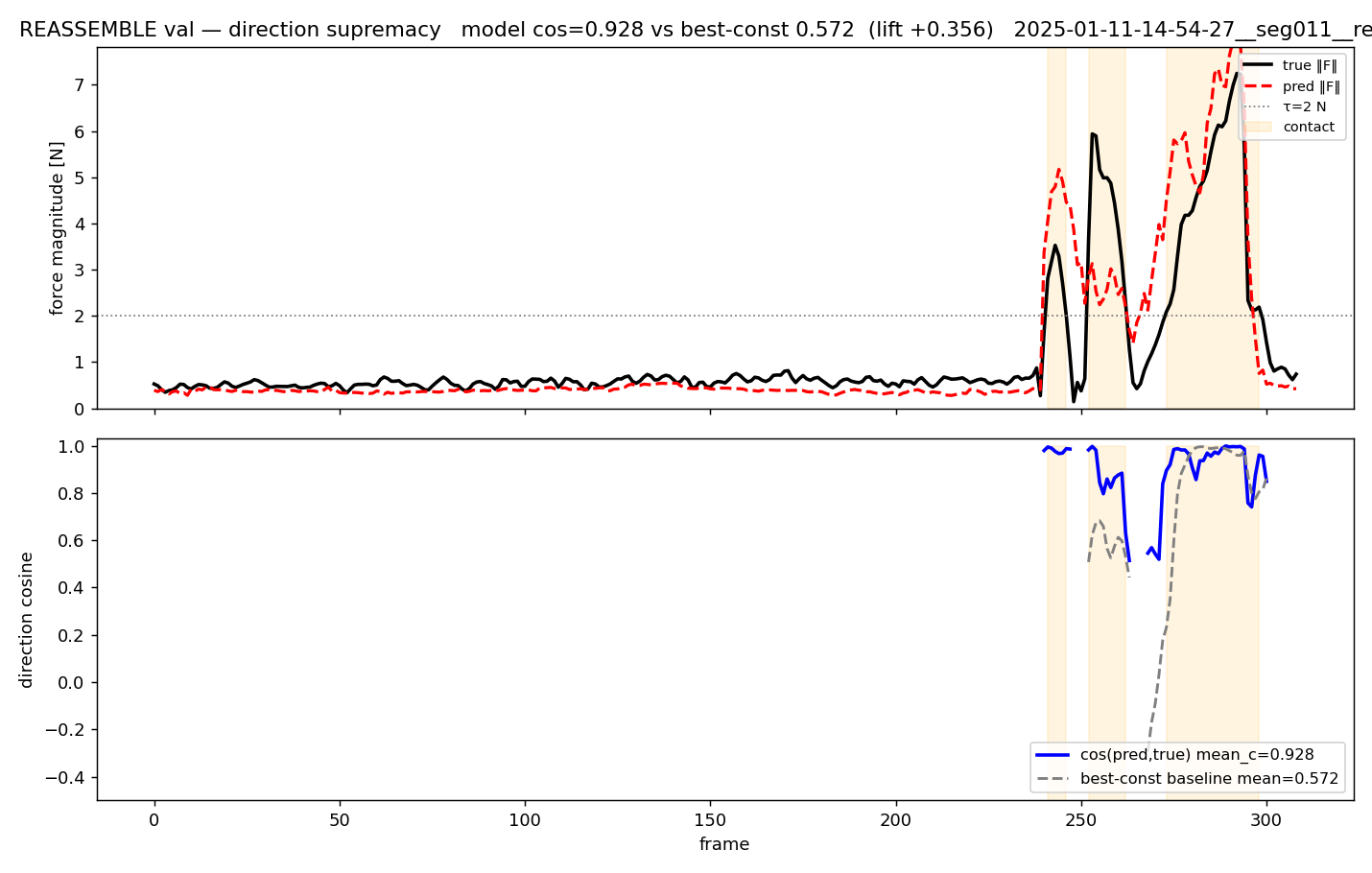
| dataset | gate-F1 | dir-cos (lift) |
|---|---|---|
| REASSEMBLE | 0.874 | 0.93 (+0.34) |
| FMB | 0.78 | biased |
| RH20T | 0.55–0.71 | frame-dependent |
H1 (contact) ✓ across all. H2 (direction) ✓ where force is clean (REASSEMBLE). Magnitude is the residual wall.
Out-of-distribution — pretrained-OOD ≥ in-domain
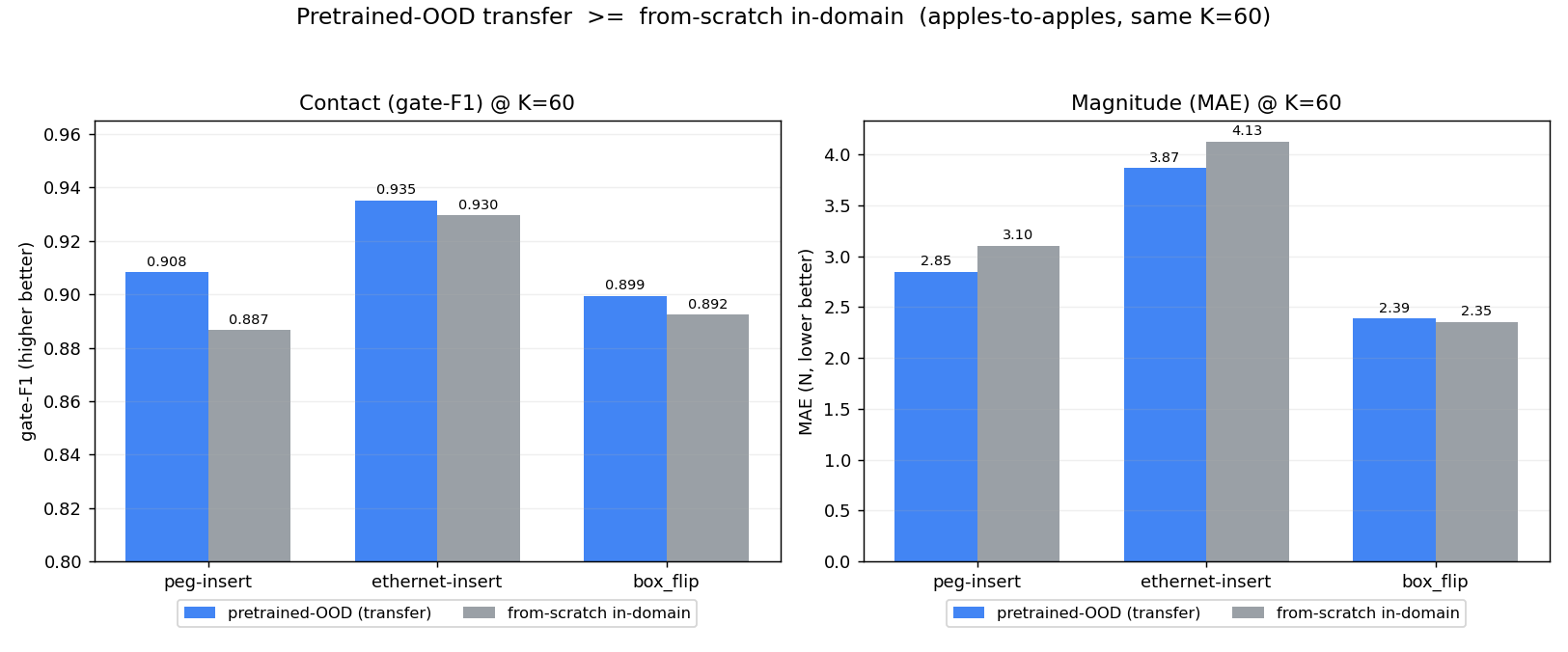
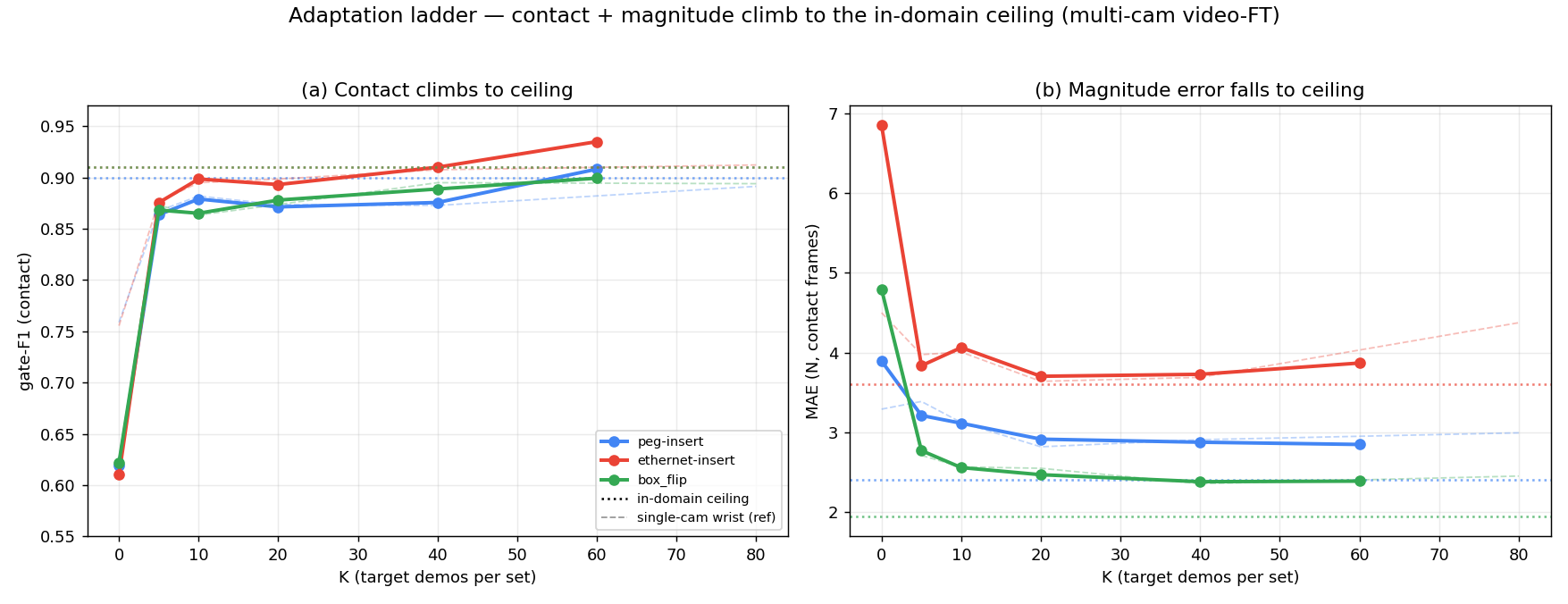
| crisp_ws (K=20 FT, multi-cam) | gate-F1 | AUC | dir-cos | |
|---|---|---|---|---|
| peg-insert | EASY | 0.874 | 0.867 | 0.765 |
| ethernet-insert | EASY | 0.888 | 0.914 | 0.828 |
| box-flip | MEDIUM | 0.867 | 0.959 | 0.935 |
The encoder is not the lever
What we swept
- Encoder: V-JEPA-L vs ViG vs E2E ViT-L
- Head: TCN vs MLP vs 3-head
- Pooling: mean vs attentive
- Frames: world vs EE-canonical
What we learned
- Frozen V-JEPA-L + dilated TCN + 3-head + mean-pool = best frozen recipe.
- Bigger / different frozen backbones cap at the same ceiling (F1 ≈ 0.78 FMB).
- Ceiling is label- / sensor-bound, not capacity-bound.
- Direction is frame- & viewpoint-locked → multi-cam + frame-unification matter most.
The SSL latent space
video↔force · across cameras · across datasets
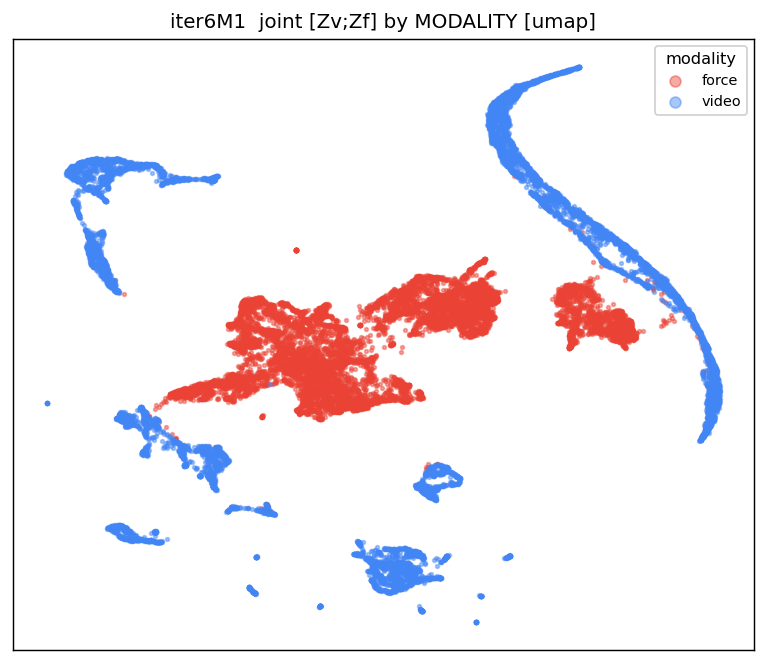
Video and force, brought into one space
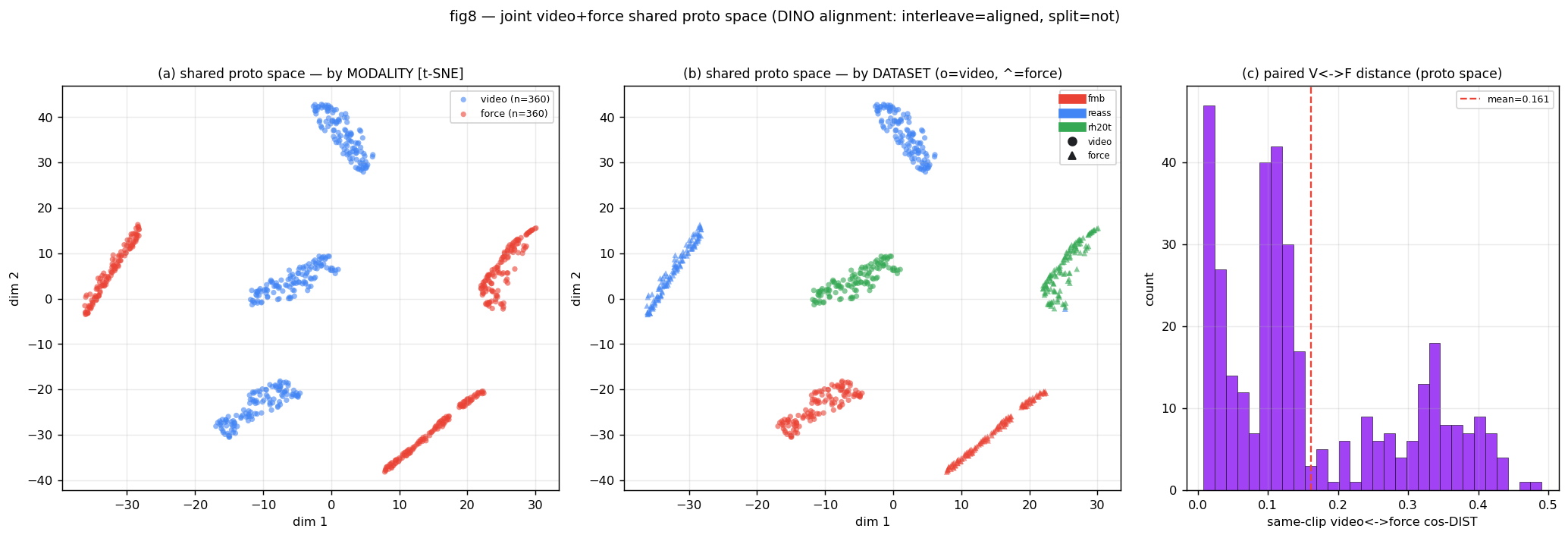
Closing the gap
| iter | CKA | centered cos |
|---|---|---|
| Stage 4 (naïve) | 0.07 | 0.014 |
| mid | 0.43 | 0.37 |
| Stage 5 champ | 0.51 | 0.51 |
Plain cosine is offset-blind (a “modality gap”) → cosine + Deep CORAL covariance-match converts a common-mode collapse into genuine alignment.
…but a residual modality gap remains
The latent forgets the camera
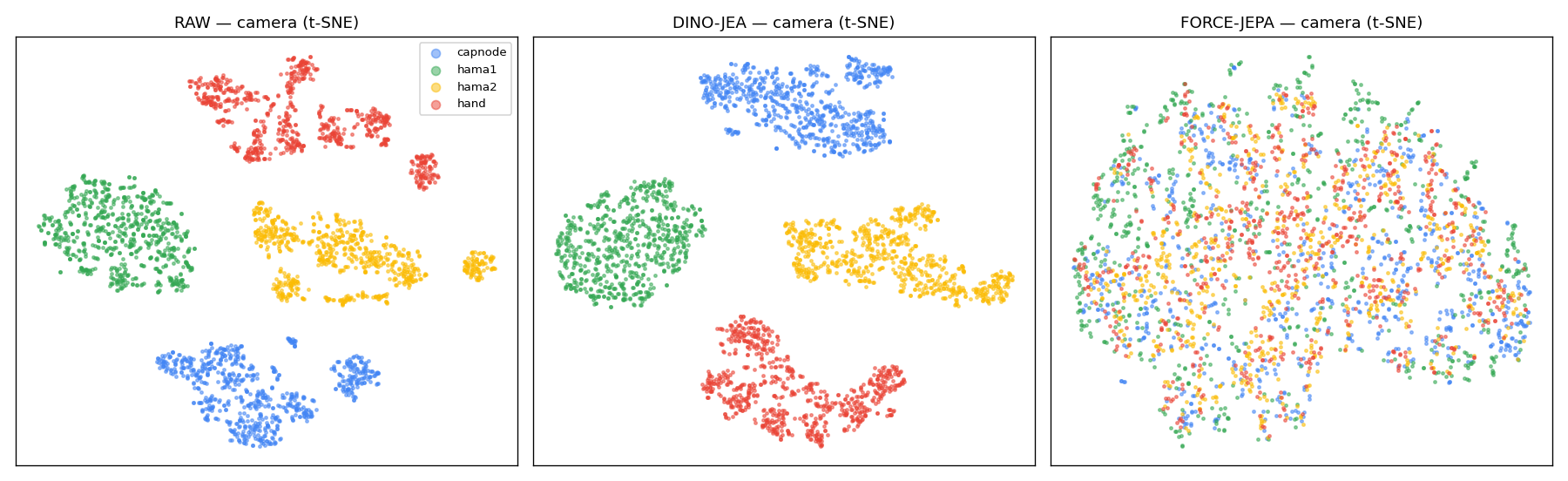
- Raw V-JEPA is camera-separable — viewpoint dominates appearance.
- The force-aligned embed erases camera ID while keeping contact structure.
- Stage 4: per-viewpoint NMI 0.03 (view-invariant) vs dataset NMI 0.58 (kept).
Video keeps appearance · force is robot-agnostic
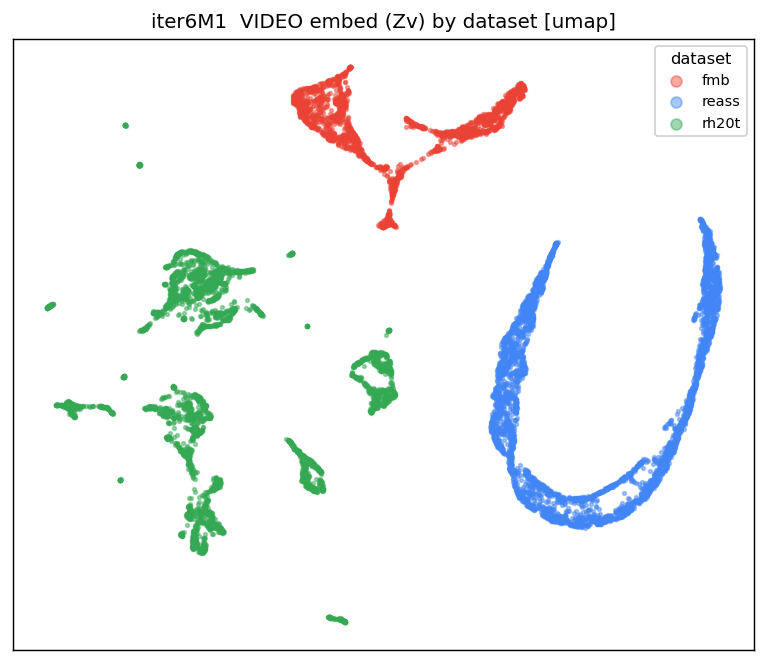
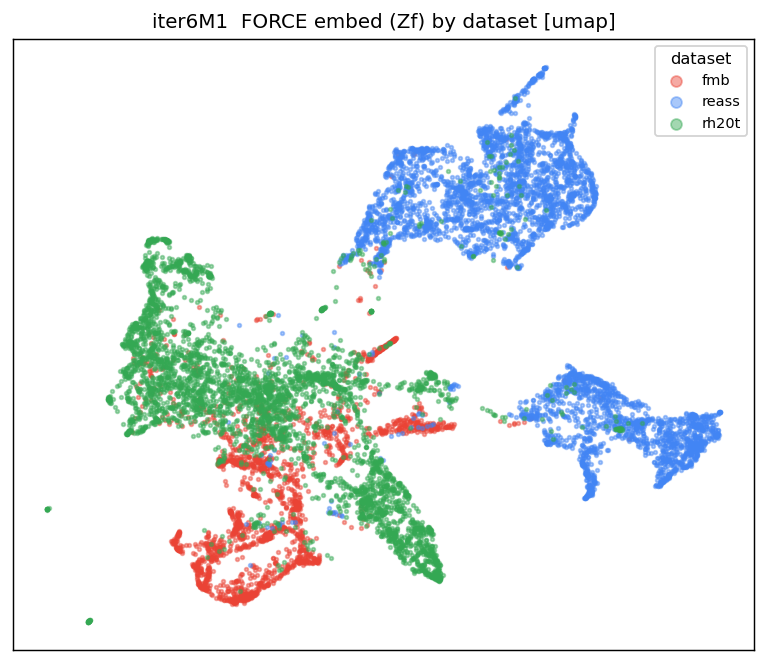
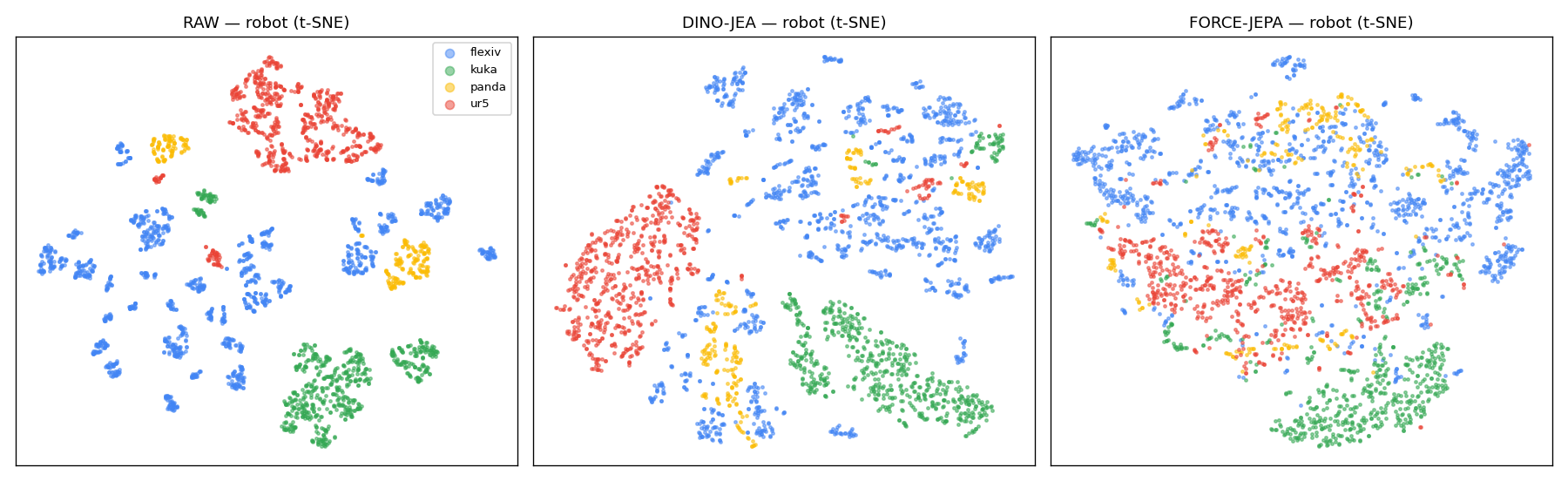
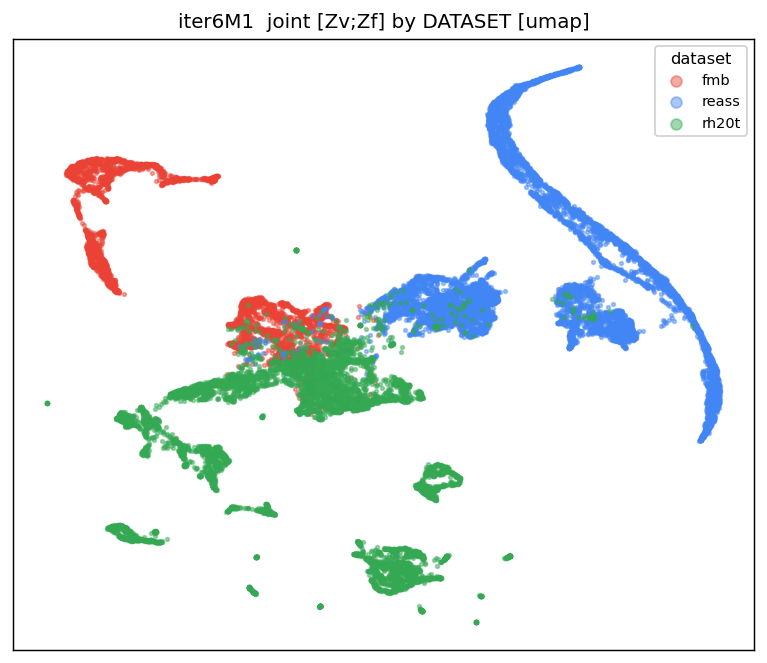
Force is dataset-/robot-agnostic but sensor-signature-bound (residual-kNN ~0.96); video retains lab/appearance on frozen features.
Beyond video→force
what else we asked the representation to do
Three downstream probes on the same features
| probe | question | input → output | best representation |
|---|---|---|---|
| Behaviour cloning | can the visual encoder drive a policy? | embed → action chunk (ACT) | raw V-JEPA |
| Replace vision w/ force | can force stand in for vision? | train on video embed → test on force embed | partial (contact only) |
| Task-type prediction | is the embed task-semantic? | embed → task-ID (RH20T 7-way · insert/release) | ≈ chance from force |
Same frozen V-JEPA / SSL / force embeddings, three new heads. The recurring answer: raw frozen V-JEPA ≥ any SSL re-encoding, and force is a real-but-narrow (contact) signal.
BC with visual encoders — raw V-JEPA wins
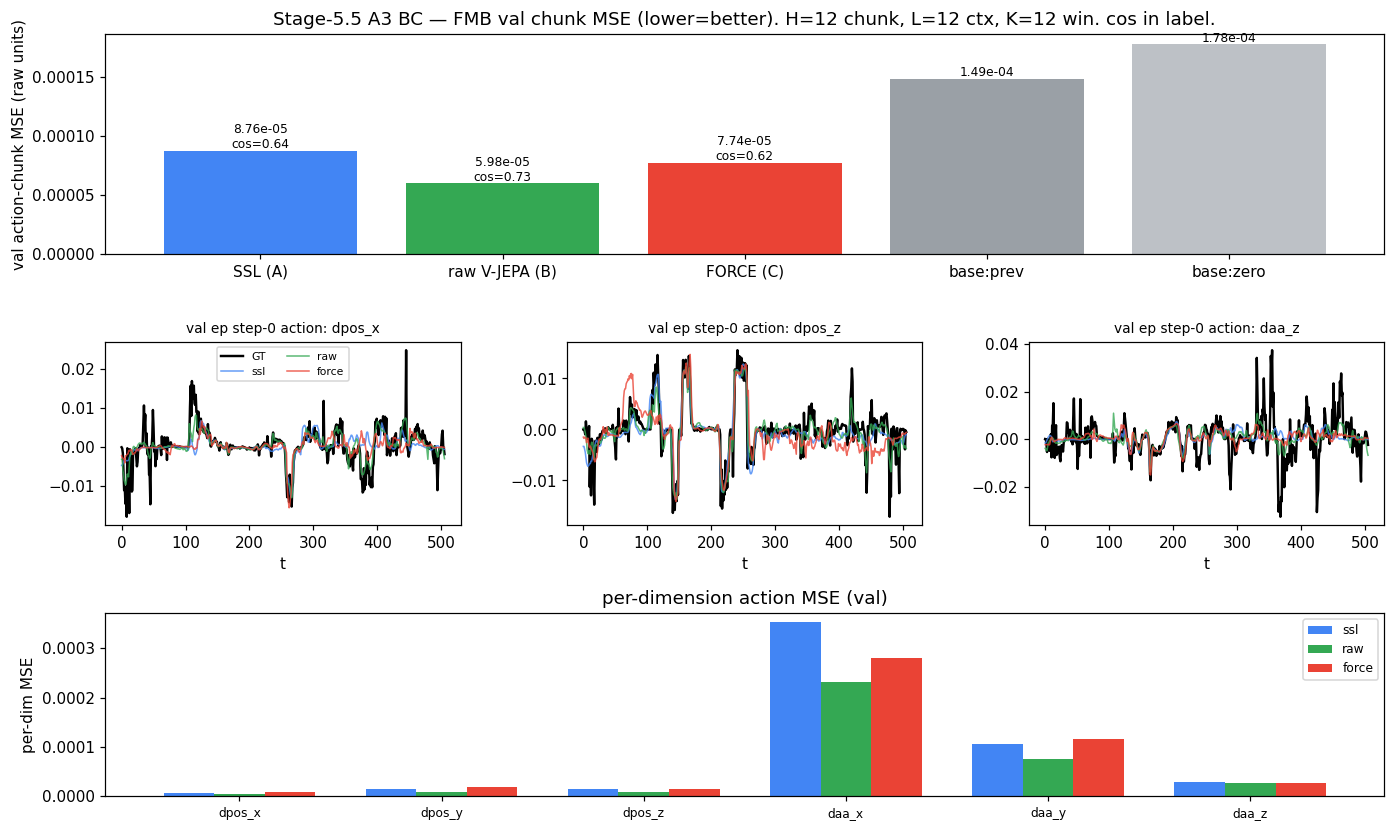
Result
| encoder → action | MSE ↓ |
|---|---|
| raw V-JEPA | 5.98e-5 |
| force encoder | 7.74e-5 |
| SSL embed | 8.76e-5 |
| trivial | — |
- Why raw wins: frozen V-JEPA feats are already action-decodable; the SSL embed re-encodes and loses info.
- Force can drive a policy (beats trivial, ties the SSL video embed) — but ~30% worse than raw.
Replace vision with force? Only for contact.
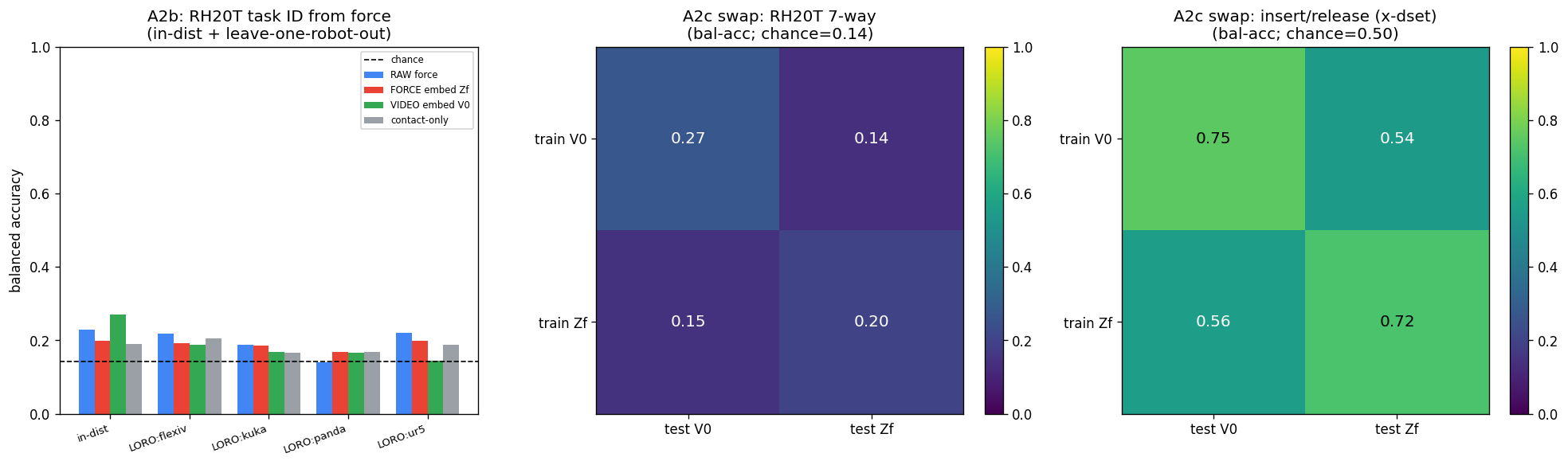
- Replace vision w/ force (train head on video embed → test on force): insert/release swap 0.54 vs within-modal 0.75 → force partially substitutes for contact, not task.
- Task-type prediction: RH20T 7-way from the force embed ≈ chance (0.14–0.27, chance 0.14) — same as a contact-only control.
- Why: force is contact-dominated, not task-semantic; the cross-modal alignment is geometric, so task structure does not transfer across modalities.
Who wins, and why
Where each tool wins
| question | Supervised (trunk + FT) | SSL embedding |
|---|---|---|
| in-dist contact / direction | best | ties raw V-JEPA |
| OOD task (crisp_ws, K-shot FT) | 0.87–0.89 F1 | no extra lift |
| unseen camera (zero target) | 0.28 | 0.70 |
| cross-dataset direction (UDA) | negative | restored (0.40→0.85) |
| robot-agnostic intermix | — | yes (NMI 0.10) |
| new info beyond frozen V-JEPA | none — every embed is a deterministic function of V-JEPA | |
Supervised wins the task; SSL wins cross-domain transfer. Complementary, not competing.
Why — the frozen-feature ceiling
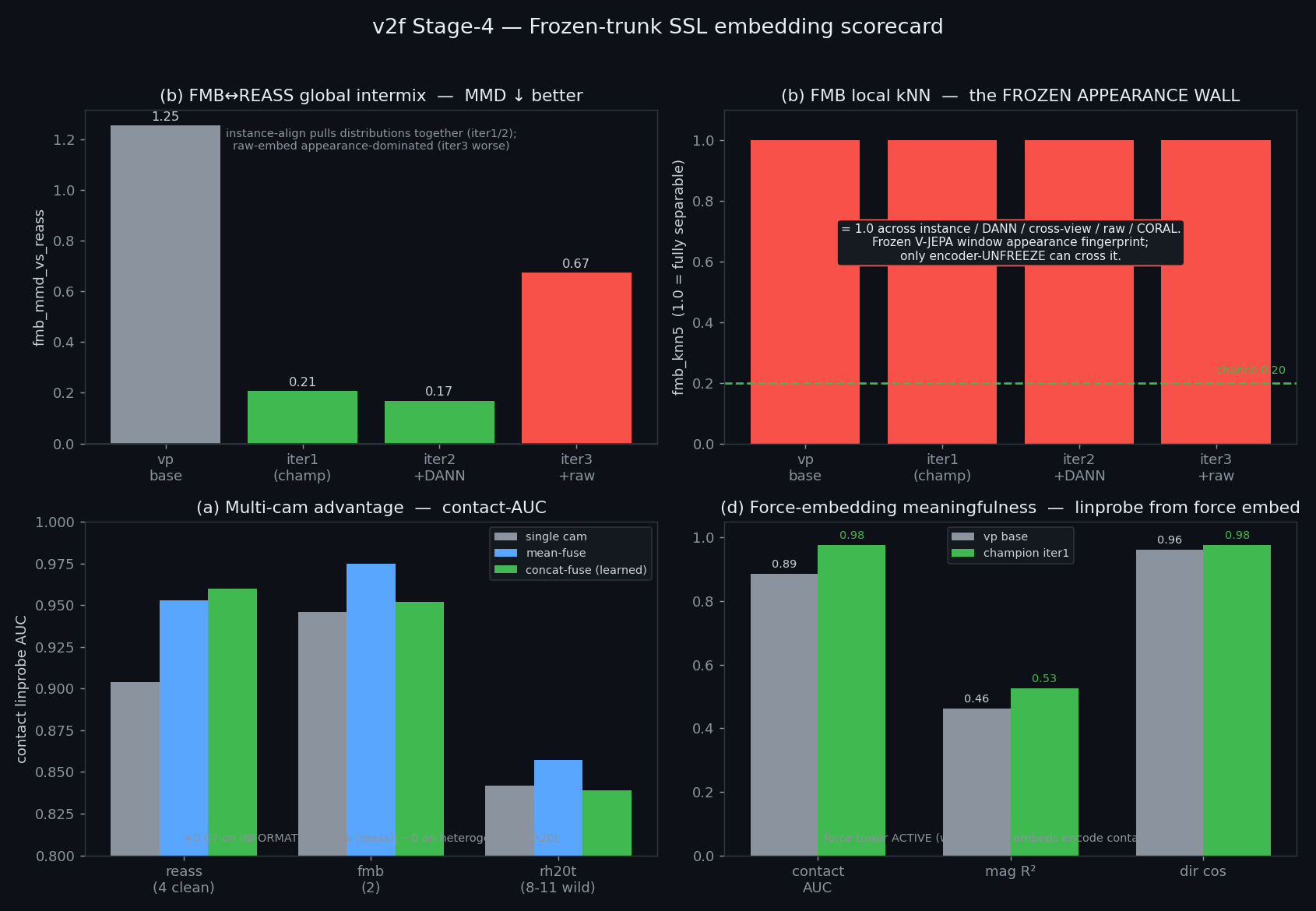
- Every SSL embed is a deterministic function of the frozen encoder → no new information (confirmed 3 ways: pooled-align, augment, temporal).
- Alignment bought geometry (CKA 0.51), not shared task structure (the swap ≈ chance — §⑥).
- Force is real but sensor-signature-bound; contact is the one shared axis (AUC ~0.97).
- The only step-change left = unfreeze the encoder (LoRA). Current work: Stage 5.6 binds force → frozen V-JEPA to test exactly this boundary.
Synthesis
What works
- Contact from video — yes, every dataset (H1 ✓).
- Direction — yes where force is clean (H2 ✓).
- OOD — supervised pretrain + few-shot FT reaches the in-domain ceiling.
- SSL — earns its keep on cross-domain transfer (camera / robot / dataset invariance).
- Downstream probes — raw V-JEPA drives BC best; force can substitute for vision only on contact, not task.
What's bounded
- Magnitude — residual wall.
- Frozen-feature ceiling — SSL adds no info beyond V-JEPA.
- Geometric alignment ≠ semantic sharing.
- Next lever: encoder unfreeze (LoRA) + force→frozen-V binding (Stage 5.6).
Detail per stage in the hosted reports: /report/v2f-stage1 … stage5 · stage5-findings.md. Appendix ↓.
Appendix
extra plots · latent diagnostics · SSL alternatives
Aligned and diverse — not collapsed
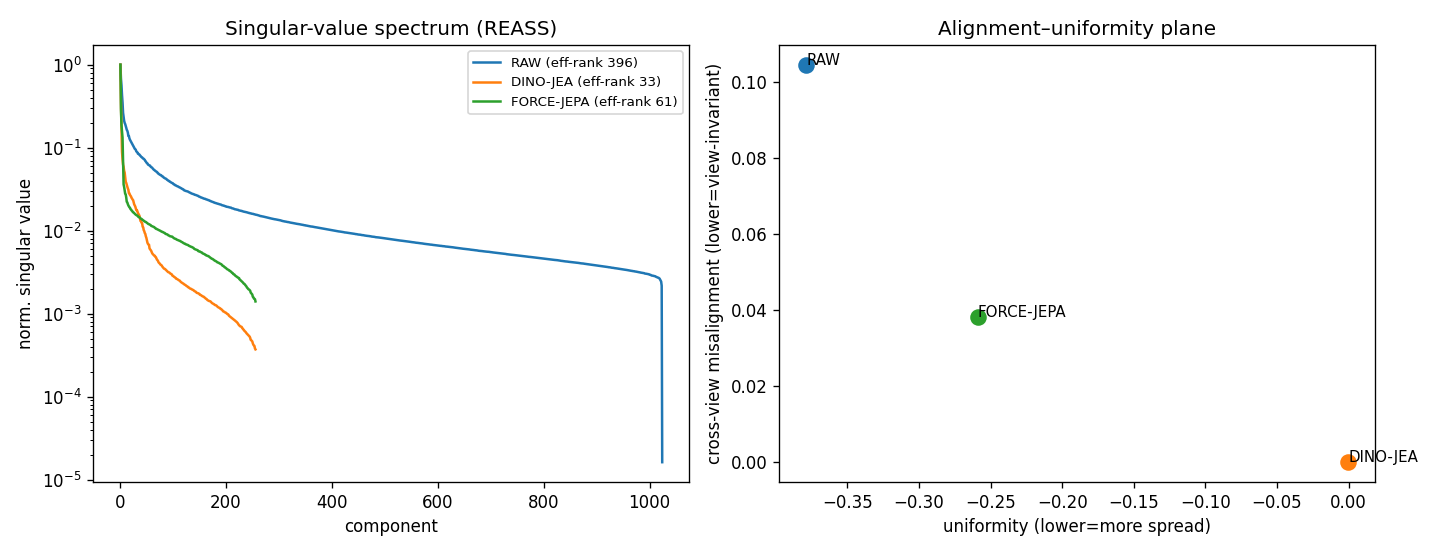
| embed | eff-rank |
|---|---|
| raw V-JEPA | 396 |
| DINO-JEA (naïve) | 33 — collapse |
| Force-aligned (ours) | 61 |
“Alignment without diversity is a lie” → every invariance claim paired with a collapse check. Stage 2 fixed PR 1.5→49.
Supervised rollouts — best / worst
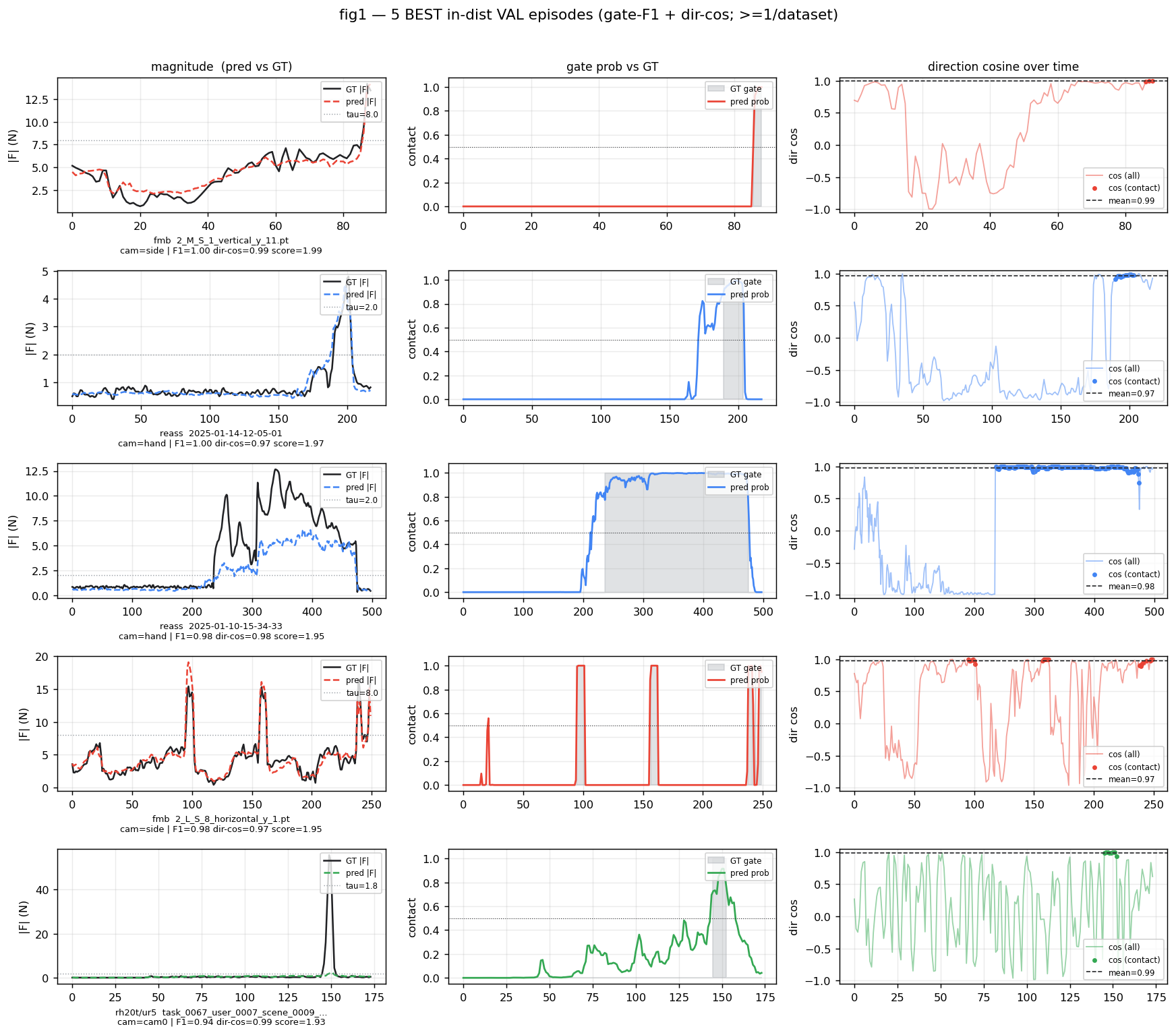
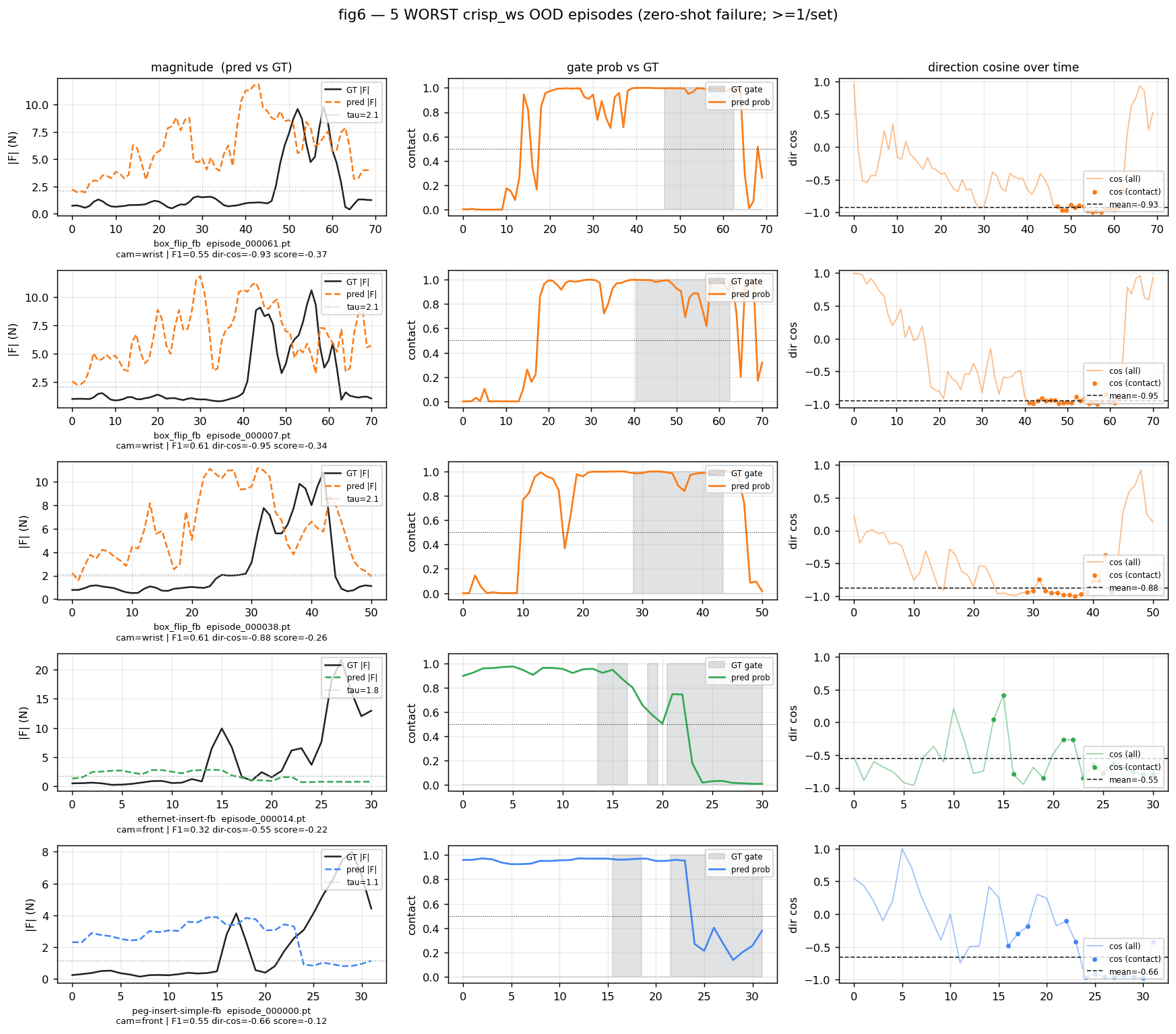
OOD domain gap in the latent
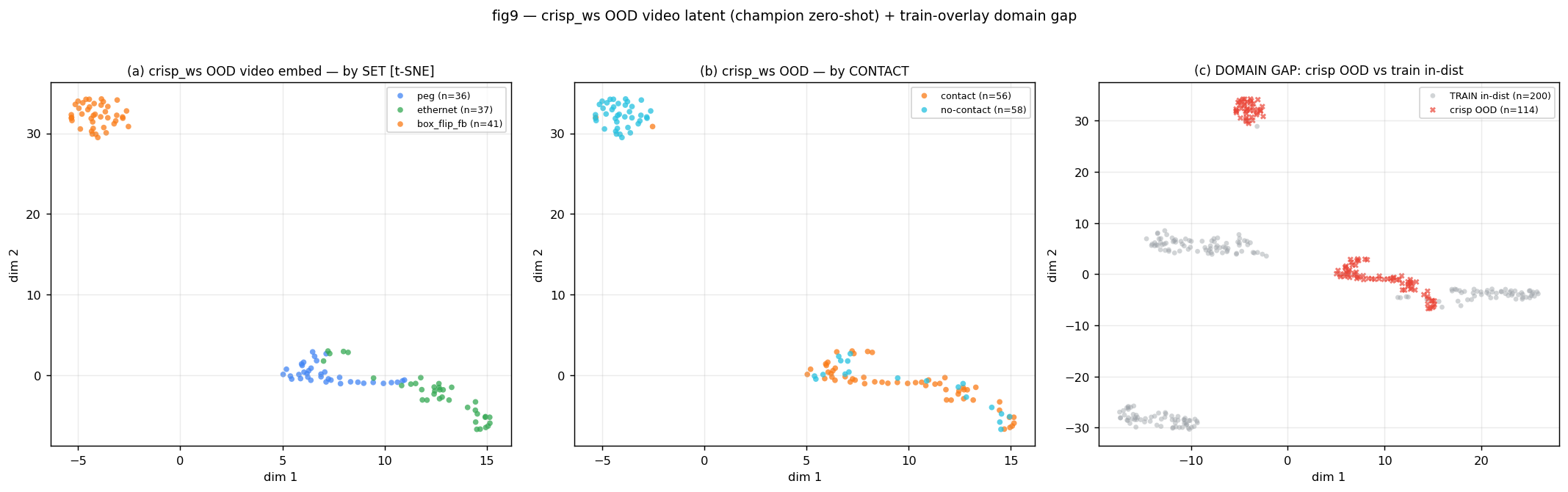
Train-on-crisp (in-domain) hits gate-F1 ≈ 0.90 on every cell, including the front-cam that collapses zero-shot → the features carry the info; the failure is domain shift, addressable by target adaptation.
Collapse, cured
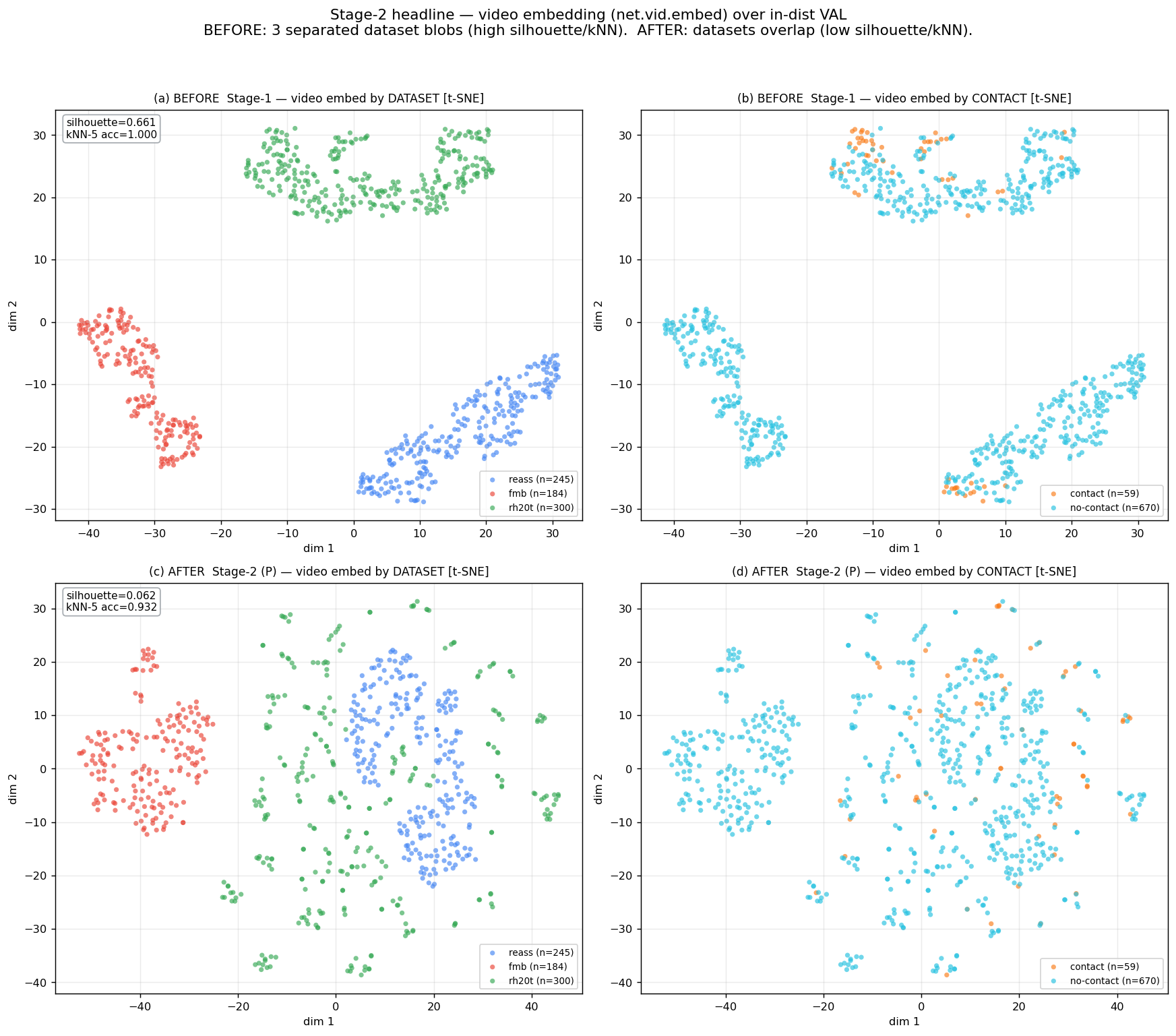
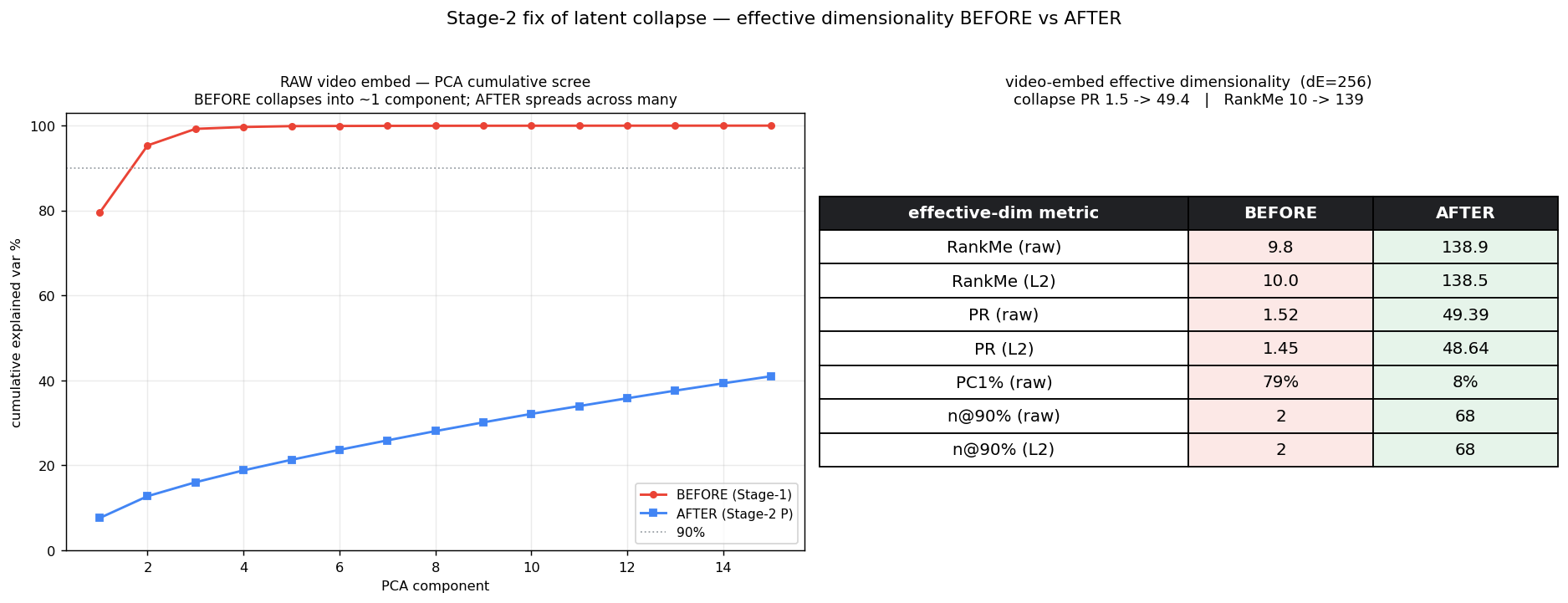
Is the force embedding trivial? No.
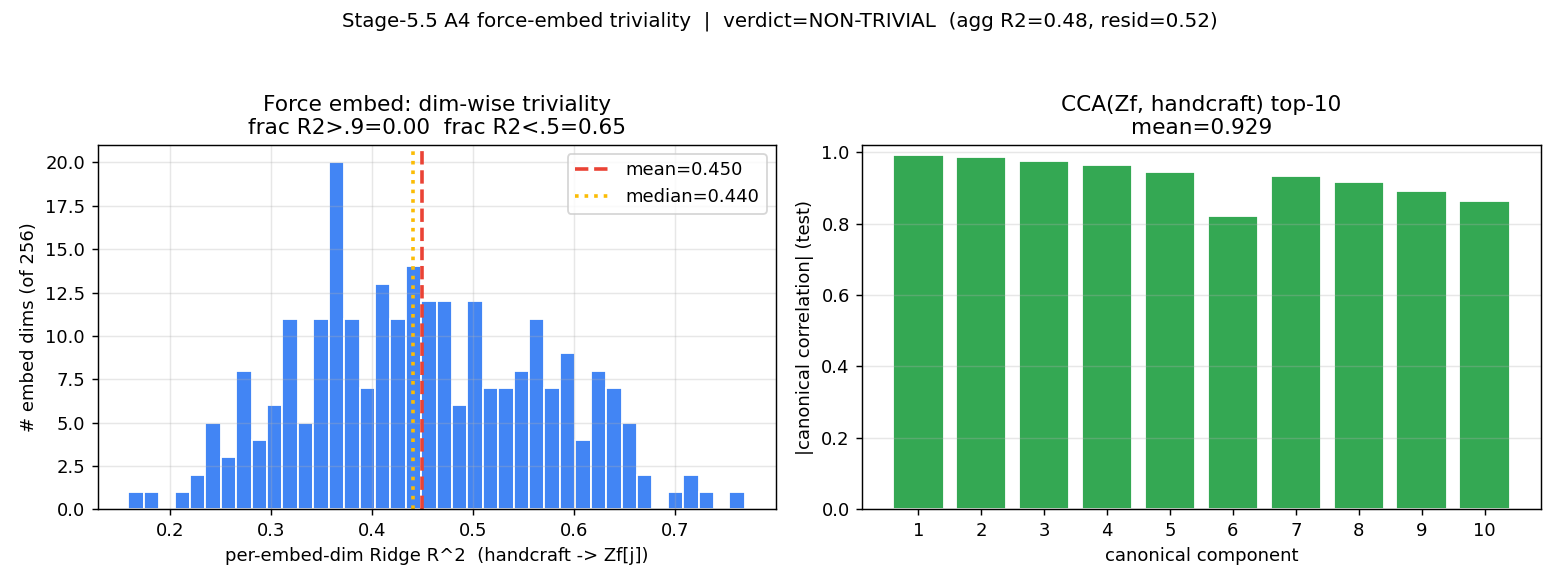
- 52% of variance unexplained by 181 hand-crafted features.
- Contact-presence AUC ~0.97 — the dominant axis.
- But it does not intermix across sensors on frozen features.
SSL alternatives we ruled out
| tried | outcome |
|---|---|
| vision-only JEPA | ruled out — label-bound F1 |
| Force-JEPA / F-SSL (force-only) | narrow cross-robot win; no in-dist edge |
| squared-L2 / VICReg-MSE bind | collapses (rank→2) |
| MixStyle / Fahim x-uniformity | hurts alignment |
| temporal binding (per-frame) | non-redundant but no v2f gain |
| x-modal force augment (concat) | OOD camera 0.28→0.70 · cross-dataset dir restored |
Full record: /report/v2f-stage5-findings.md.