Video → Force
Recovering the missing contact modality from vision · feasibility synthesis
Six questions, one thread
Thread: supervised wins the task in-domain; self-supervision wins cross-domain transfer.
The missing modality
- Data factories collect enormous visuomotor datasets — and vision will stay the dominant way manipulation data is gathered.
- Almost all of it is vision-only — no haptics, no force/torque.
- Yet contact force is what makes contact-rich tasks work: assembly, insertion, handling.
- Idea: generate the missing force modality from the video itself.
What we set out to predict
Can a model read contact off a video?
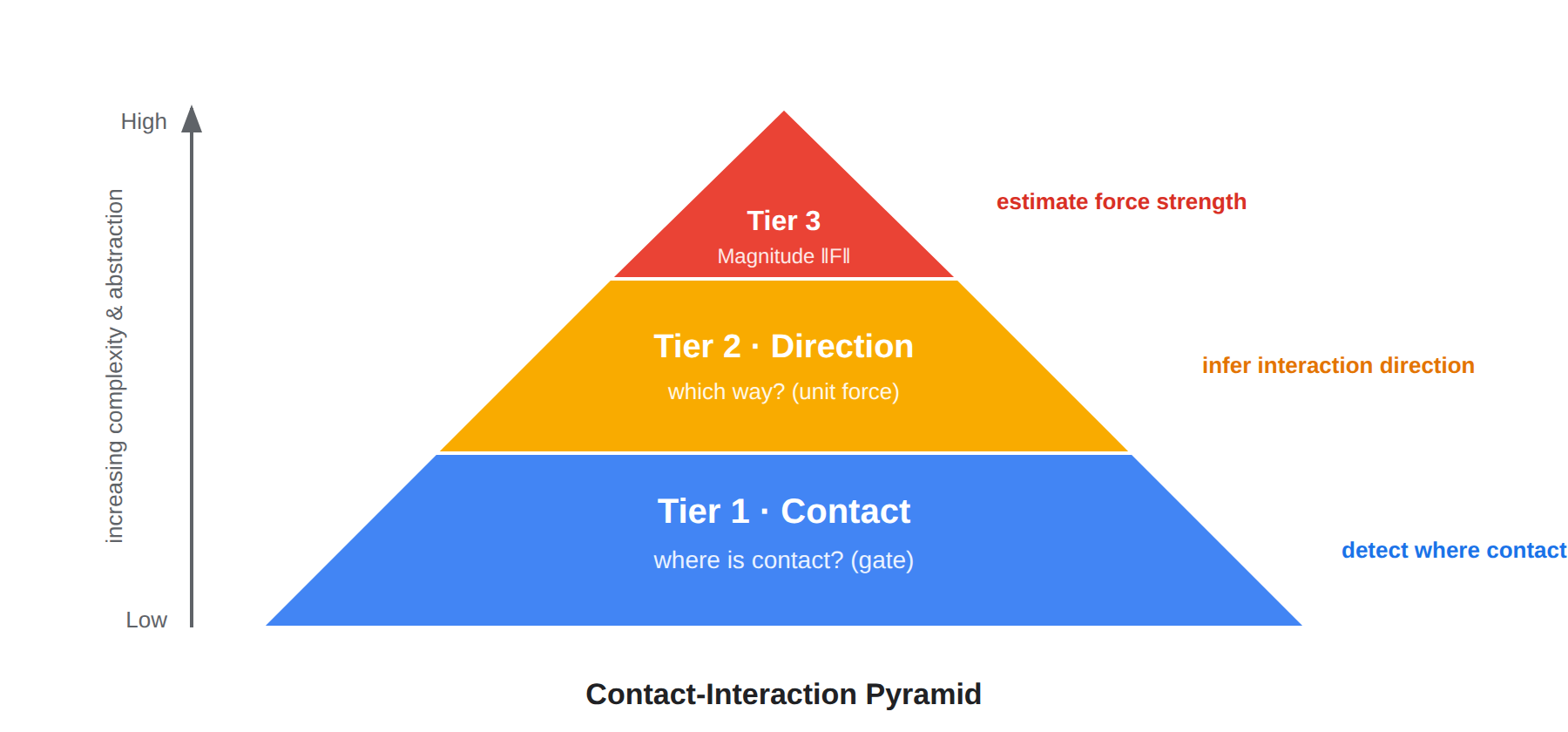
- Contact event — when something touches (gate).
- Direction — which way the force pushes (unit vector).
- Magnitude — how hard (Newtons).
Constraints
Inference is video-only (no proprioception at test time). Force is post-processing — acausal allowed. Frozen V-JEPA encoder throughout.
The data is already there
| dataset | task | cams | force |
|---|---|---|---|
| FMB | peg / board insertion | 2–4 ext | wrist F/T, biased |
| REASSEMBLE | NIST board insert/remove | 4 | clean <1 N |
| RH20T | 147 tasks · 4 robots | 8–11 | base-frame, mixed |
| ours (crisp_ws) | 3 contact tasks | front + wrist | clean, sensor-frame |
≈16.8k rollouts · ~178 h · ~6.4M frames — ≈ 14× Meta's haptic corpus. Public, abundant, mostly unused.
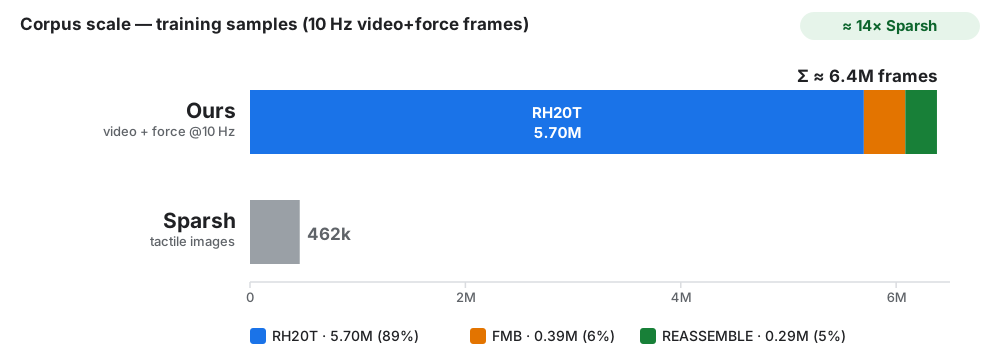
Three public sources
Our own dataset — 3 contact tasks, ~90–100 demos each
In-lab, clean bias-removed sensor-frame force (NetFT, server-published). Held-out validation set for OOD / cross-lab transfer.
Force/torque sampling — harmonized to 10 Hz
| dataset | sensor rate | stored | frame | contact τ |
|---|---|---|---|---|
| FMB | 10 Hz (observer est.) | 10 Hz | EE | ~10 N |
| REASSEMBLE | ~500 Hz | 10 Hz (LP-filt) | base→EE | 2 N |
| RH20T | 100 Hz | 10 Hz (unfilt) | base / world | per-robot ~1.5–3 N |
| ours | 250 Hz | 10 Hz | sensor→TCP→world | 3.65 N |
Why 10 Hz
All forces resampled to 10 Hz to match the V-JEPA RGB frame rate. After downsampling, the residual walls are label quality (FMB bias) and per-robot τ heterogeneity (RH20T) — not sample rate.
Two ways to learn it
Supervised — force labels → TCN
- Best in-domain: directly fits contact / direction / magnitude.
- Scales poorly OOD: new lab / camera / robot → drops hard, direction can invert.
- Needs force labels for every target domain.
Self-supervised — align video ↔ force latent
- No task labels; learns a shared video–force representation.
- Generalizes OOD much better: robot-/camera-agnostic, restores cross-dataset direction.
- Ties — not beats — supervised in-domain.
Verdict preview: complementary — supervised owns the in-domain ceiling, SSL owns the transfer gap.
Self-supervision — three families
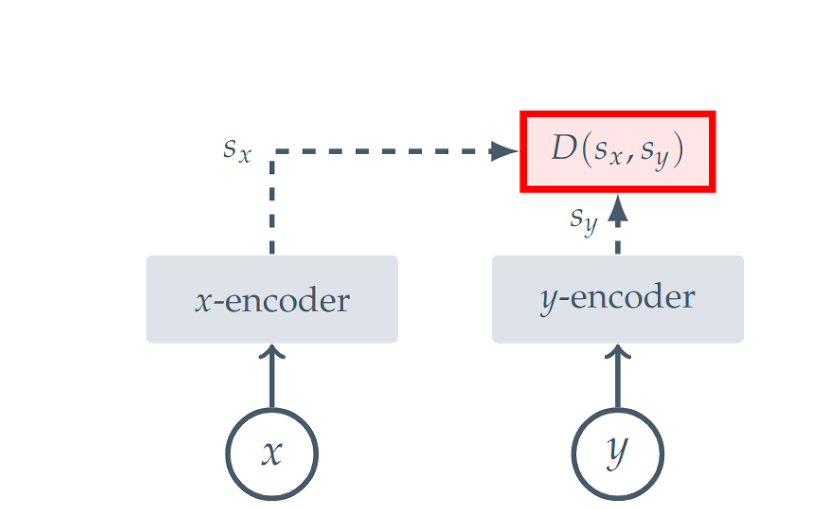
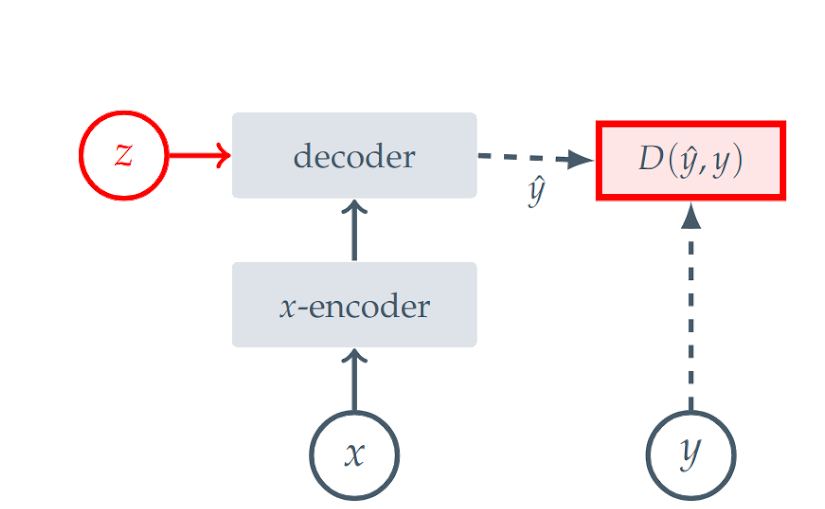
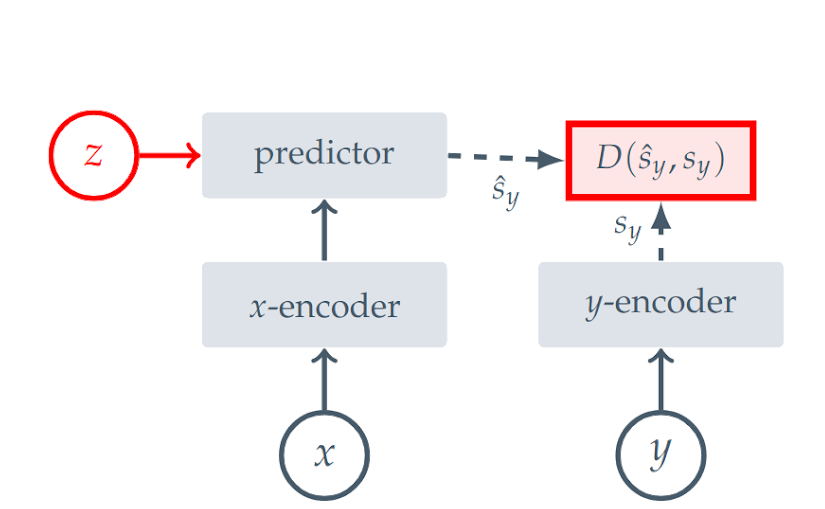
X = video (context), Y = force (target), Z = latent. We keep the frozen V-JEPA video encoder and learn a force / alignment head on top.
Frozen V-JEPA → dilated TCN → 3 heads
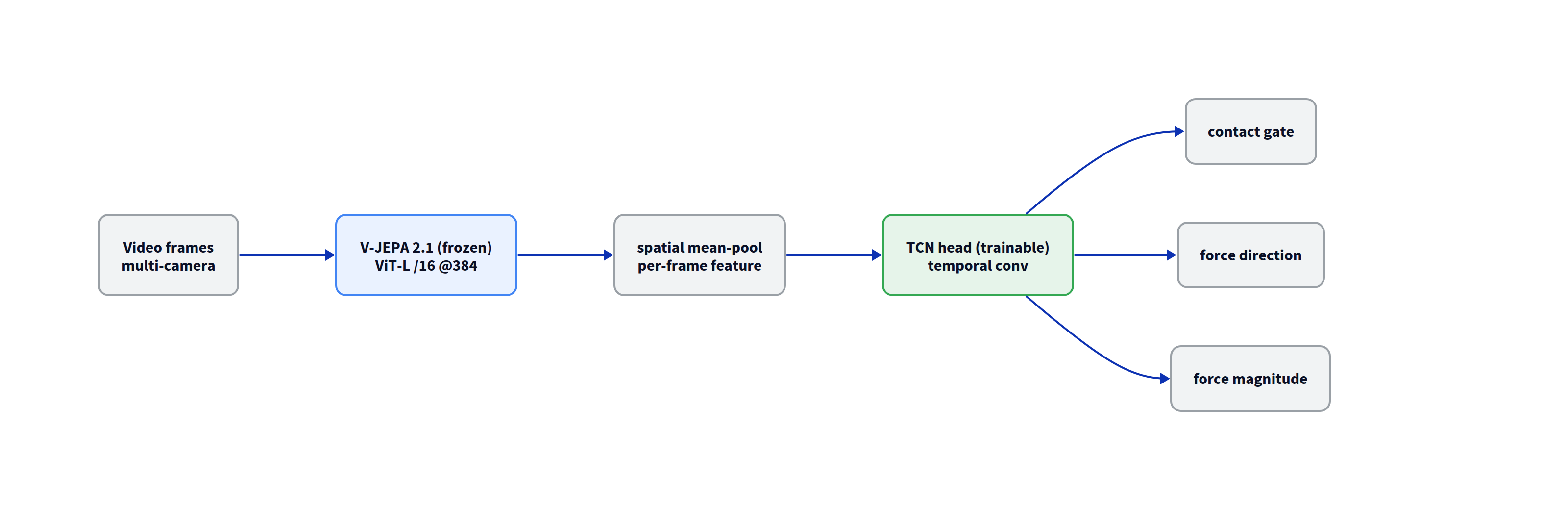
- Encoder: V-JEPA 2.1 ViT-L/16@384, frozen, mean-pool → 1024-d/cam.
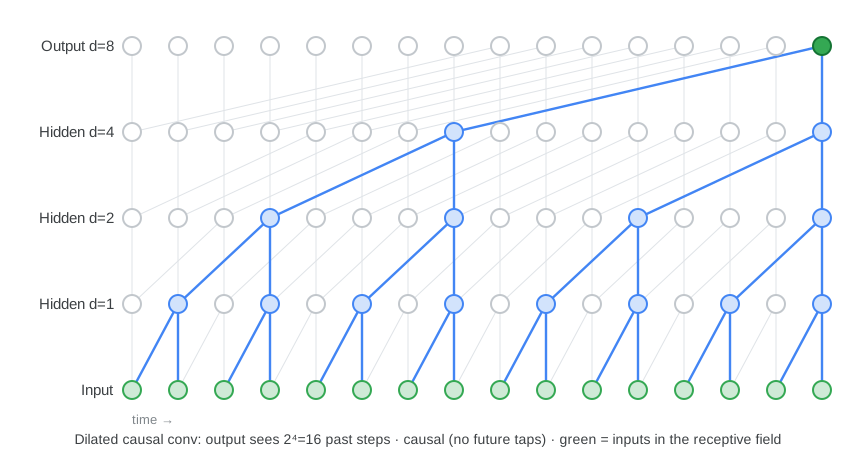
- Trunk: dilated TCN, 7 blocks (dil 1→64), hid 384 — causal, cheap.
- Heads: gate (BCE) · direction (cos) · magnitude (smooth-L1).
- Multi-cam view-attention fuser.
- Dilation 1·2·4·…·64 → a window sees 2⁶ past steps.
In-distribution ceiling — contact & direction work
| dataset | gate-F1 | raw cos-dir (+lift) | mag MAE (N) |
|---|---|---|---|
| REASSEMBLE | 0.86 | 0.91 (+0.34) | 1.6 |
| FMB | 0.78 | 0.97 (+0.02) | 2.8 |
| RH20T | 0.63 | 0.39 (+0.27) | 5.4 |
| ours · peg-insert | 0.90 | 0.83 (+0.02) | 2.4 |
| ours · ethernet-insert | 0.91 | 0.93 (+0.00) | 2.4 |
| ours · box-flip | 0.91 | 0.97 (+0.08) | 2.4 |
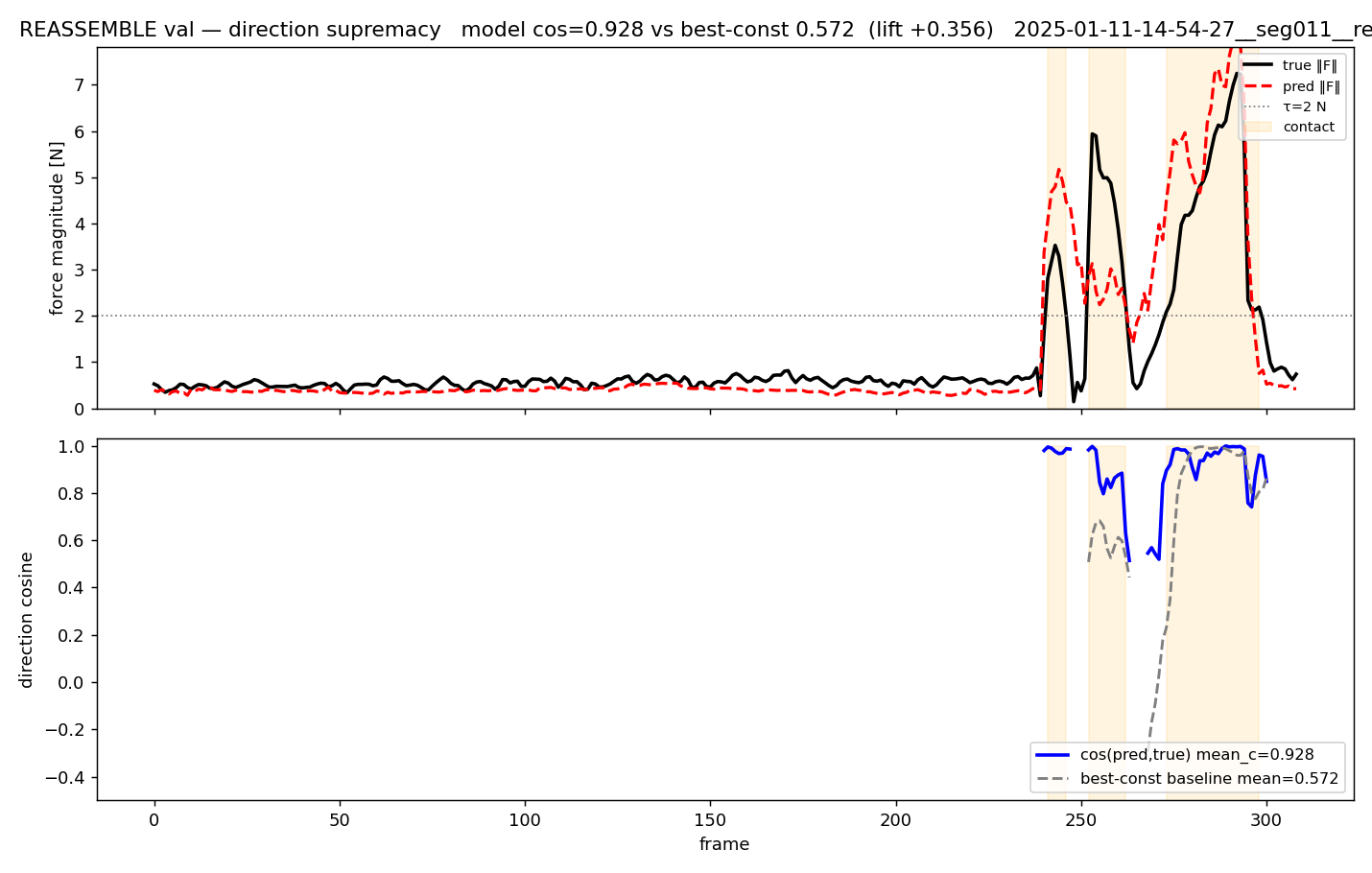
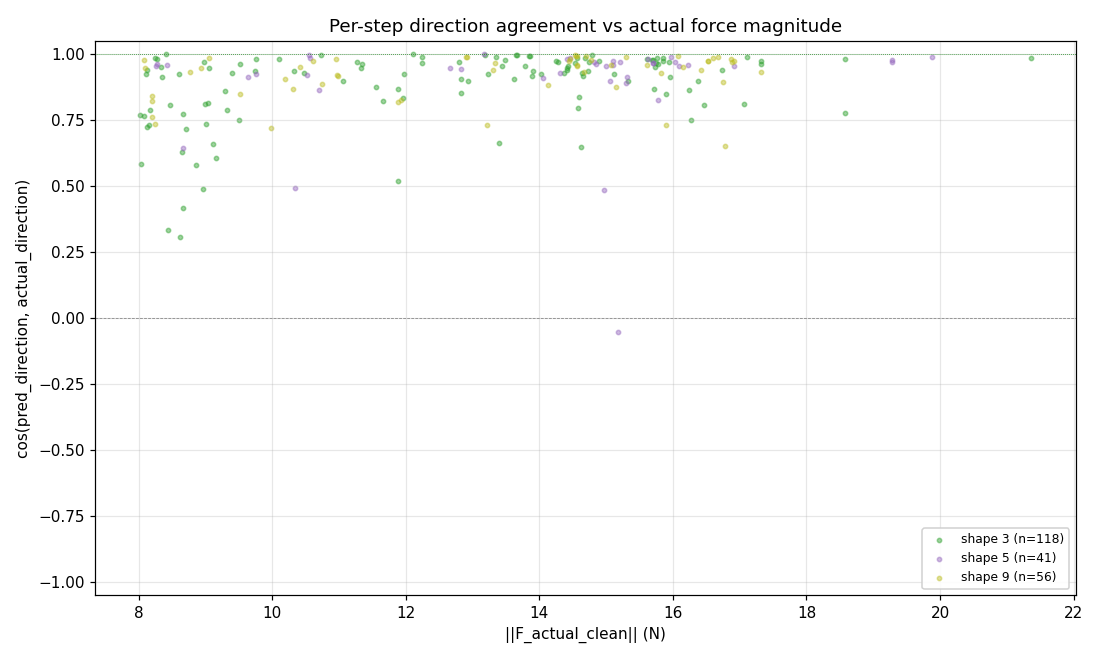
H1 (contact) ✓ across all. H2 (direction) ✓ where force is clean (REASSEMBLE, box-flip). FMB + peg/ethernet direction is near-trivial (axial / biased +Z); magnitude is the residual wall.
Contact prediction on FMB
Predicted contact gate overlaid on an FMB insertion rollout — the model fires exactly when the peg meets the board.
- Contact is the cleanest signal even when FMB force magnitude is biased.
- Gate-F1 ≈ 0.78 at τ≈10 N (force-histogram valley).
- Video-only inference — no proprioception.
Out-of-distribution — zero-shot transfer breaks
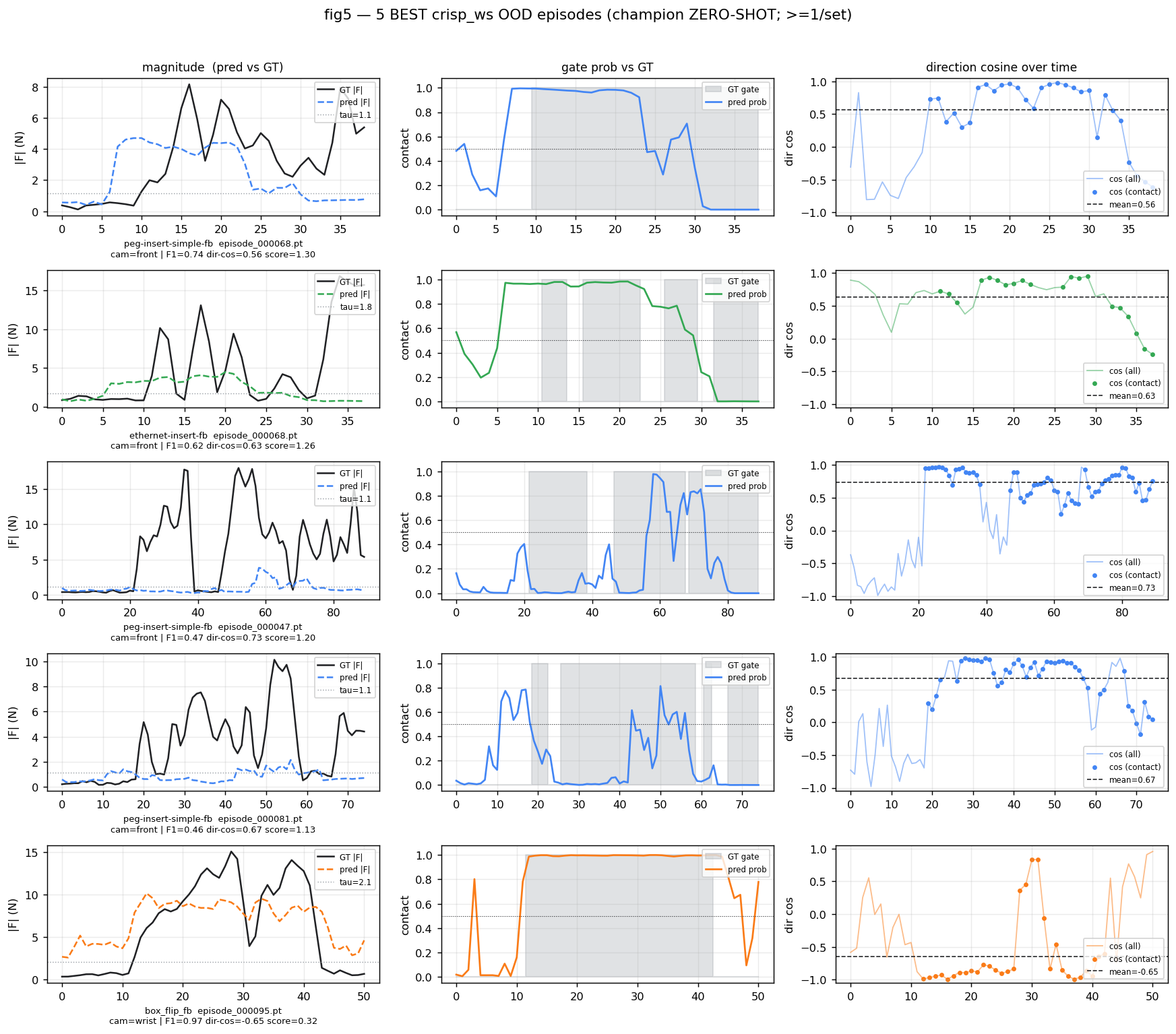
- Direction inverts (raw cos, zero-shot → after K-shot FT): box-flip −0.74 → 0.97; peg −0.33 → 0.83; ethernet +0.39 → 0.93.
- Front-cam contact collapses: 0.86 → 0.39–0.43 (viewpoint extrapolation).
- Magnitude scale mismatch: MAE 1.6–2.8 → 4.8–7.6 N (per-dataset τ).
- Adaptation recovers: K≈20–60 target demos + multi-cam → pretrained-OOD ≥ from-scratch in-domain.
The encoder is not the lever
- Frozen V-JEPA-L + dilated TCN + 3-head + mean-pool = best frozen recipe.
- Bigger / different frozen backbones cap at the same ceiling (F1 ≈ 0.78 FMB).
- Ceiling is label- / sensor-bound, not capacity-bound.
- Direction is frame- & viewpoint-locked → multi-cam + frame-unification matter most.
What we trained — and is it collapsed?
Train: REASSEMBLE + FMB + RH20T (jointly). Eval: in-dist val + our held-out crisp_ws.
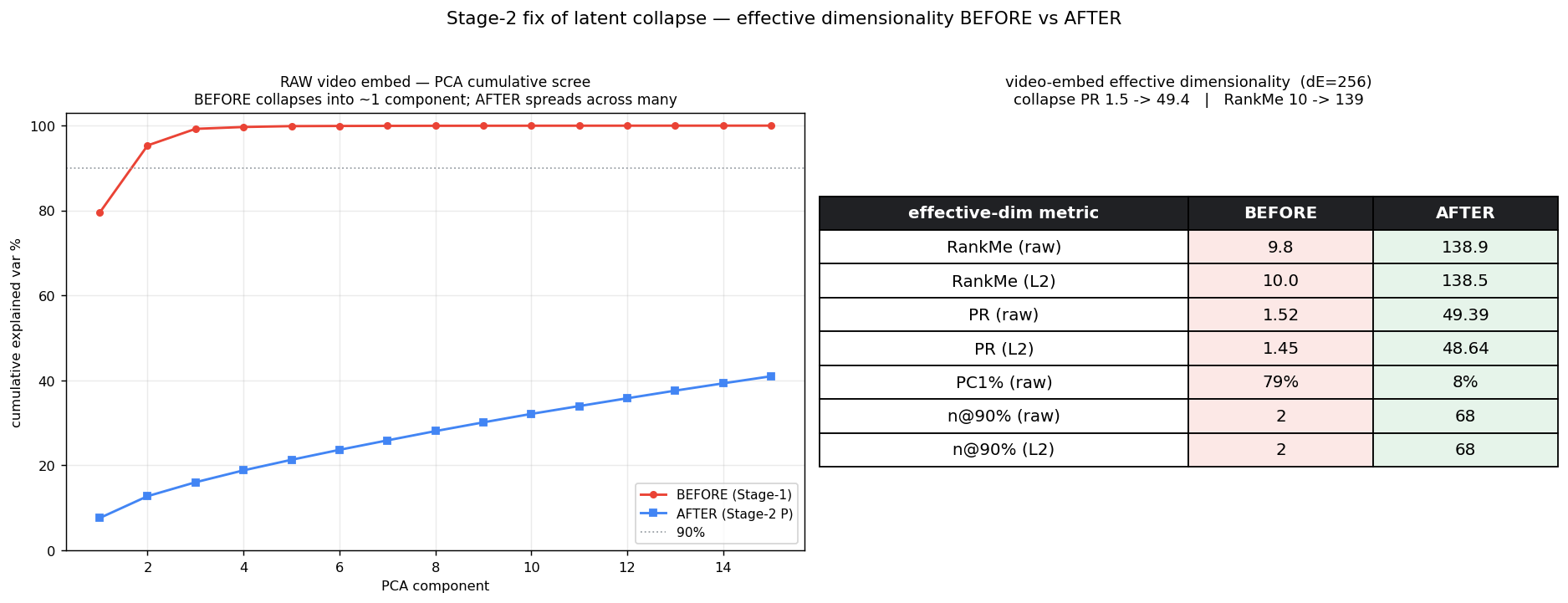
| embedding | RankMe (eff. rank) | verdict |
|---|---|---|
| raw V-JEPA (video) | 396 | full |
| naïve DINO align | 33 | collapsed |
| Stage-1 joint | 9.8 | near 1-D |
| Stage-2 (ours) | 139 | fixed |
| force tower (ours) | 51 | active |
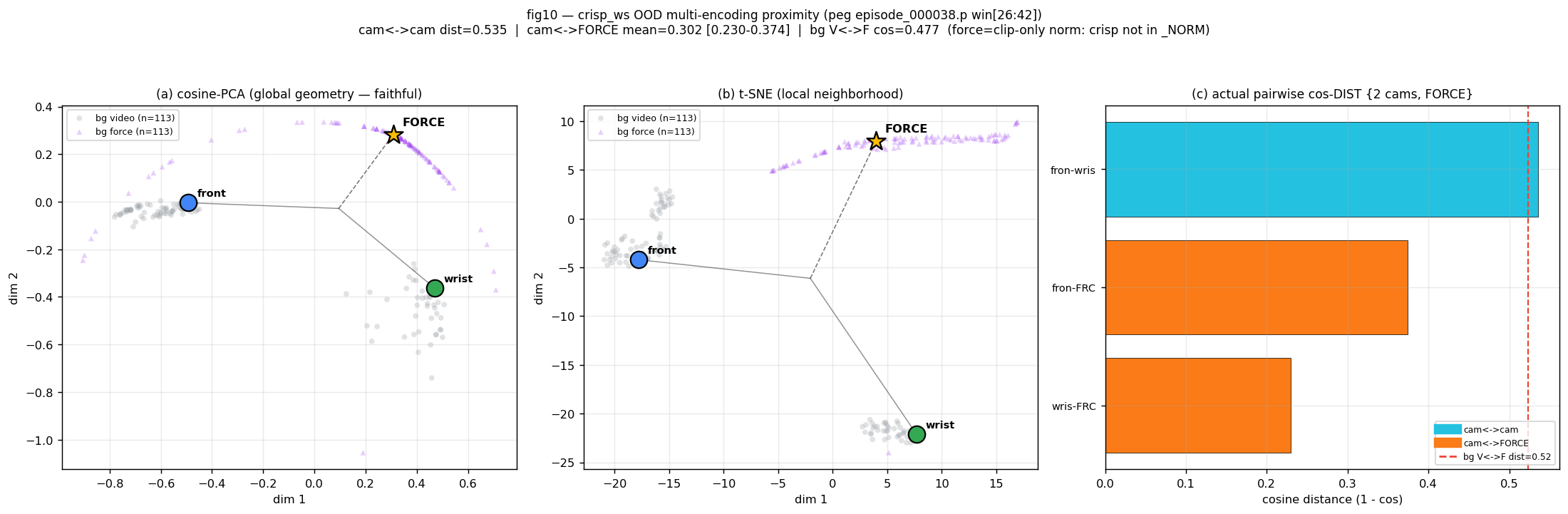
The latent forgets the camera and the robot
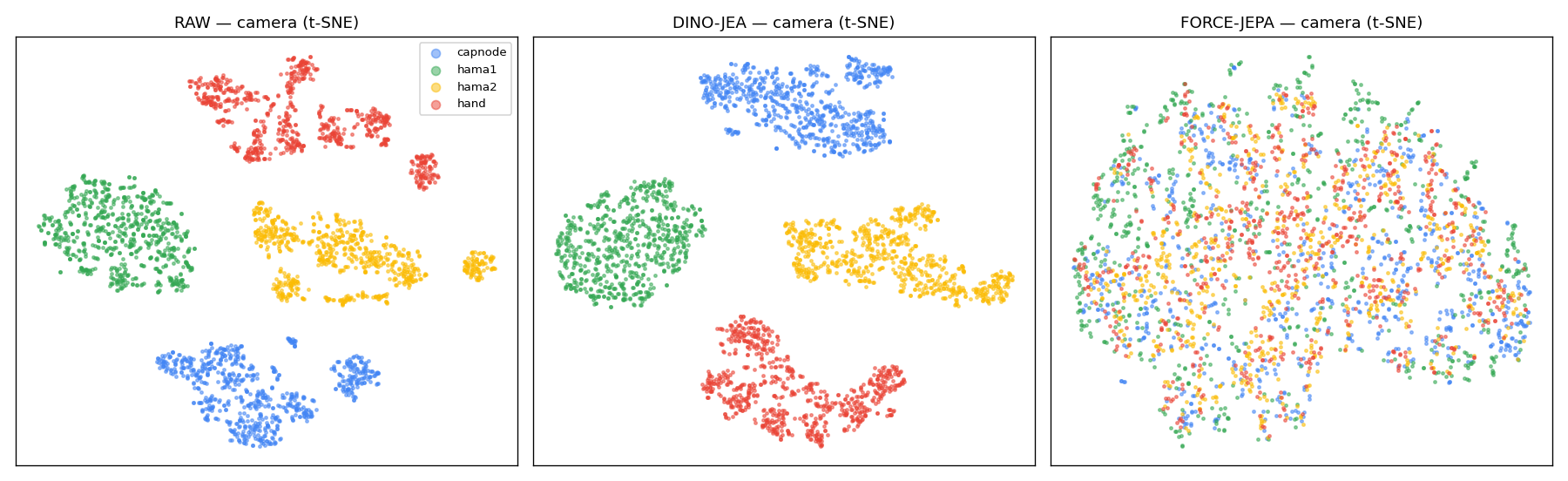
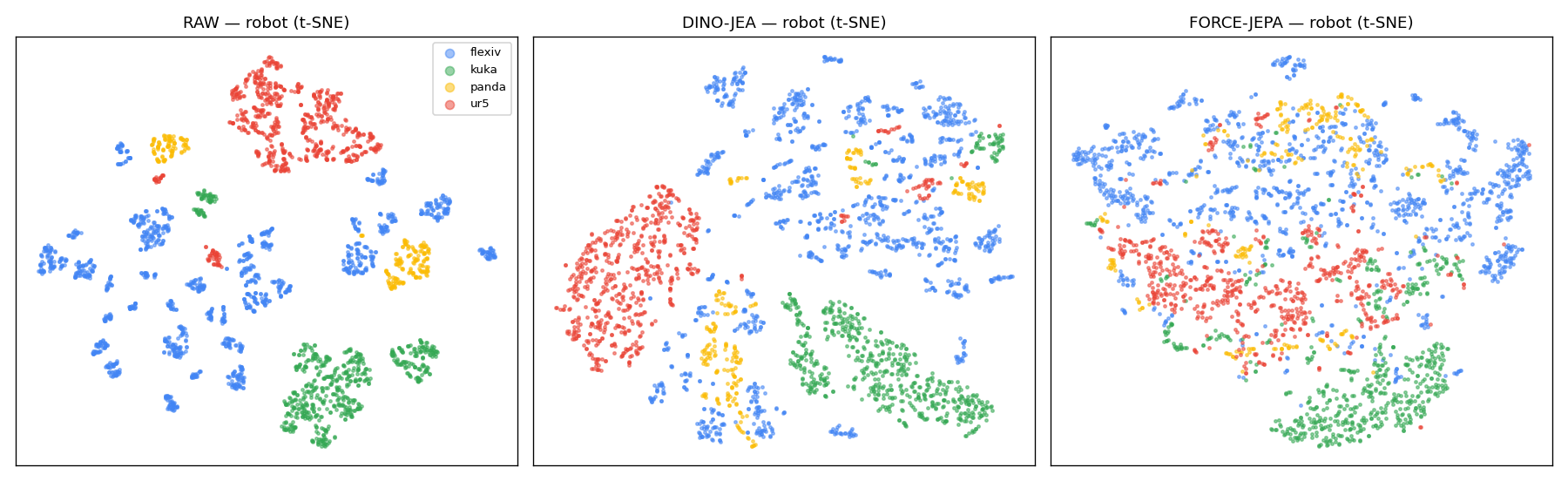
Viewpoint and embodiment — the two things that break supervised OOD — are exactly what the SSL embed discards.
Force embeddings — binding video to force
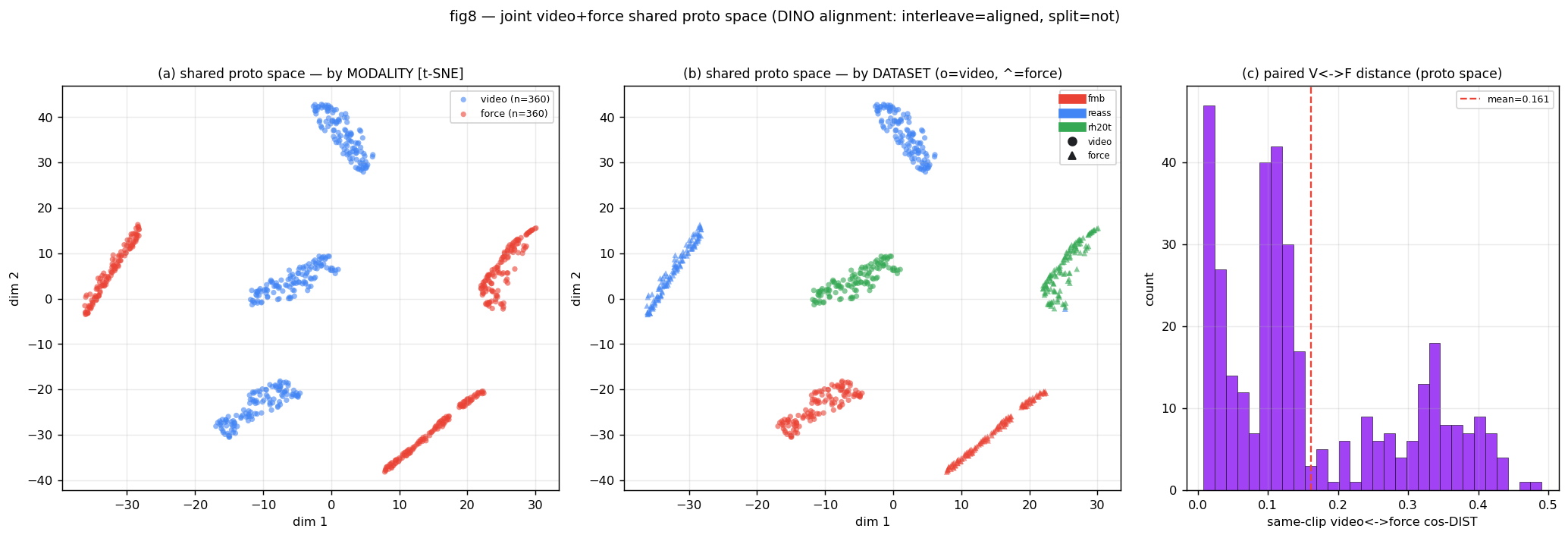
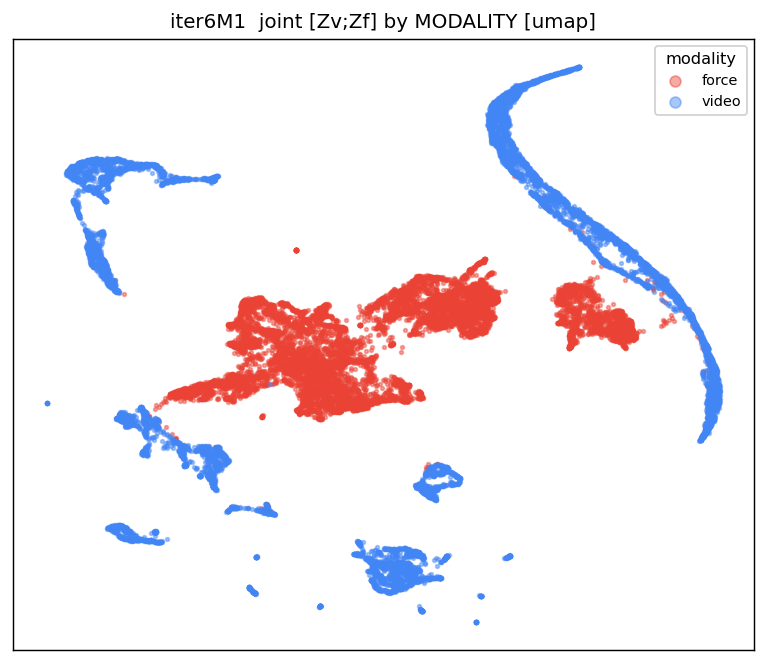
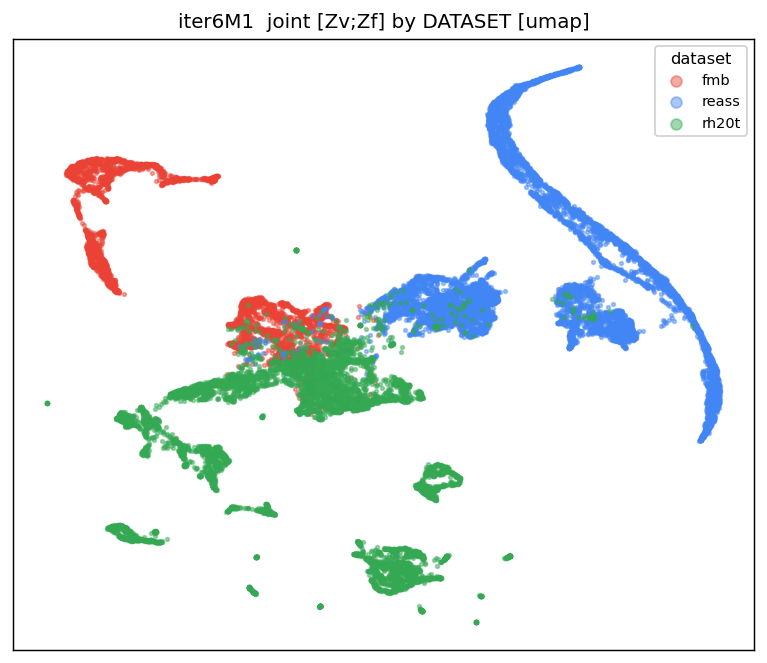
A trainable force tower (RankMe 51, active not collapsed) is pulled onto the frozen video latent. Naïve cosine is offset-blind; centering the common mode + covariance-matching converts a fake alignment into a real one. The force embedding is non-trivial — it carries contact structure beyond hand-crafted force features.
Video→force with SSL — where it pays off
| setting | raw V-JEPA | + force-aligned embed |
|---|---|---|
| in-distribution contact / direction | best | ties (no lift) |
| held-out camera — contact F1 | 0.28 | 0.70 |
| cross-dataset direction · REASS→FMB | 0.41 | 0.87 |
| cross-dataset direction · FMB→REASS | 0.40 | 0.83 |
Augment, don't replace: concat[ raw V-JEPA ‖ force-aligned embed ] → TCN. Zero in-distribution cost; large OOD / cross-domain gains — unseen camera (F1 0.28→0.70) and cross-dataset direction (UDA, 0.40→0.87 both ways).
Supervised vs self-supervised — complementary
| question | supervised (trunk + FT) | SSL embedding |
|---|---|---|
| in-dist contact / direction | best | ties raw V-JEPA |
| OOD task (our data, K-shot FT) | 0.87–0.91 F1 | no extra lift |
| unseen camera (zero target) | 0.28 | 0.70 |
| cross-dataset direction (UDA) | negative | restored 0.40→0.85 |
| robot-agnostic intermix | — | yes |
Supervised wins the task; SSL wins cross-domain transfer. The frozen-feature ceiling is the next lever — encoder unfreeze.
Takeaways
- Force is recoverable from video — contact ✓ everywhere, direction ✓ where force is clean.
- The data exists at scale (≈14× Meta's haptic corpus) and is mostly unused.
- Supervised sets the in-domain ceiling; self-supervision closes the OOD gap — camera-/robot-agnostic, restores cross-lab direction.
- Quality, honestly measured: RankMe (no collapse) + UMAP/t-SNE (true intermix).
- Next: unfreeze the encoder — the frozen ceiling is the last wall.