Sinew
Teaching machines to feel — from ordinary video
Ivan Domrachev · Sinew · 2026 · technical report prepared for D2SF · → chapters · ↓ detail
The missing sense
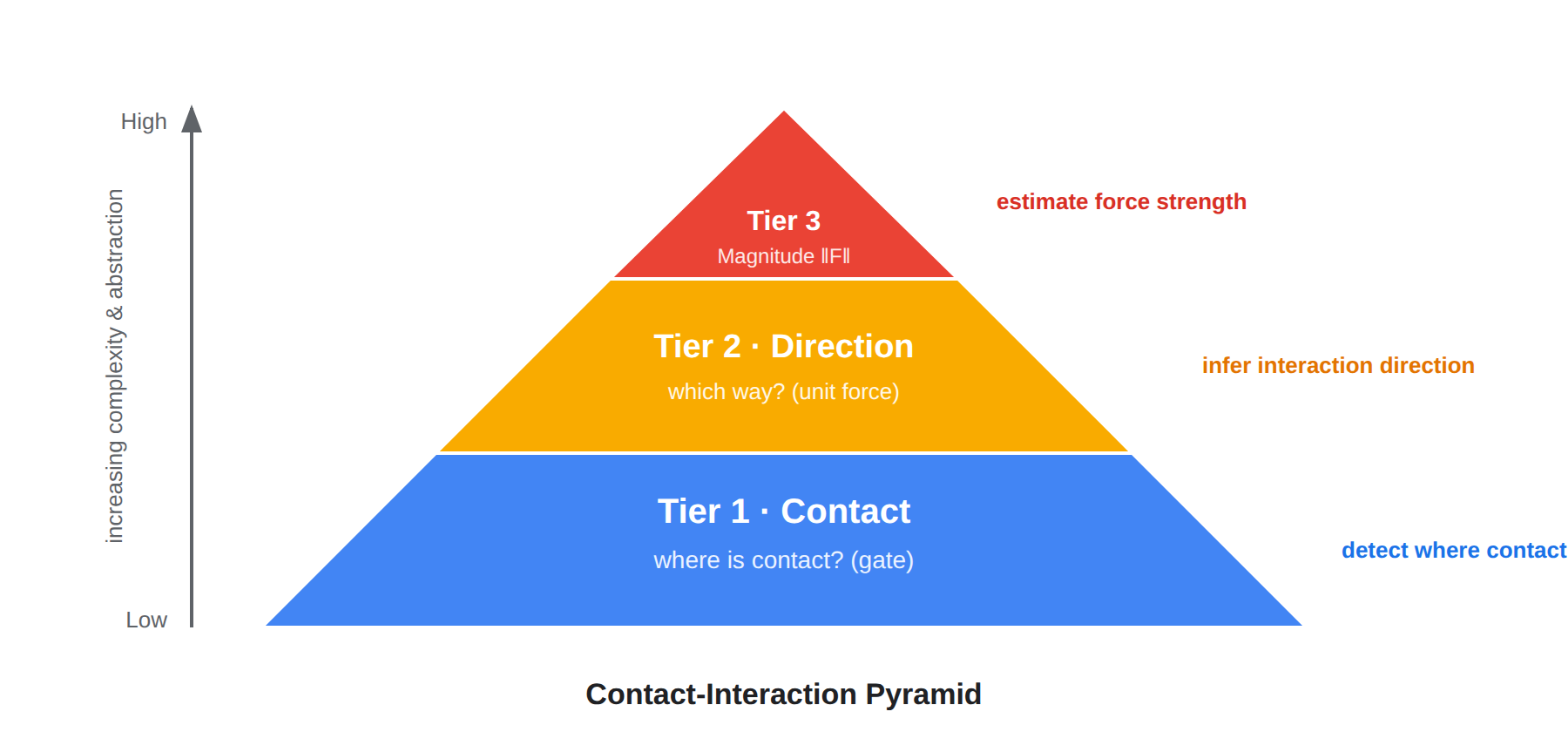
- Robots learn from millions of videos — but video has no sense of touch.
- Touch & force are what make contact-rich tasks work: assembly, insertion, handling.
- Our idea: recover the force from the video itself — add the missing sense to data that never recorded it.
Three levels of touch: is it touching? · which way? · how hard?
What we set out to prove
① Read force from video
Can a model tell when something touches and which way it pushes?
② Enough data
Is there enough data out there to learn this?
③ Generalization
Does it work on robots & scenes never seen?
Three questions. We answered all three — yes.
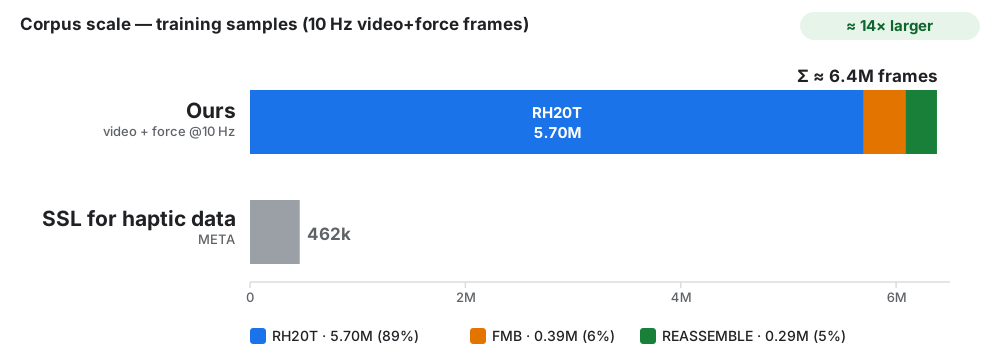
The data is already there — nobody used it
| Source | What | Recordings | Strength |
|---|---|---|---|
| FMB | Peg insertion | 1 844 | clean, controlled environment |
| REASSEMBLE | Assembly | 2 262 | excellent force-sensor quality |
| RH20T | Many tasks & robots | 12 666 | huge diversity |
Supervised learning
Does it work at all?
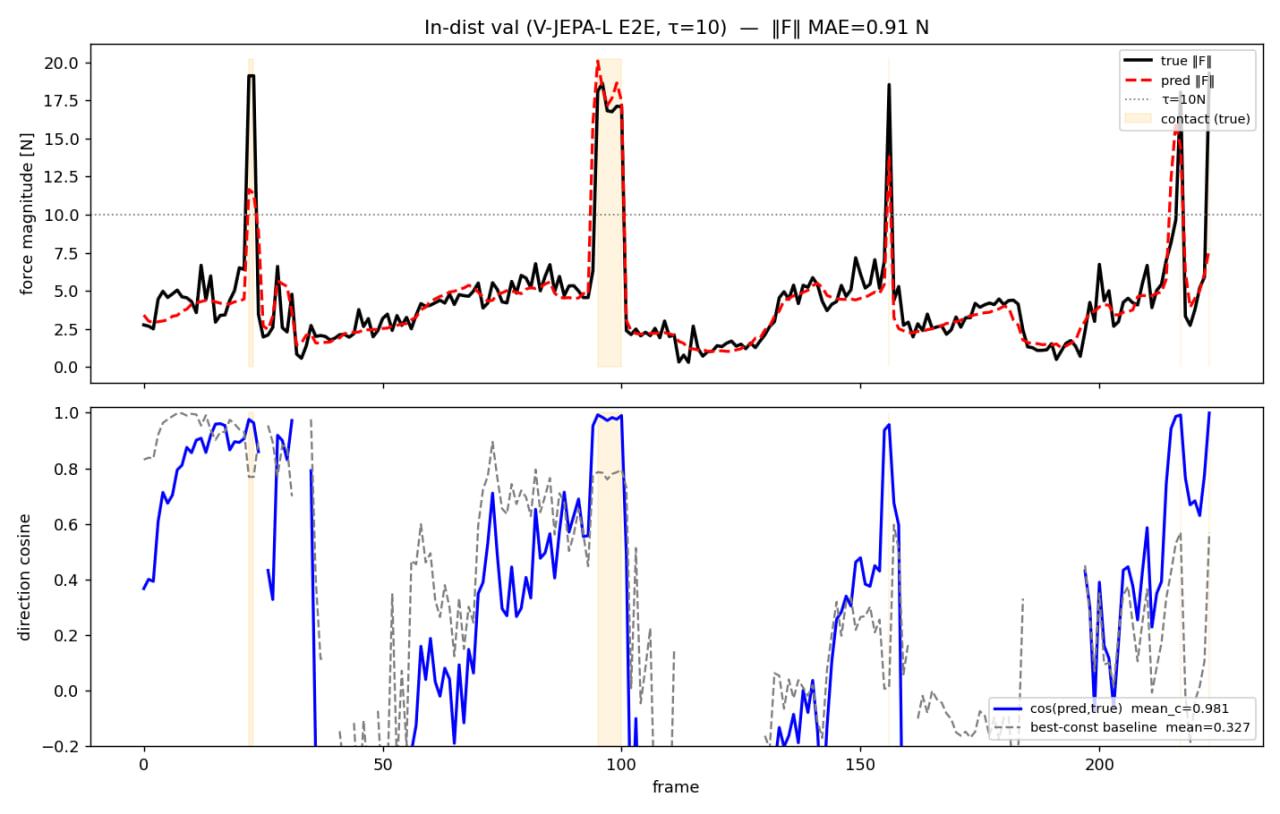
Goal: prove the general feasibility — can a model read force off video?
Yes — it recovers the force
Self-supervised learning
Does it generalize?
Goal: prove generalist capability — work on cameras, labs & robots it never trained on.
Works on a camera angle it never saw
| new camera angle | contact | direction |
|---|---|---|
| Supervised baseline | fails | fails |
| Sinew | works (0.70) | works (0.78) |
- A normal model breaks on an unseen viewpoint.
- Sinew keeps working — and loses nothing on familiar views.
Works on data from a different lab
| force direction, new lab | Supervised baseline | Sinew |
|---|---|---|
| dataset A → B | 0.41 | 0.87 |
| dataset B → A | 0.40 | 0.83 |
- Cross-lab transfer normally collapses.
- Sinew restores it — no new force labels needed, just the target's video.
One model, many robots
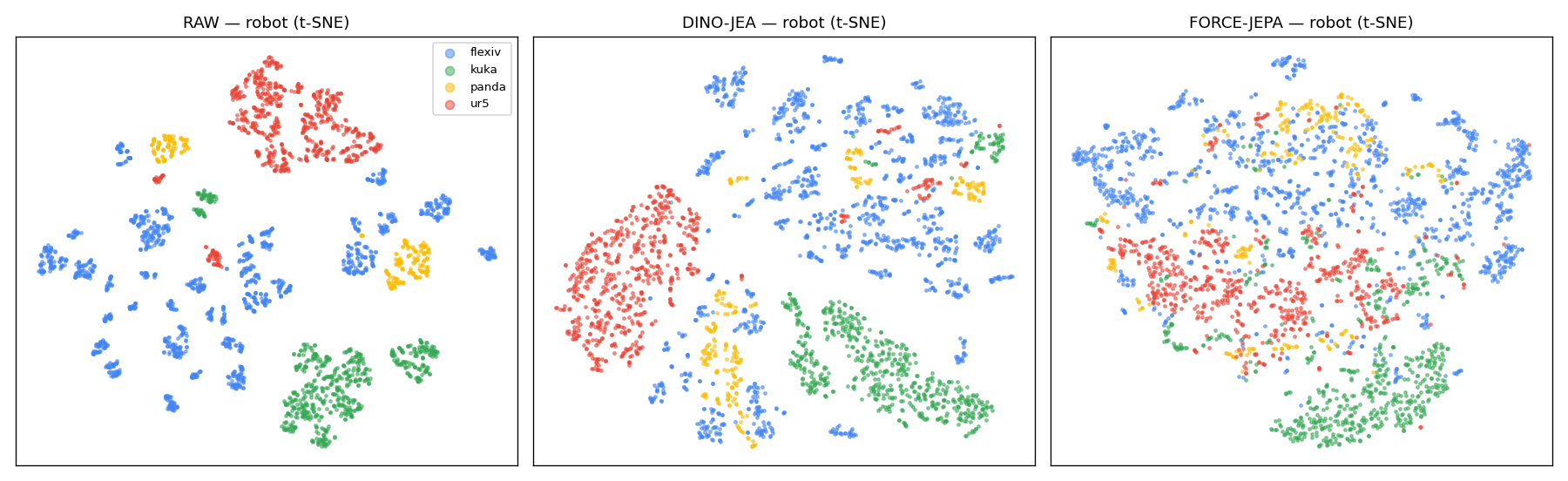
Sinew learns what is happening, not which robot recorded it — so the same model carries across different robots. The right-hand map shows robots fully mixed together: the signal is robot-agnostic.
Proven — and ready to scale
All three questions — answered
- ① Read force from video: yes ✓ — contact & direction
- ② Enough data: yes ✓ — abundant & untapped
- ③ Generalization: yes ✓ — unseen cameras, labs & robots
Verdict
Technical feasibility is done & validated.
Video recovers touch — contact, strength & direction — and it generalizes.
Next: scale up across more robots, hands & tasks.