v2f Stage-5.5 — Do the SSL Embeddings Earn Their Keep?
epic sinew-292 · validation ablation on the Stage-5 champion (frozen V-JEPA) · best-to-best, in-dist + OOD · 2026-06-12
Why. Stage-5 produced a video↔force embedding that is geometrically aligned (CKA 0.07→0.51). This stage asks
the hard question: does that embedding actually improve downstream performance, or is the alignment cosmetic? Five
ablations, all best-to-best vs honest baselines (raw V-JEPA, raw force, trivial predictors).
Headline. The Stage-5 (raw-embed) SSL embedding does not earn its keep downstream. It is a redundant projection of pooled raw V-JEPA (R²=0.96), never beats raw for force-prediction or behavior-cloning, and its alignment does not transfer task semantics across modalities. Three nuances from post-review re-runs (A5/A5b/A6): (1) v2f does generalize OOD under the proper recipe — A1's OOD collapse was a probe artifact; (2) a trunk-embed (Stage-4) preserves temporal structure that the raw-embed lacks and gives a real (task-split) OOD augment win — the prior good results were genuine; (3) the force embedding is non-trivial and can drive a policy. But no embed adds information beyond the frozen encoder — the consistent lever is encoder-unfreeze, not a raw-derived SSL projection.
Headline. The Stage-5 (raw-embed) SSL embedding does not earn its keep downstream. It is a redundant projection of pooled raw V-JEPA (R²=0.96), never beats raw for force-prediction or behavior-cloning, and its alignment does not transfer task semantics across modalities. Three nuances from post-review re-runs (A5/A5b/A6): (1) v2f does generalize OOD under the proper recipe — A1's OOD collapse was a probe artifact; (2) a trunk-embed (Stage-4) preserves temporal structure that the raw-embed lacks and gives a real (task-split) OOD augment win — the prior good results were genuine; (3) the force embedding is non-trivial and can drive a policy. But no embed adds information beyond the frozen encoder — the consistent lever is encoder-unfreeze, not a raw-derived SSL projection.
Scorecard — five questions
| # | question | result | verdict |
|---|---|---|---|
| A1 | SSL embed vs raw V-JEPA for v2f (in/OOD) | in-dist: S edges gate-F1 (+0.04) but loses direction (0.33→0.13). OOD: A1's apparent collapse was a probe artifact (pooled-window + zero-shot + in-dist threshold) — see A6. | NO — raw ≥ SSL (in-dist) |
| A5 | does the SSL embed add NEW info? (redundancy + concat) | champion embed = proj(pooled-raw): MLP R²(S from raw)=0.963 ⇒ ~0 new info; concat[raw‖S] never meaningfully beats raw | NO — redundant |
| A5b | same check on Stage-1 / Stage-4 trunk-embeds | Stage-4 trunk-embed R² 0.854 (less redundant — temporal) ⇒ box_flip OOD augment win; Stage-1 (0.990) & Stage-5 raw (0.963) degenerate | trunk-embed adds temporal (Stage-4), raw-embed doesn't |
| A6 | FAIR v2f OOD (full trunk + multi-cam + target-FT) | OOD is strong (peg/eth/box gateF1 0.87–0.90, dirCos 0.76–0.94 — reproduces Stage-3); SSL-augment ties BASE (no OOD help) | v2f OOD strong; SSL-augment neutral |
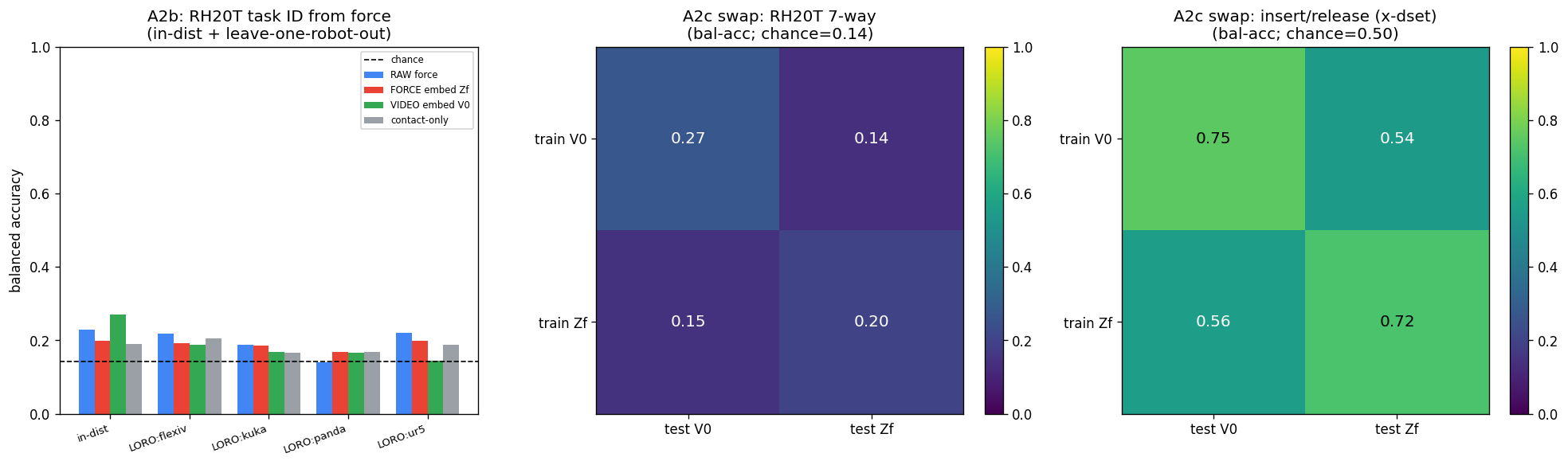
| A2b | task ID from force embed vs raw force | RH20T 7-way all 0.14–0.27 (chance 0.14) ≈ contact-only control; raw ≥ embed | NO — contact-dominated, not semantic |
| A2c | cross-modal swap (train video → test force) | 7-way swap at chance; insert/release swap 0.54 vs within-modal 0.75 | NO — alignment geometric, not task-semantic |
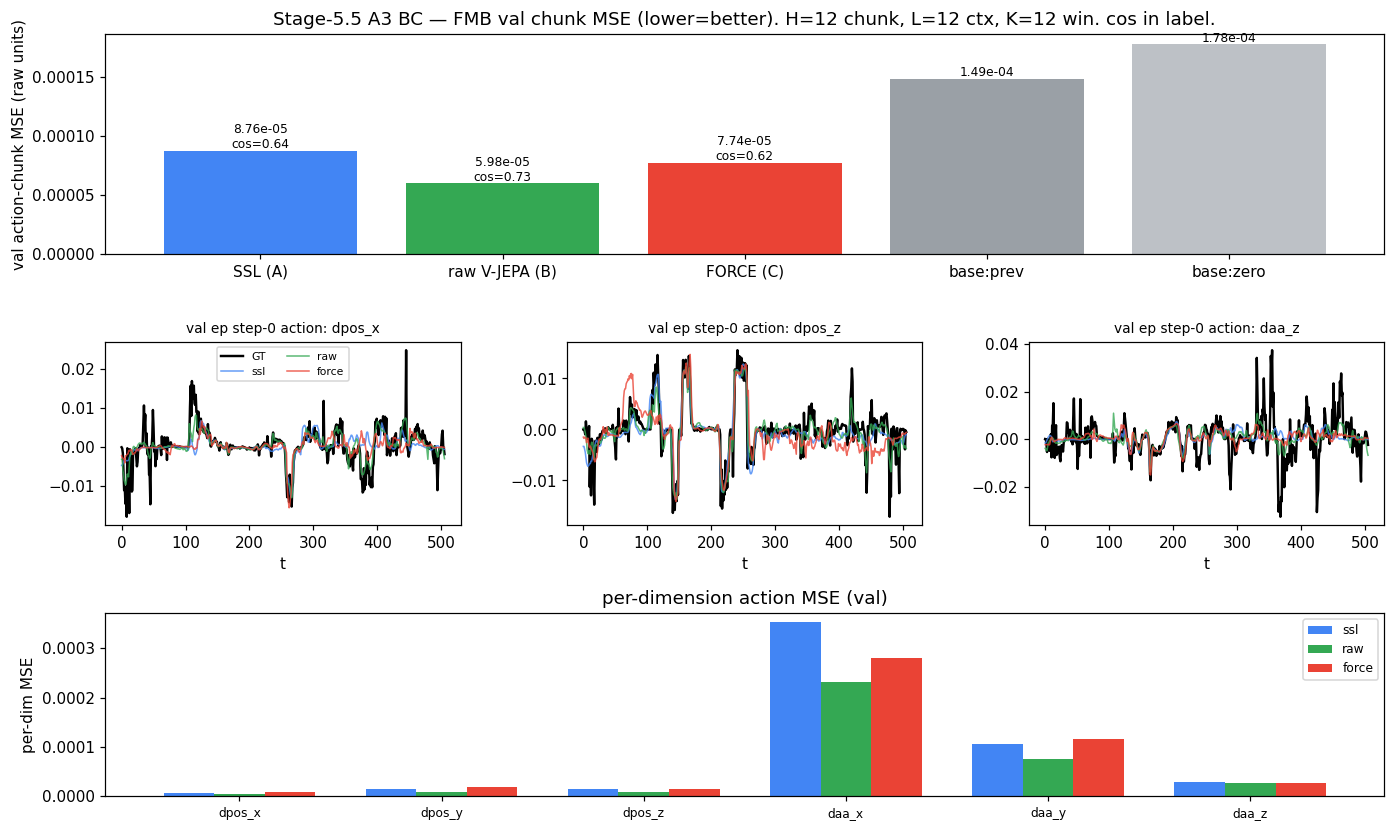
| A3a | SSL embed vs raw V-JEPA for BC (ACT) | raw MSE 5.98e-5 > force 7.74e-5 > SSL 8.76e-5; all beat trivial | NO — raw ≥ SSL |
| A3b | BC policy preserved under video→force swap | force beats trivial baselines, ties SSL video embed, ~30% worse than raw video | PARTIAL — force can drive a policy |
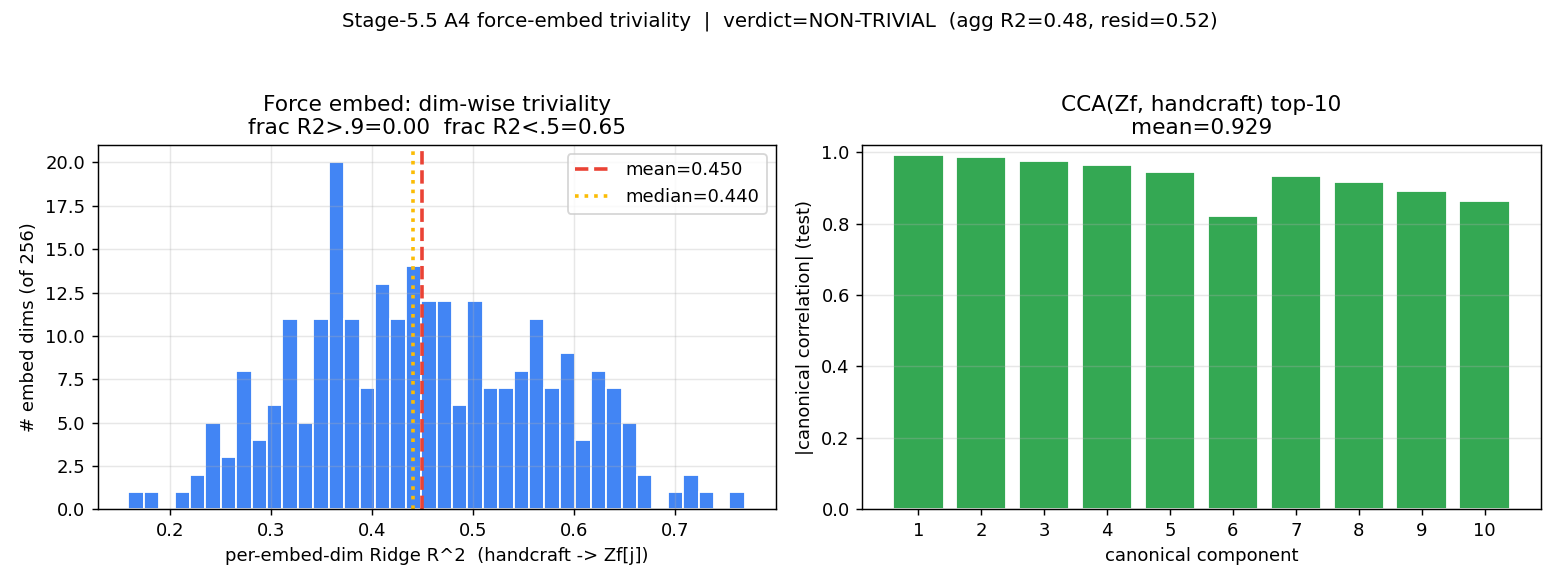
| A4 | is the force embed trivial? | per-dim R² mean 0.45 (0% dims>0.9, 65%<0.5); 52% of variance unexplained by 181 hand-crafted features; contact-AUC 0.97 | NO — force embed is non-trivial |
A1 — SSL embed vs raw V-JEPA for v2f
Window-level v2f (where the embed lives; the deployed per-frame path detaches it). Raw V-JEPA (R, 1024-d) vs SSL embed
(S, 256-d) vs concat (C). S loses direction and collapses OOD; C ≈ R — the augment effect (sinew-228) does not
reproduce for v2f.
*in-dist-tuned threshold mis-calibrated to crisp's positive rate; read AUC for separability.
| split | rep | gateF1 | gateAUC | dirCos |
|---|---|---|---|---|
| in-dist | raw | 0.63 | 0.90 | 0.33 |
| in-dist | SSL | 0.68 | 0.89 | 0.13 |
| OOD | raw | 0.63 | 0.62 | 0.44 |
| OOD | SSL | 0.00* | 0.42 | 0.06 |
A2 — task identity from force + the cross-modal swap
Left: 7-way RH20T action classification — raw force / force-embed / video / contact-only, in-dist + leave-one-robot-out.
Everything hugs chance + the contact control → the force signal is contact-presence, not task semantics. Right: the
train-modality × test-modality swap matrices — off-diagonals at (7-way) or barely above (binary) chance → the aligned
latent does not carry task labels across modalities.
A3 — behavior cloning (ACT) on FMB delta-pose
Minimal ACT-style chunk regressor, history-as-context. raw V-JEPA > force > SSL embed, all well above trivial
baselines. Notably the force-driven policy ties the SSL video embed — a policy can be driven from force alone (3b).
A4 — is the force embed trivial?
Per-dim R² of the 256-d force embed regressed on 181 hand-crafted force features (left), and the top CCA correlations
(right). A handful of canonical directions capture the obvious |F|/contact axis (CCA top-5 ≈ 0.99), but 52% of embed
variance and 65% of dims are not linearly explainable by even a comprehensive statistic bank → the force tower learned
non-trivial structure (it cleanly encodes contact, AUC 0.97, plus real residual).
Do the embeddings add new information? (A5 / A5b / A6 — added after review)
A reviewer flagged that A1's OOD numbers contradicted the prior stages' OOD wins. Re-checking exposed two things:
Reconciliation. The prior augment success is reproduced only by Stage-4's trunk-embed (R² 0.854 ⇒ it preserved
window-dynamics that
- A1's OOD "collapse" was a recipe artifact. A1 pooled the window (bypassing the temporal trunk), went zero-shot, and used an in-dist-tuned threshold. A6 re-ran v2f OOD with the matched Stage-3 recipe (full trunk + multi-cam + per-domain threshold + few-shot target-FT) → OOD is strong (peg/eth/box gate-F1 0.87–0.90, dir-cos 0.76–0.94), reproducing the Stage-3 wins. v2f generalizes; A1 just measured a weaker path.
- Two senses of "new info". Beyond ALL of raw V-JEPA: none — every embed (Stage-1/4/5) is a deterministic function of the frozen encoder's output; it invents no signal V-JEPA didn't extract (frozen ceiling). Beyond POOLED raw: only the trunk's temporal structure, if not pooled away — this is where prior gains live.
| encoder | embed_src | R²(S from pooled-raw) | concat helps v2f? |
|---|---|---|---|
| Stage-1 (s1_viewinv) | trunk | 0.990 | no (temporal pooled away) |
| Stage-4 (s4_iter1) | trunk | 0.854 | box_flip OOD win (ΔAUC +0.29); peg/eth tie |
| Stage-5 champion | raw | 0.963 | no — degenerate redundant |
mean_t(raw) discards ⇒ box_flip OOD win) — confirming the mechanism and that the prior
results were real. Stage-5's embed_src=raw (R² 0.963) is the degenerate redundant case where concat is
dead-weight. Two wrinkles: a trunk is not automatically non-redundant (Stage-1, also trunk, re-pooled to R² 0.990 and
fails like Stage-5), and even Stage-4's win is task-split, not uniform. (OOD: read gate-AUC, not gate-F1 — the F1 zeros on
peg/ethernet are a compressed-sigmoid threshold artifact.)
What this means
- The frozen SSL embedding is alignment-specialized, not a richer state. Optimized for video↔force geometry, the 256-d projection discards direction/action information that raw 1024-d V-JEPA retains — so it loses on v2f and BC, and collapses OOD.
- The Stage-5 alignment is geometric, not semantic. CKA 0.51 buys cloud overlap but not task-label transfer across modalities (A2c ≈ chance). The shared structure is coarse (contact / magnitude), consistent with the +Z low-entropy force.
- The force tower is real, though. Non-trivial (A4) and able to drive a policy (A3b) — its content is genuine, just contact-dominated rather than task-discriminative.
- The lever is unchanged. Every ablation points the same way: gains require raw V-JEPA / supervised heads / encoder-unfreeze, not the frozen SSL embed. This is the empirical close on the "SSL-for-v2f is frozen-bound" thesis — the next real investment is unfreezing the video encoder.
v2f Stage-5.5 · validation ablation · frozen champion s5_champion.pt · all probes best-to-best vs honest baselines.