TL;DR
Goal: the Stage-1 latent was ill-trained — it collapsed (~1.5 effective dims) and kept the three training datasets in separate clusters. Stage-2 = make it healthy: collapse-free, datasets intermixed, no downstream cost.
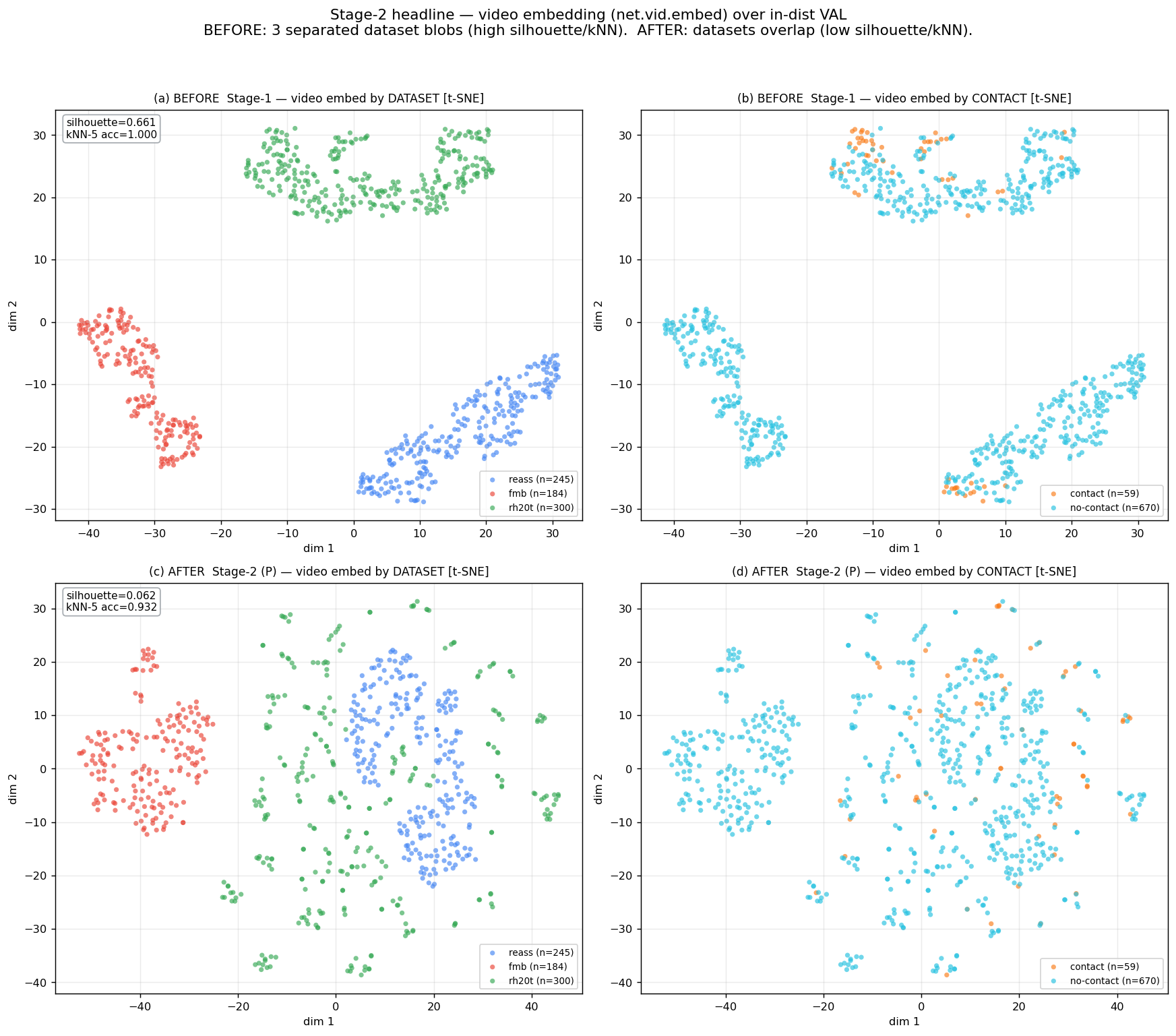
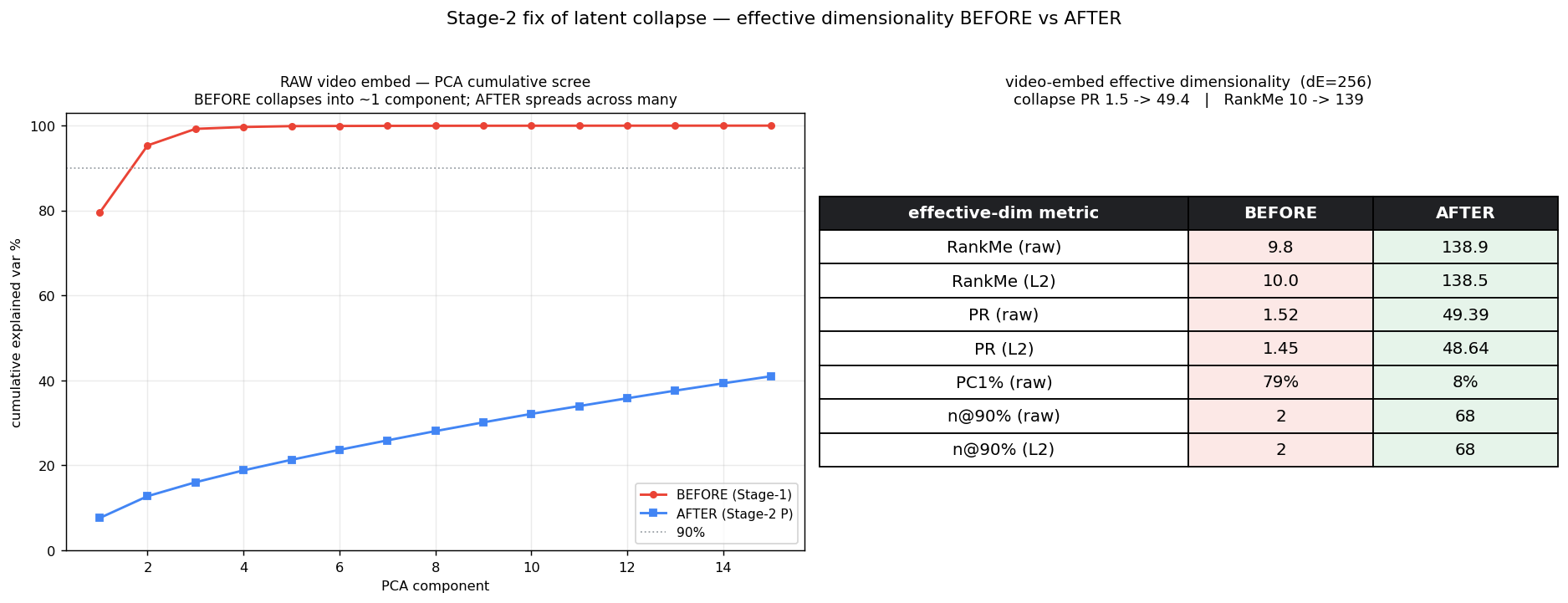
Collapse decisively solved; global dataset-separation collapsed too. The pooled video embedding went from a near-1-D line to a genuinely high-rank manifold, and the datasets went from cleanly separated to broadly overlapping — at zero cost to the supervised task. The strict local intermix (kNN) only partly moved: that residual is appearance-bound on the frozen encoder (see the wall).
| latent health (in-dist val, video embed) | BEFORE (Stage-1) | AFTER (Stage-2 P) | goal |
|---|---|---|---|
| RankMe (effective rank) | 9.8 | 138.9 | ↑↑ |
| participation ratio | 1.52 | 49.4 | ↑↑ |
| PC1 variance | 79% | 8% | ↓↓ |
| dataset silhouette | 0.661 | 0.062 | →0 |
| dataset kNN-5 acc | 1.000 | 0.932 | →.41 |
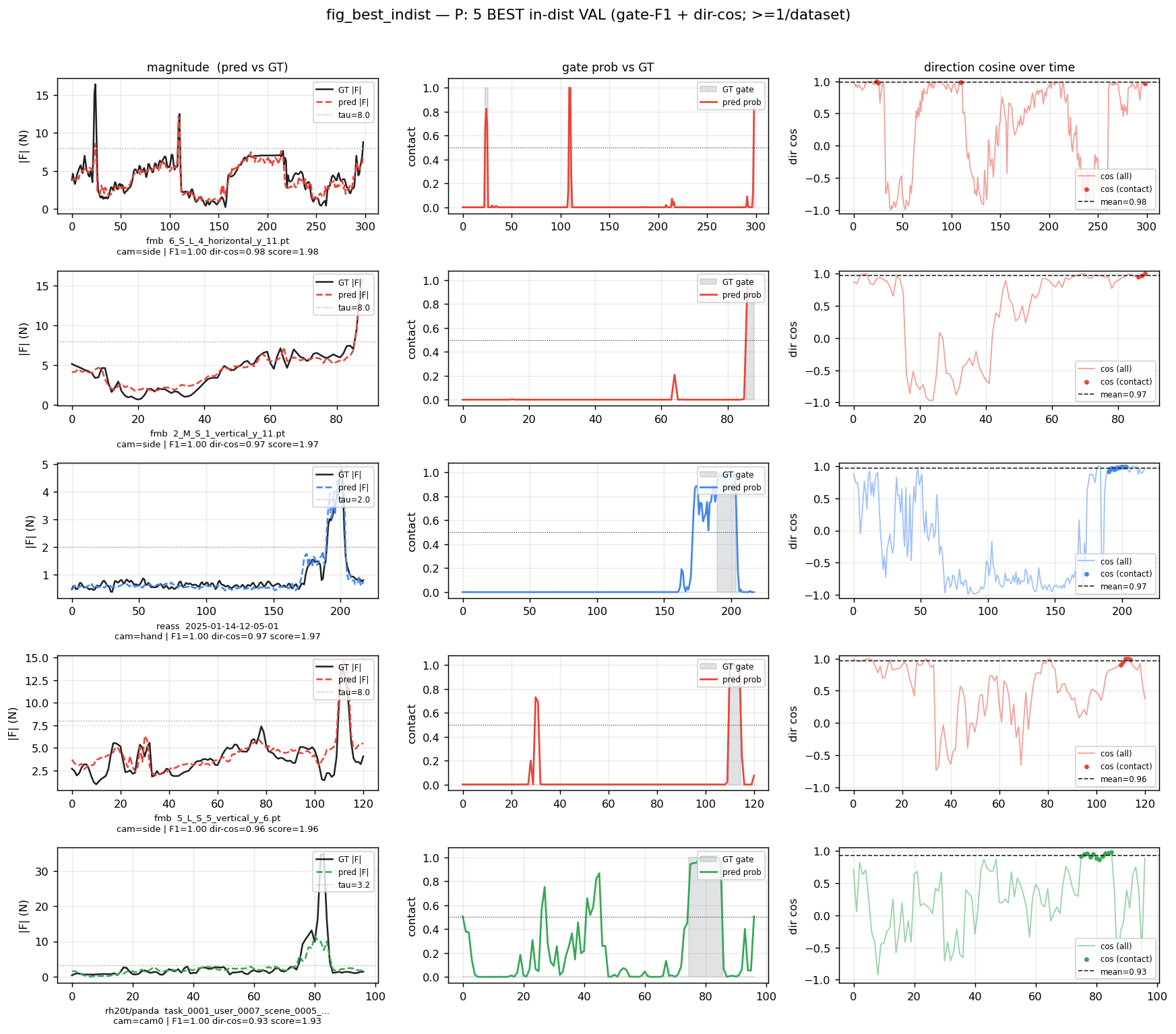
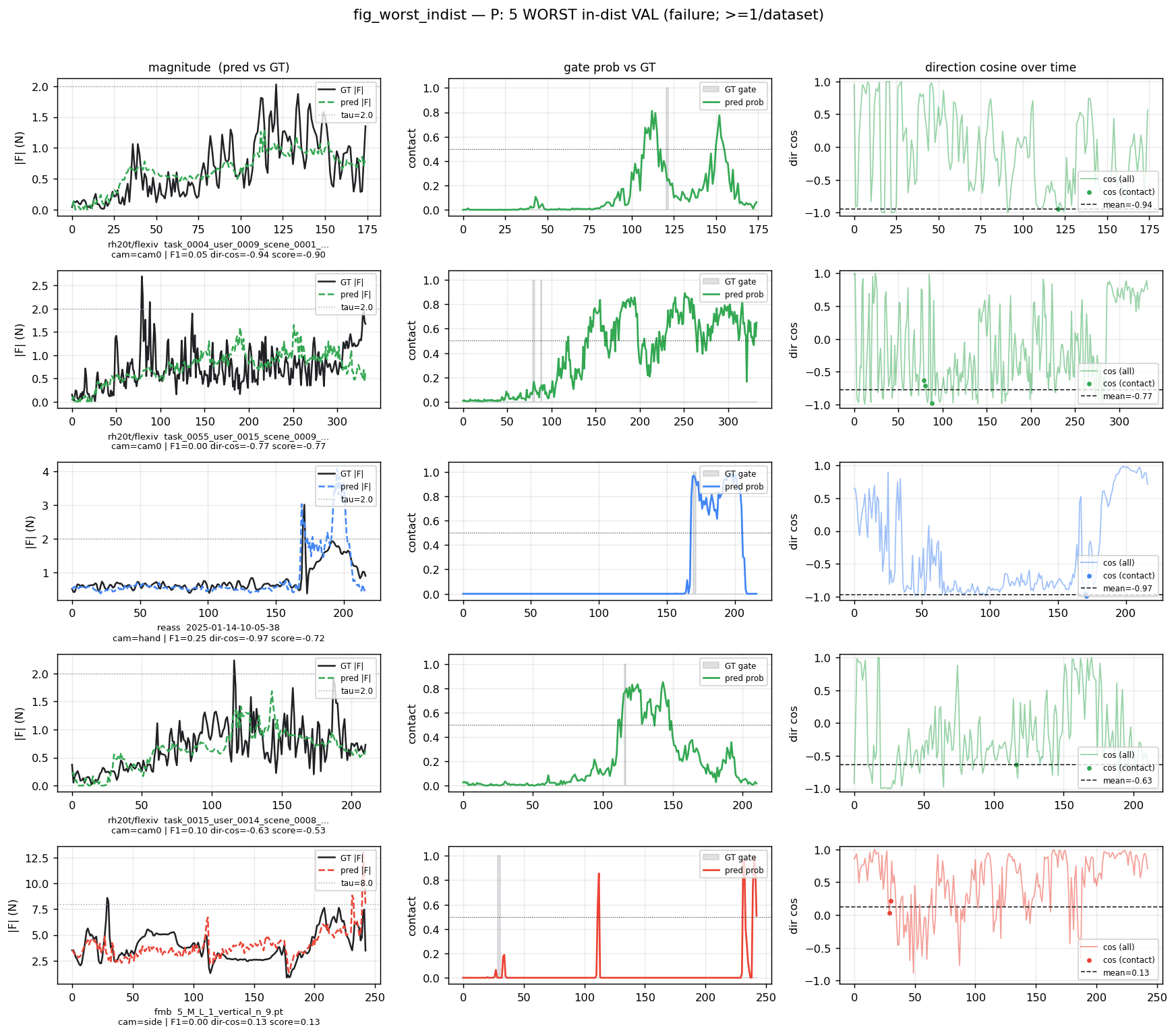
| in-dist task (F1 sum) | 5.539 | 5.527 | preserved |
Collapse + global intermix solved; downstream preserved. Local kNN is the residual appearance floor.
The disease — quantified on the Stage-1 champion
Diagnosed on s1_iter2_vp (729 in-dist + 114 crisp episodes):
| pathology | metric | value | meaning |
|---|---|---|---|
| collapse | RankMe / PR / PC1 | 9.8 / 1.5 / 79% | ~1–2 effective dims of 256 (persists on L2-norm → genuine, not a sphere artifact) |
| datasets separated | kNN / silhouette | 1.000 / 0.659 | the model trivially knows which dataset a clip is from — zero intermix |
| retrieval floored | video→force R@1 | 0.003 | paired cosine is high but a clip can't find its own force → 1-D cone, no instance discrimination |
The fix — 7 iterations, two clean wins
1 · Collapse → add decorrelation
Adding the missing covariance off-diagonal term to VICReg (decorrelate, not just rescale) lifts RankMe 9.8→100+ immediately, with downstream untouched. Barlow Twins helped less (batch-limited); MixStyle killed rank. Covariance decorrelation is the collapse cure.
2 · Intermix → the right tool (after the wrong ones)
Domain-adversarial DANN and CORAL/moment-matching both failed — DANN destroyed the cross-modal alignment and diverged; CORAL left kNN at 1.0. A history check confirmed why: classification domain-adaptation distorts feature scale and hurts regression (force is a regression target). The working lever is the opposite — bind the embedding to physics:
- raw-feat embed — project the pooled embedding straight from the frozen V-JEPA features, bypassing the supervised trunk (whose features are baked dataset-specific by the per-dataset heads).
- force-anchor — align that embedding (cosine) to a fixed, dataset-agnostic force target
[dir ‖ log(1+|F|)]: force direction+magnitude is the same physical quantity in every lab, so pulling video onto it makes the embedding encode what force is happening, not which lab.
Clean ablations: raw-feats beat trunk (kNN .89 vs .98), force-anchor beats cluster-DINO (1.0). This is the same mechanism that previously drove camera-NMI 1.0→0.009.
Champion s2_armP: --embed-src raw --align-mode anchor --vic-cov-w 0.5
--rh20t-ncam 2 --bs 48 (frozen V-JEPA throughout).
Before / After
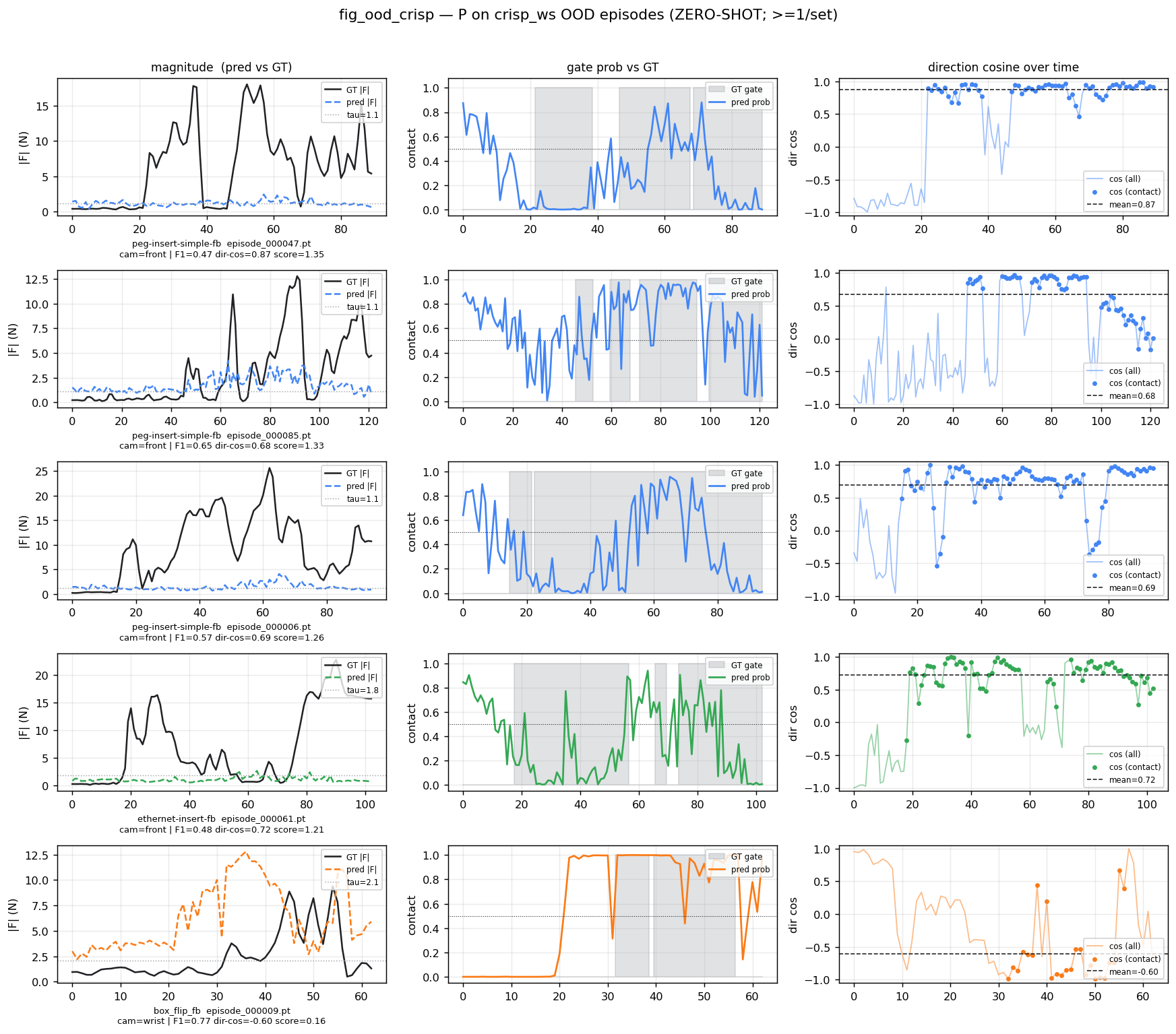
Plots — task quality preserved
The latent fix is decoupled from the supervised heads, so task quality is unchanged. Examples:
The wall — why local kNN floors at ~0.93
Every intermix method (gentle stat-matching, adversarial DANN, instance-anchor, even decoupling the embed from the trunk) drives global separation down (silhouette 0.66→0.06) and makes the embedding linearly domain-unpredictable — but the local kNN-5 purity sticks near 0.9. The reason is a genuine tension, not an unsolved hyperparameter:
Key findings
- Collapse was a missing decorrelation term — variance-hinge-only VICReg. The covariance term fixes it decisively (RankMe 9.8→139, PR 1.5→49), free, no downstream cost.
- Classification domain-adaptation (DANN/CORAL) hurts regression — confirmed live (DANN killed the cross-modal alignment, moment-matching diverged). The right intermixer is physics-anchoring, not adversarial deletion.
- Global dataset intermix is achievable on frozen feats (silhouette 0.66→0.06) via raw-feat embed + fixed force-anchor — the dataset-agnostic-physics mechanism.
- Local intermix + instance retrieval are frozen-encoder-bound — the rank⊥intermix tension above; the next lever is the encoder, not another loss.
Stage-3 — open
- E2E LoRA encoder unfreeze (sinew-253) — lets V-JEPA learn dataset-invariant features, the only way past the local-kNN floor and the in-dist ceiling. The single biggest remaining lever.
- Learned force tower in the shared space — the champion aligns video to a fixed anchor (force tower inert); co-embedding a learned force tower would restore a genuine modality-retrieval axis (where the data allows it).
- Magnitude / τ head (sinew-254) — the residual task wall, unchanged since Stage-1.
Full trace: docs/v2f_stage2_iteration_log.md · research docs/v2f_stage2_latent_research.md · champion ~/out_stage2/s2_armP.pt.