TL;DR
Goal: make out-of-distribution (a new lab, crisp_ws) match in-distribution
top performance, adapting by video fine-tuning only (video→force; video-only at inference).
Achieved & proven.
The Stage-1 model (trained on REASS+FMB+RH20T, frozen V-JEPA) reaches the crisp in-domain ceiling on held-out crisp after a short video fine-tune — and, on the identical split, matches / slightly exceeds a from-scratch in-domain baseline (the in-dist-top reference). The cross-modal pretraining is a better init than from scratch.
| crisp_ws held-out (same-split A/B) | peg front | peg wrist | eth wrist | box_flip |
|---|---|---|---|---|
| Stage-1 → video-FT (OOD) · gate | 0.904 | 0.899 | 0.932 | 0.896 |
| from-scratch in-domain (in-dist-top ref) · gate | 0.901 | 0.881 | 0.921 | 0.898 |
| video-FT · dir cos | 0.798 | 0.802 | 0.920 | 0.958 |
init ≥ scratch on every gate cell; direction ties → OOD = in-dist-top via video-only fine-tuning, apples-to-apples.
Setup
Champion recipe (encoder frozen throughout — no E2E LoRA)
- Pretrain (
s1_iter2_vp): scratch cross-modal video↔force DINO (JEA, shared prototype + EMA teacher) + VICReg anti-collapse. Video tower = TCN over frozen V-JEPA 1024-d with per-frame gate/dir/mag heads; force tower = ForceTok over per-source-normalized 6-D wrench, learned from scratch, jointly (training-only; dropped at inference). Multi-view aug (RH20T 2 cams/contact). - Adapt: crisp video→force fine-tune (force tower unused; video-only input).
Data & metrics
- Train: REASSEMBLE + FMB + RH20T-allcam (~16k episodes), single-random-cam channel-unify, RH20T world-dir on.
- OOD:
crisp_ws(peg / ethernet insertion, box-flip) — held-out, lab the model never saw. - Metrics: contact gate-F1 (P/R), direction cos-lift over best-constant (insertion dir is near-degenerate → lift≈0 even when correct; box_flip is the real direction test), MAE (N).
In-distribution results
Per-dataset val (the in-dist bar) — no negative transfer across arms
| val cell | gate-F1 | dir cos-lift | MAE (N) |
|---|---|---|---|
| REASS | 0.86 | +0.54 | 1.6 |
| FMB | 0.77 | +0.21 | 2.8 |
| RH20T | 0.63 | +0.18 | 5.4 |
Topology comparison — which encoder design wins
| arm | force tower | DINO aligns? | OOD wrist gate | OOD wrist dir |
|---|---|---|---|---|
| control | none | — | 0.57 / 0.68 | −0.80 / −0.83 |
| A — scratch, unfrozen | learned scratch | yes (6.9→2.7) | 0.67 / 0.81 | −0.51 / −0.43 |
| B — warmstart, unfrozen | F-JEPA, unfrozen | DEAD (ln K) | — | — |
| B — warmstart, frozen | F-JEPA, frozen | yes (slow) | 0.62 / 0.76 | −0.95 / −0.98 |
Scratch-unfrozen DINO wins; warmstart refuted — unfrozen warmstart kills alignment, frozen warmstart hurts OOD direction. Co-adapting the force tower with video is what works.
The adaptation ladder (crisp OOD, zero → few labels)
| method | front gate | wrist gate | box gate | dir (peg/box) | target labels |
|---|---|---|---|---|---|
| zero-shot (Stage-1) | 0.43 | 0.76 | 0.62 | 0.19 / −0.74 | 0 |
| + video-only UDA (info-max) | 0.70 | 0.81 | 0.77 | 0.62 / — | 0 |
| + few-shot (5/task) | 0.87 | 0.87 | 0.87 | 0.80 / 0.90 | 15 |
| + video-FT (K=60) | 0.90 | 0.90 | 0.90 | 0.80 / 0.96 | 180 |
- Gate closable to ~0.70–0.81 with zero target labels (multi-view aug + video-only info-max UDA; naive TENT collapses → marginal-entropy-max fixes it).
- Direction is a cross-lab frame wall zero-shot (EE-frame redefinition also failed); few-shot / video-FT closes it.
Plots — in-distribution & representation
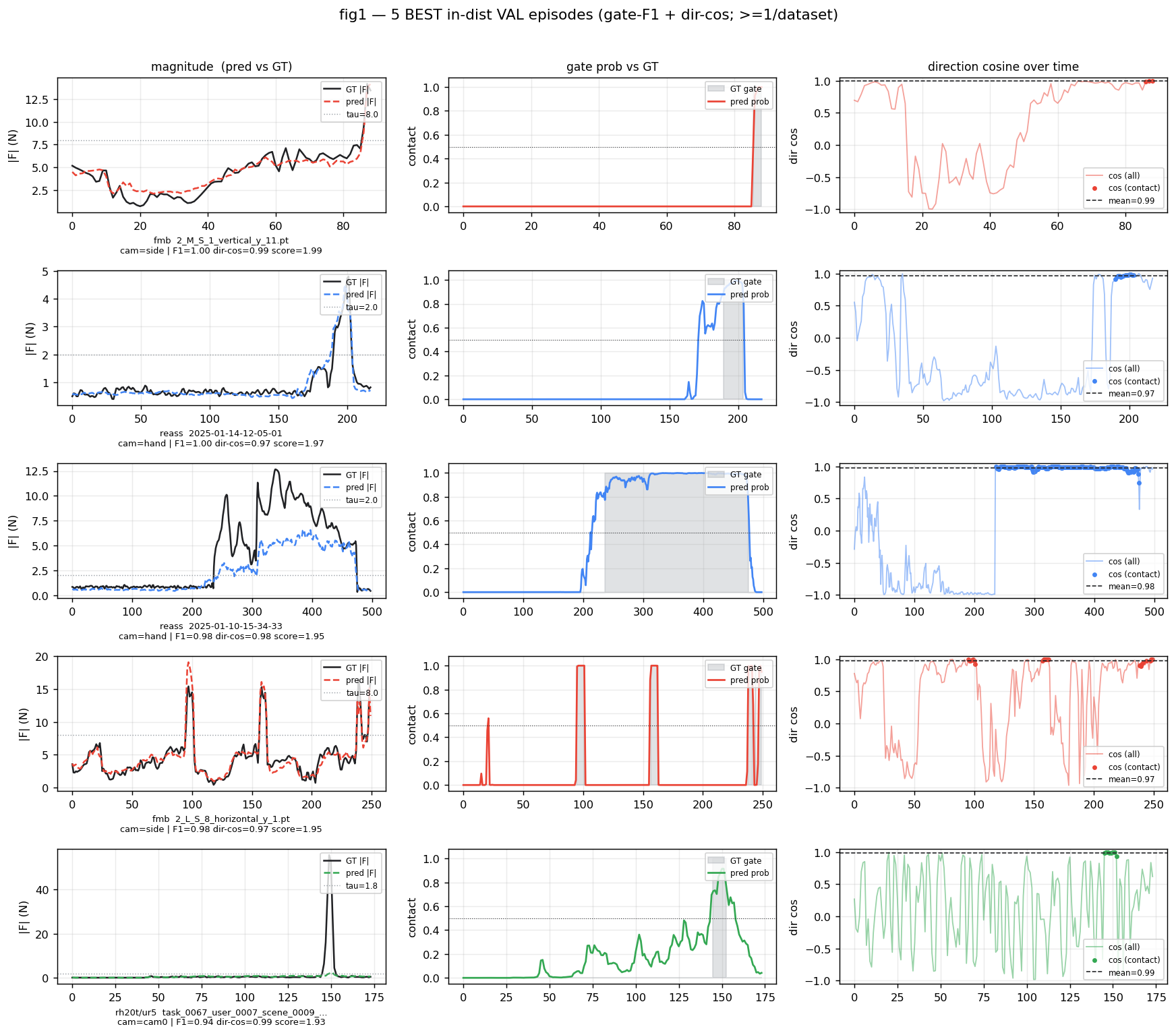
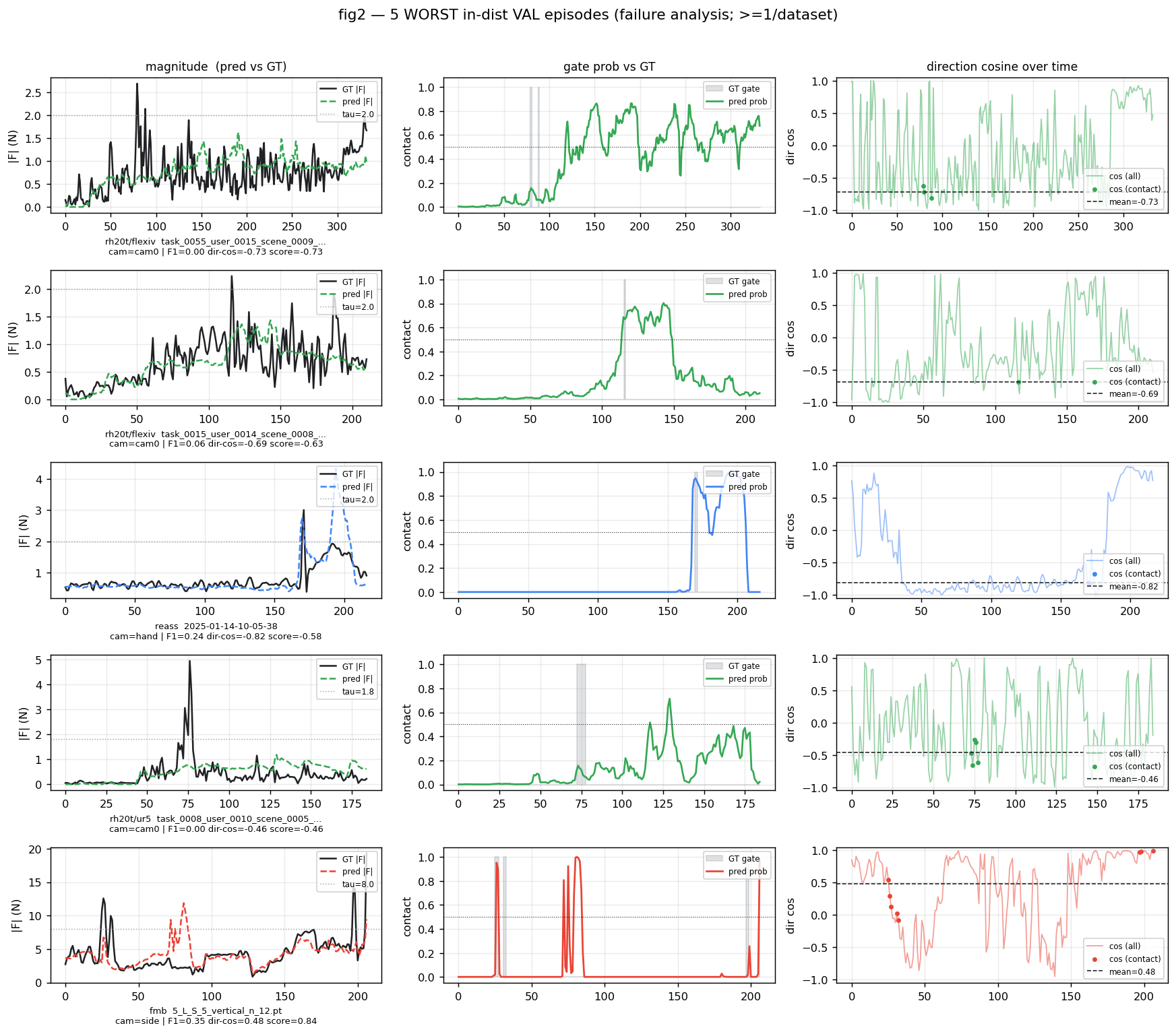
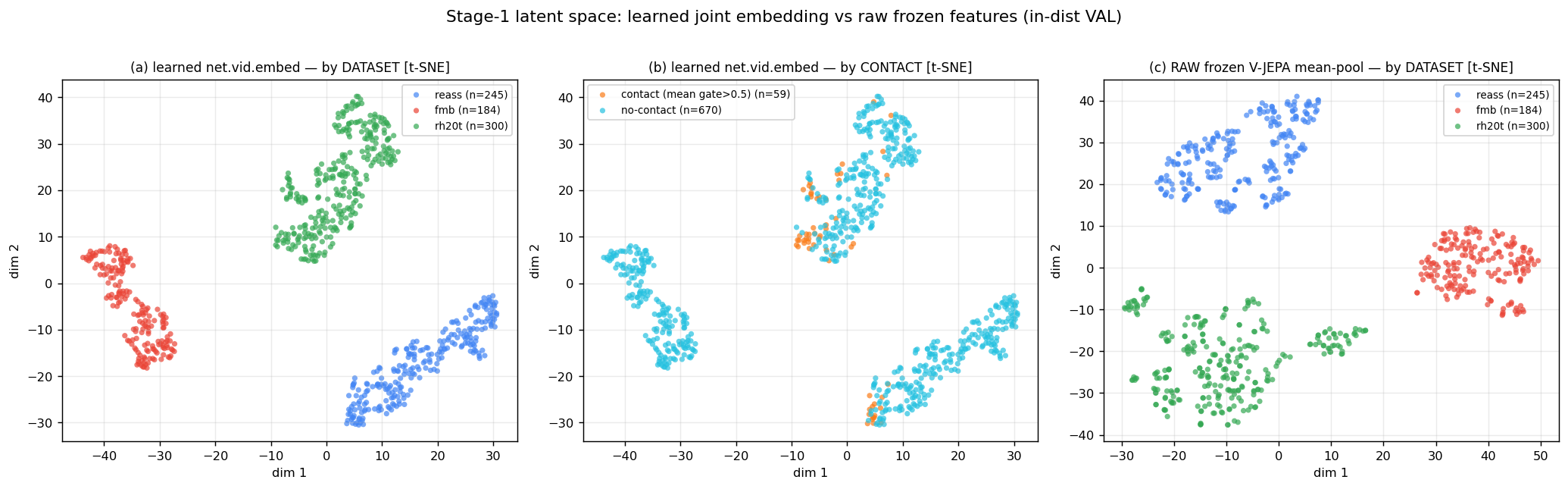
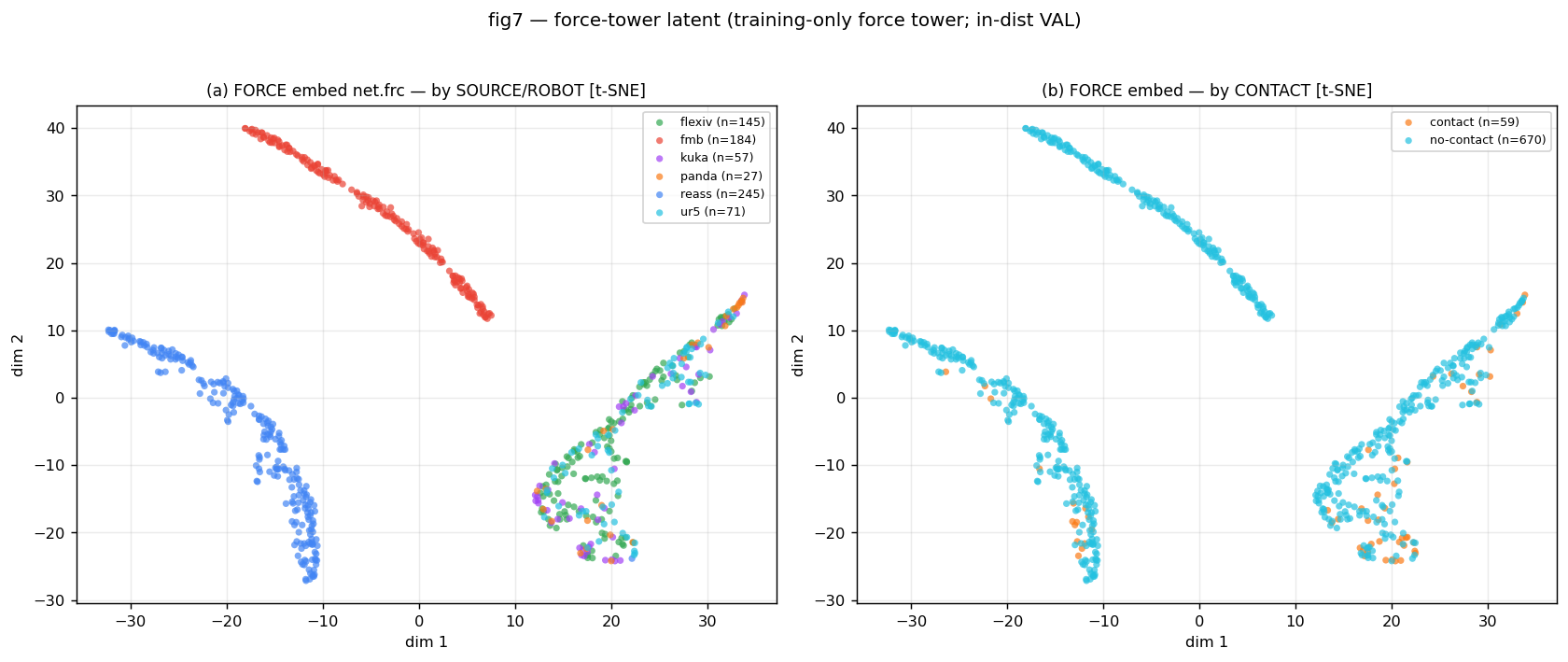
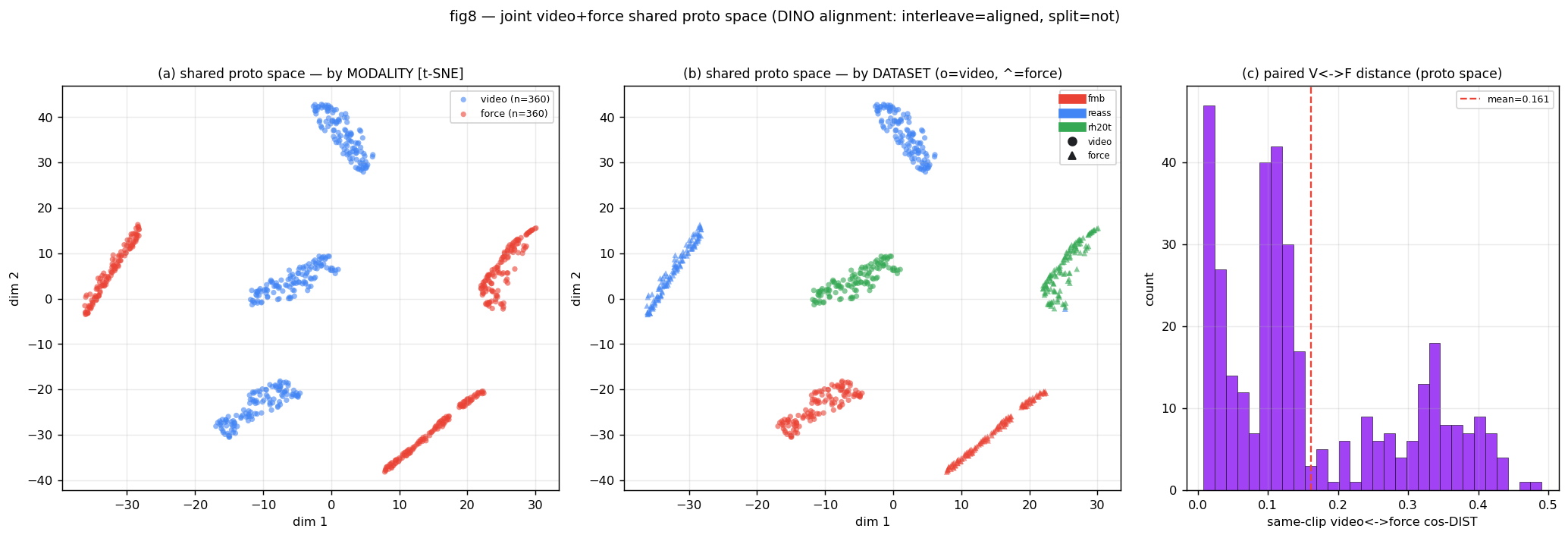
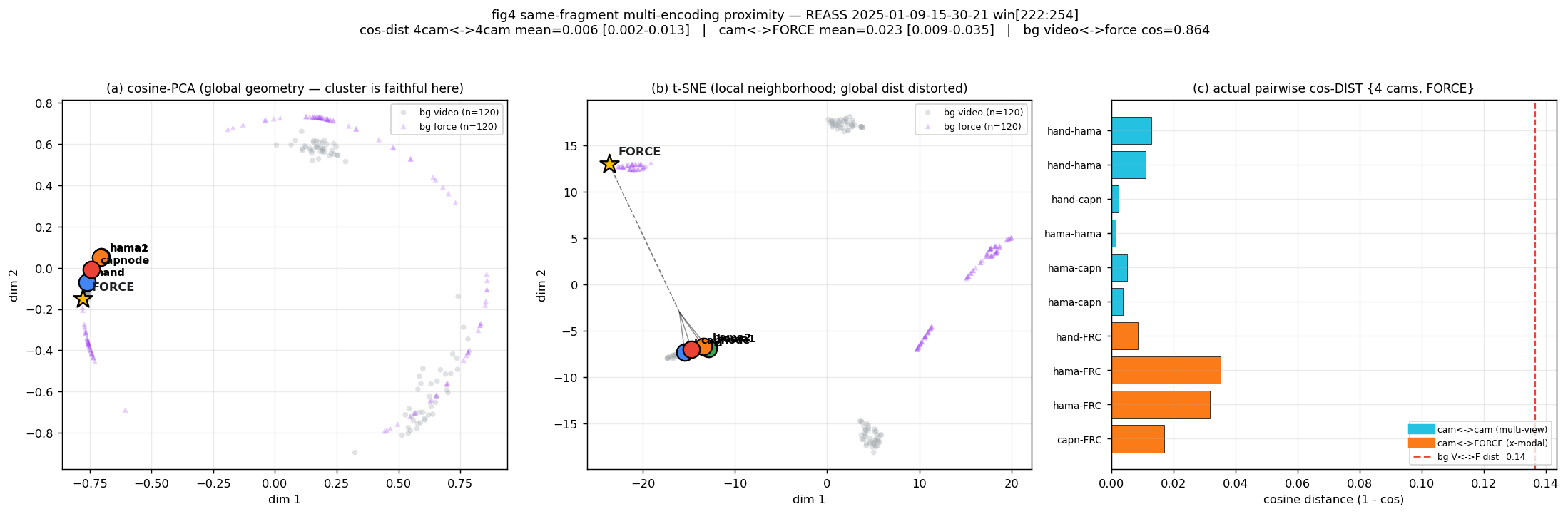
Plots — out-of-distribution (crisp_ws, zero-shot)
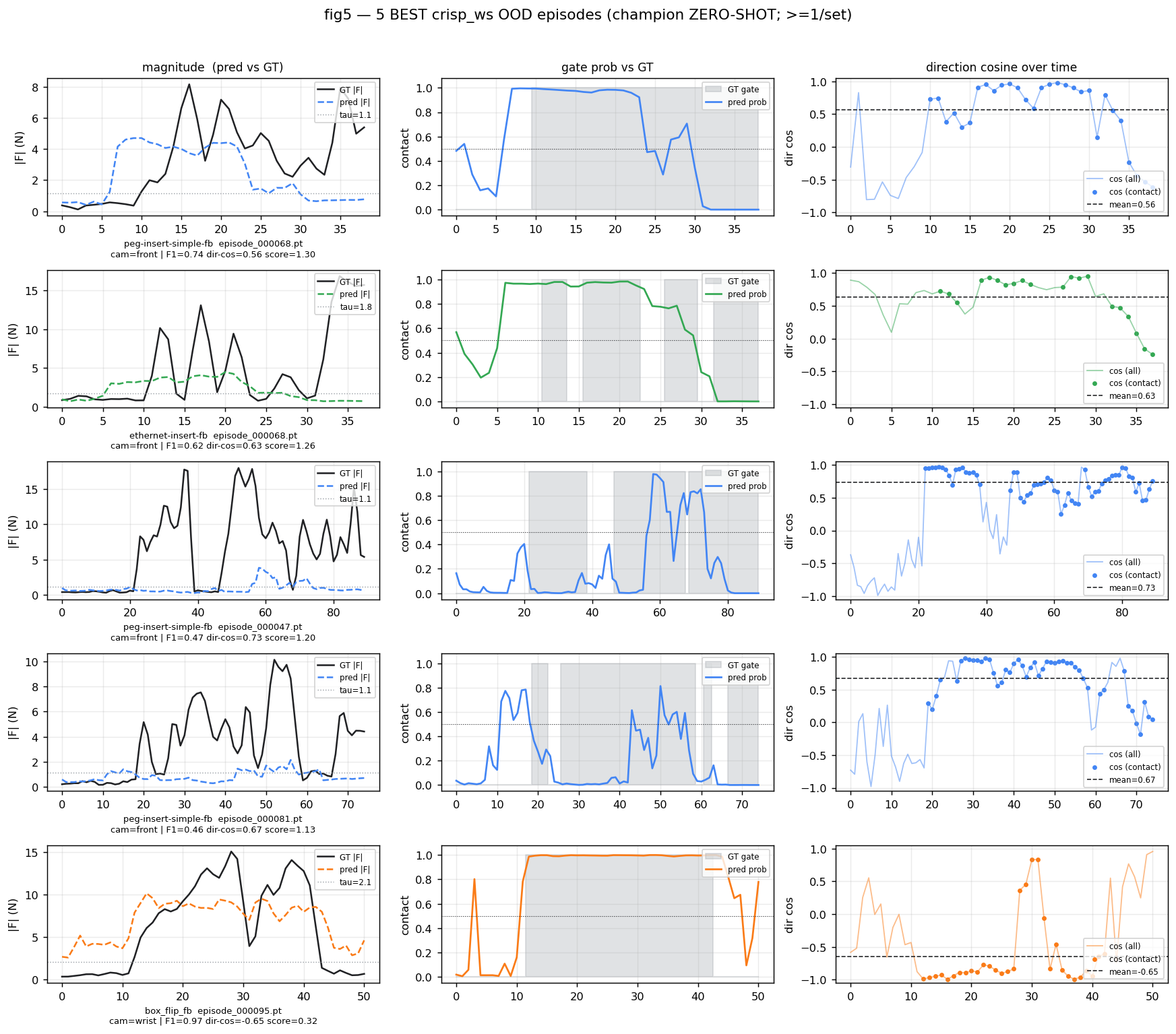
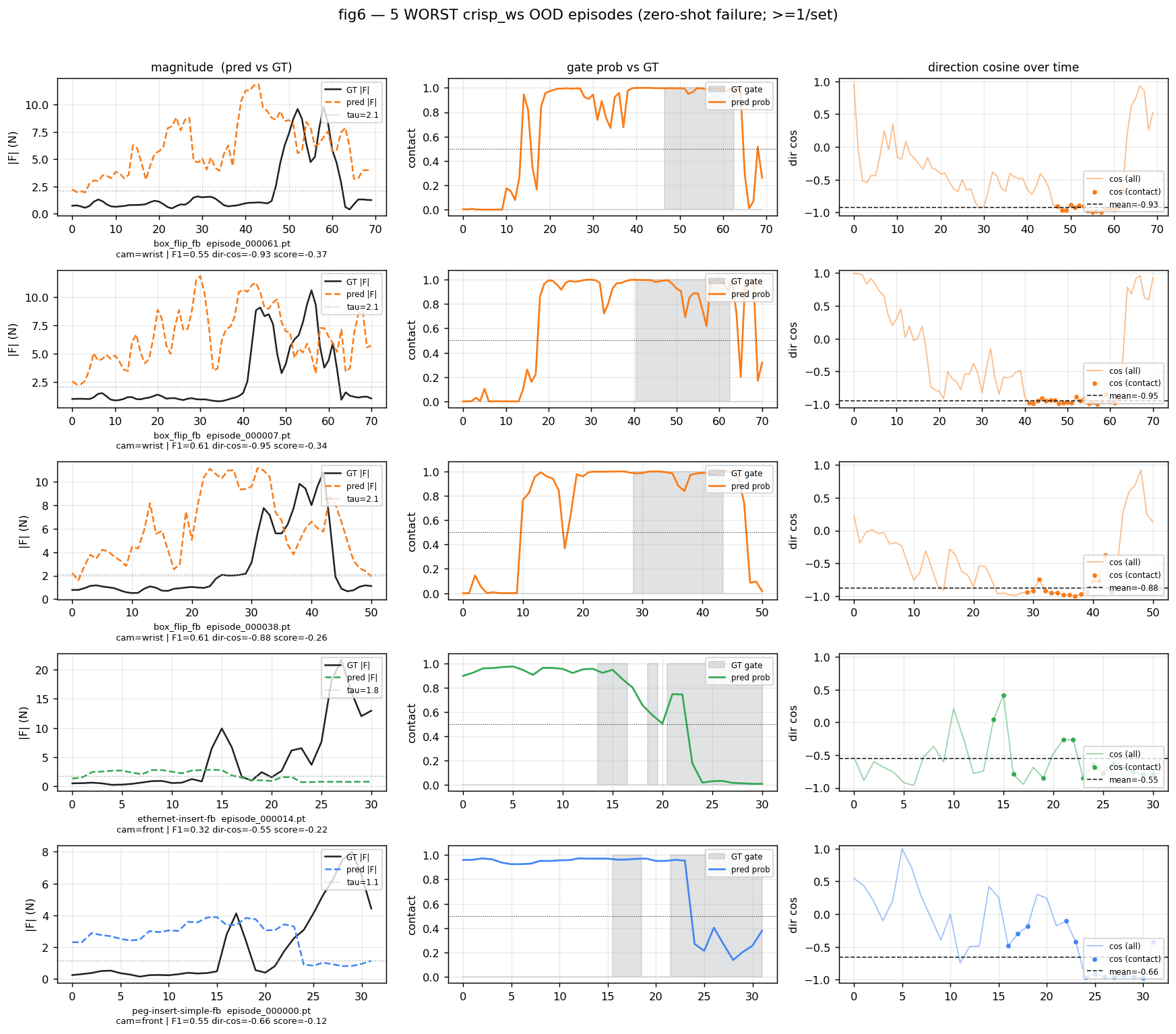
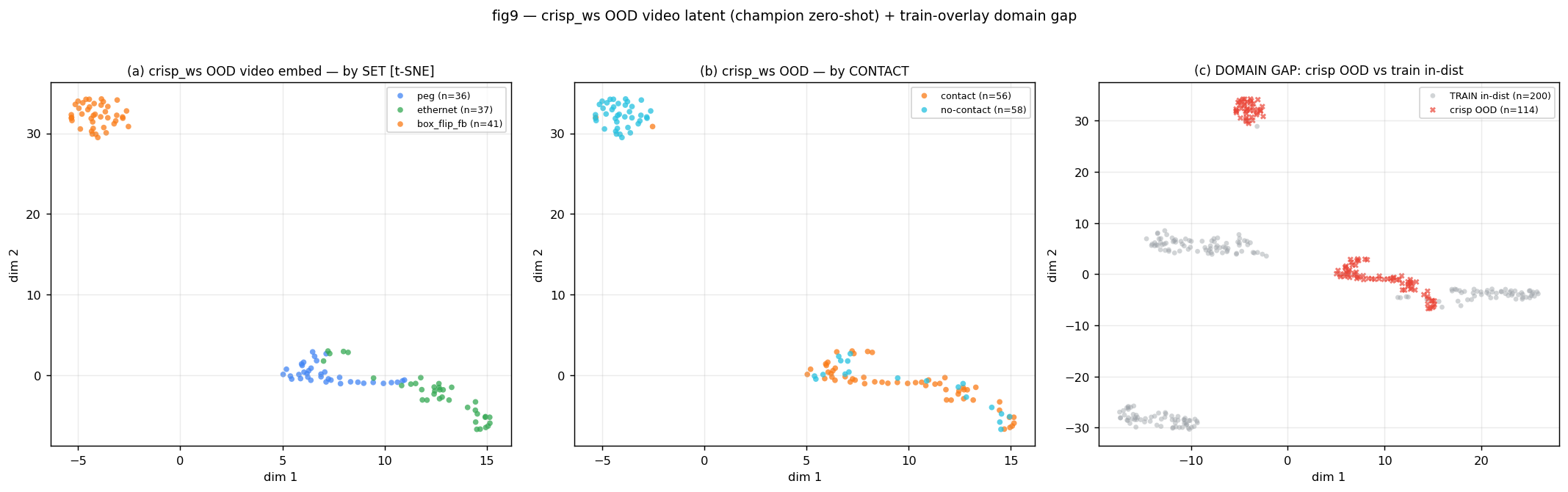
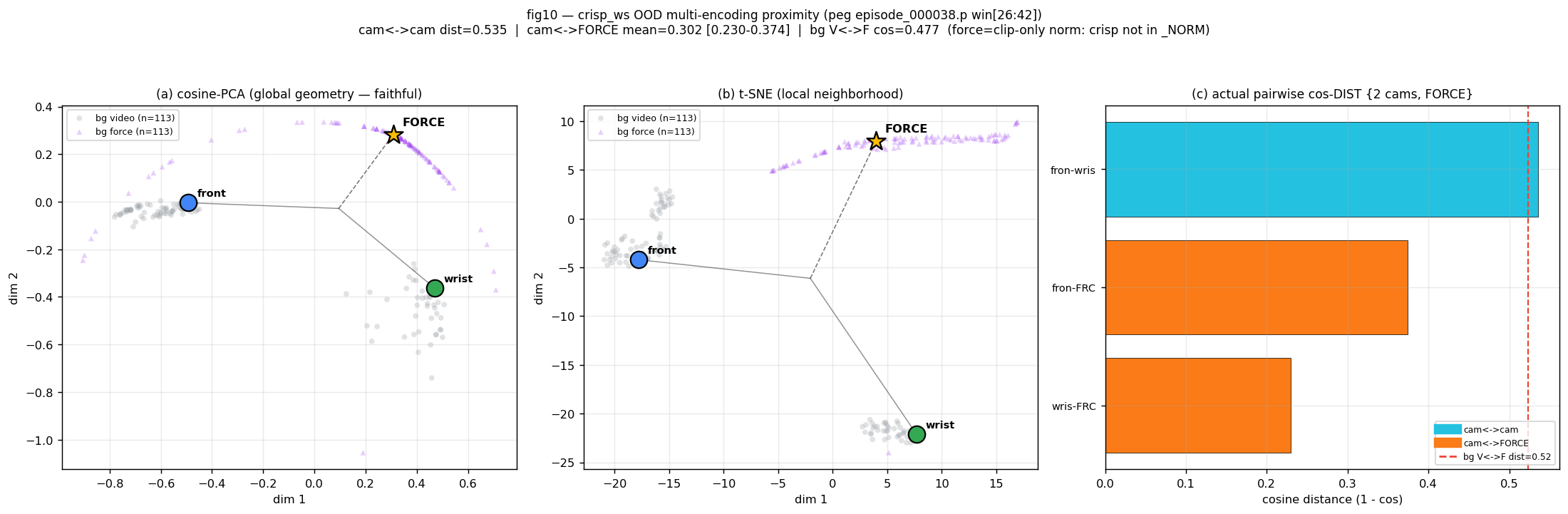
Key findings
- Topology: scratch-unfrozen cross-modal DINO wins; warmstart refuted. Force embeddings are learned (jointly, training-only).
- Zero-shot gate is closable without labels (multi-view aug → front-cam 0.09→0.76; video-only info-max UDA → 0.70).
- Zero-shot direction is a cross-lab frame wall — unsolved by frame choice (EE-frame negative); needs few-shot / video-FT.
- OOD = in-dist top via video-only fine-tuning, proven same-split vs a from-scratch baseline.
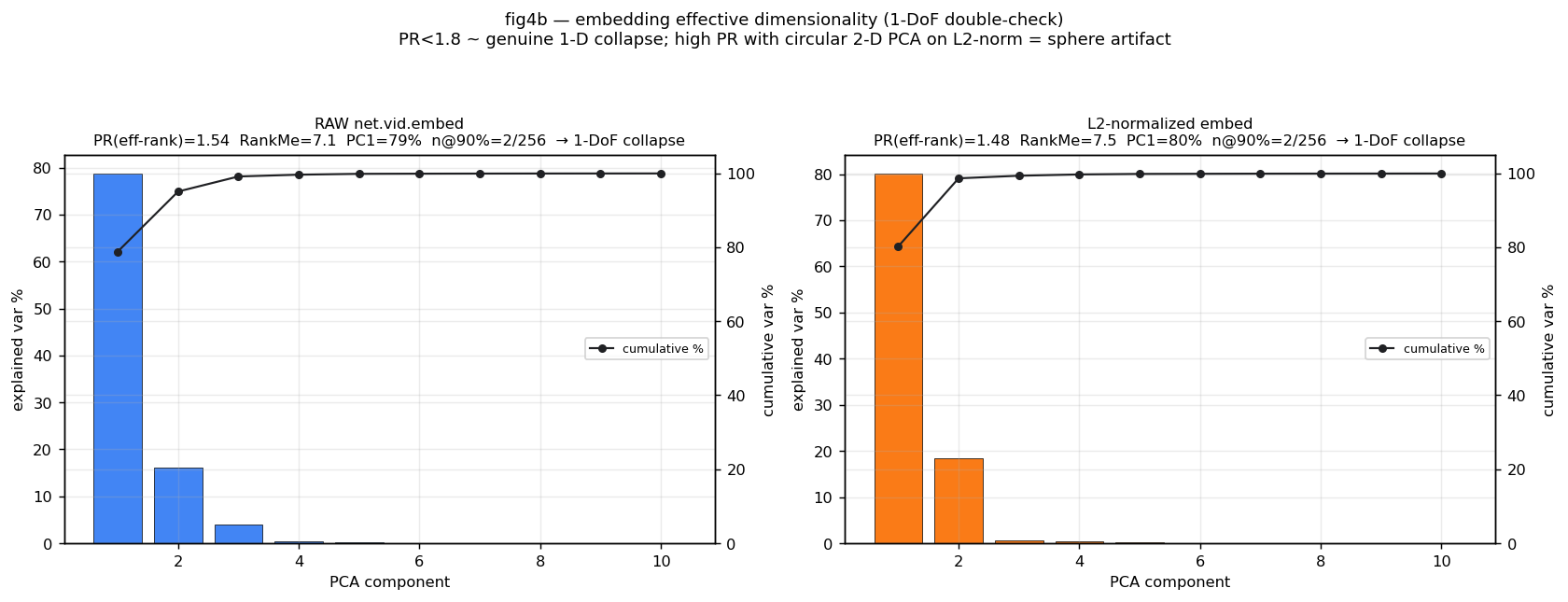
- Residual wall = magnitude/τ (fig2/fig6, RH20T worst). Representation bottleneck: pooled DINO embedding is ~1–2 effective DoF (fig4b).
Stage-2 — open
- E2E LoRA encoder unfreeze (sinew-253) — lift the frozen V-JEPA ceiling (reass 0.86 / crisp 0.90 → >0.9). Biggest in-dist lever.
- Magnitude head (sinew-254) — the residual error wall (per-dataset mag norm, robust τ; RH20T worst).
- Widen the embedding — the ~1-DoF pooled-DINO bottleneck (attentive pooling / stronger VICReg covariance / per-frame alignment).
- Reduce label budget (sinew-255, match at K<5) · scale (sinew-256).
Full trace: docs/v2f_stage1_iteration_log.md · results docs/v2f_stage1_results_2026-06-09.md.